About this series. Reverse Aging is a ten-part series on what aging science can do today, what it cannot do yet, and what longer, healthier lives would mean for work, money and family. This is Part 3: what longer working lives would do to retirement, pensions and the shape of a career.
“For more than a century, retirement has been viewed as life’s final chapter. But what happens if that chapter suddenly becomes twice as long?”
For generations, the script of adult life has been remarkably predictable. We spend our early years in education, build a career through adulthood, retire around the age of 60 or 65, and hope to enjoy a decade or two of rest before old age catches up.
At a Glance
- If healthy adulthood extends by twenty or thirty years, retirement at 65 stops making sense.
- Retirement age was set for a world with a much shorter working life — the article explains its origin.
- The 100-year life implies several careers, not one.
- Phased retirement is already replacing the cliff-edge exit in some countries.
- The reality check: retirement is not disappearing, it is changing shape.
- What longer working lives mean for society is treated separately from what they mean for you.
That model made perfect sense when average life expectancy was much lower than it is today. When retirement systems were first introduced in the late nineteenth and early twentieth centuries, relatively few people lived long enough to spend decades outside the workforce.
Retirement was designed as a period of financial security after a lifetime of labour, not as a second adulthood.
Today, that assumption is being challenged.
As biomarkers of biological aging become more reliable, retirement decisions may eventually rely less on chronological age and more on an individual’s health and functional capacity.
Medical advances, healthier lifestyles, and progress in longevity science are steadily increasing healthy life expectancy. As discussed in the previous article, reaching the age of 90 or even 100 is becoming increasingly common in many parts of the world.
If future therapies succeed in slowing biological aging, people may remain physically and mentally capable of working well beyond the traditional retirement age.
This raises an important question:
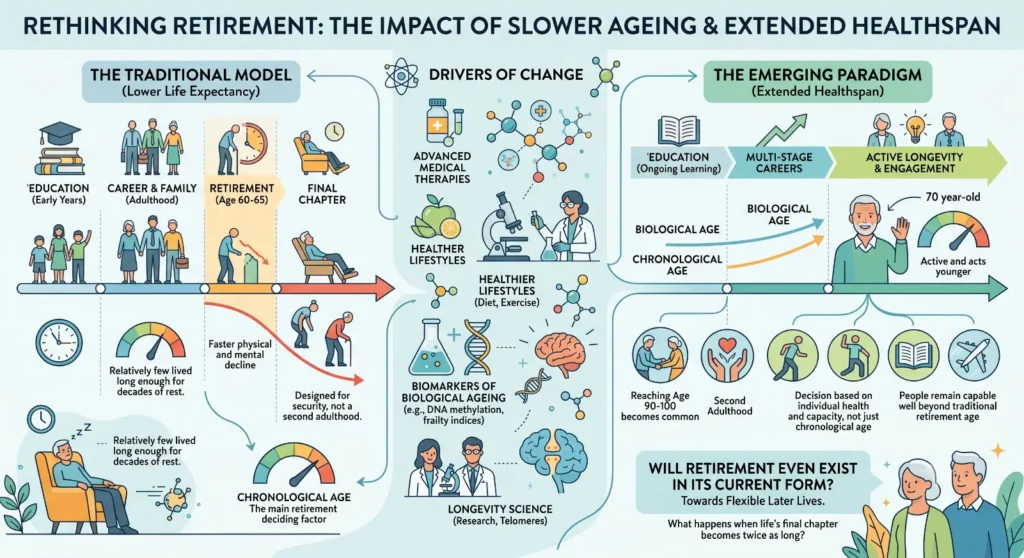
If healthy adulthood extends by twenty or thirty years, should retirement remain fixed at 65?
The answer may reshape not only our careers, but also education, family life, financial planning, and society itself. Healthier older adults can continue contributing economically and socially rather than being viewed only as pension recipients.
Why Was Retirement Set at 65 in the First Place?
Many people assume that retiring at 65 is a biological milestone. In reality, it is largely a historical and economic decision.
One of the earliest national pension systems was introduced in Germany during the 1880s under Chancellor Otto von Bismarck. At the time, retirement benefits began at an age that relatively few citizens reached. The purpose was to provide financial support for older adults who could no longer work, not to fund decades of leisure.
During the twentieth century, many countries adopted similar retirement models as industrialisation expanded. Fixed retirement ages simplified pension planning, workforce management, and social security systems. As life expectancy increased, the retirement age often remained unchanged even though people were living much longer.
The result is a growing mismatch.
In many developed nations, individuals now spend twenty to thirty years in retirement. While this represents a remarkable achievement of modern medicine, it also places increasing pressure on pension systems, healthcare services, and government finances.
If longevity continues to improve, the traditional retirement model may become increasingly difficult to sustain.
The Rise of the 100-Year Life
Researchers have begun describing the future as the era of the 100-year life, a world in which living to 100 becomes increasingly achievable for large sections of the population.
This idea, popularised by economists Lynda Gratton and Andrew Scott, suggests that longer lives require a complete redesign of how we think about education, work, and retirement.
Instead of dividing life into three distinct phases, education, employment, and retirement we may move through several overlapping stages.
A person might complete university in their twenties, establish a career during their thirties and forties, return to higher education in their fifties, launch a new profession in their sixties, transition into consulting or mentoring in their seventies, and remain professionally engaged well into their eighties or more.
Such a life would not necessarily involve working continuously. Instead, it would include multiple periods of learning, career reinvention, flexible employment, and purposeful semi-retirement.
In this model, retirement becomes less of a finish line and more of a gradual transition.
From One Career to Many
Longer, healthier lives are already changing career patterns.
Previous generations often remained with one employer, or even one profession for their entire working lives. Today, rapid technological change means that many skills become outdated within a decade. Automation, artificial intelligence, and digital transformation are constantly reshaping the labour market.
Rather than simply replacing jobs, AI may also help older adults remain productive by reducing repetitive tasks, improving accessibility, and allowing experienced professionals to focus on mentoring, creativity, and decision-making.
As longevity increases, career flexibility may become essential rather than optional.
Someone who begins working at 25 and remains healthy until 85 could potentially spend six decades in the workforce. Few professions remain unchanged for that length of time.
Rather than following one career path, people may pursue several distinct careers over their lifetime.
A software engineer may later become a university lecturer. A physician might transition into healthcare consulting. An entrepreneur could spend later years mentoring start-ups or serving on advisory boards. Creative professions, research, education, and consulting may become increasingly attractive because they rely more on knowledge and experience than on physical endurance.
This shift also changes the role of education.
Learning would no longer end after graduation. Universities and professional institutions may increasingly serve adults returning throughout life to update their knowledge, acquire new skills, or prepare for entirely different careers.
Lifelong learning could become one of the defining characteristics of healthy aging.
Today’s pressure to earn a living often pushes people to choose stable, well-paying careers over their true interests. But if people remain healthy and live to 100 or beyond, they may have the time and freedom to explore long-held passions later in life, potentially making valuable contributions in fields driven by creativity, purpose, and personal fulfilment.
Phased Retirement: A New Way to Leave Work
Retirement may not disappear completely, but it is likely to evolve.
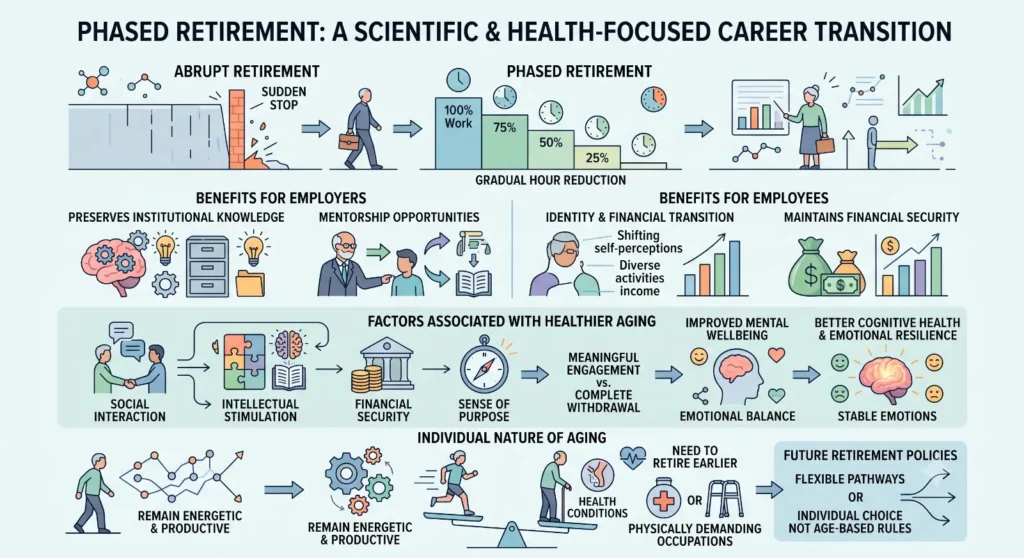
Many organisations are already experimenting with phased retirement, allowing experienced employees to reduce their working hours gradually instead of leaving abruptly.
For employers, this approach preserves valuable institutional knowledge while providing opportunities to mentor younger colleagues.
For older adults, retirement is not only a financial transition but also an identity transition. Phased retirement offers several benefits. Continuing to work part-time can maintain social interaction, intellectual stimulation, financial security, and a sense of purpose, all factors associated with healthier aging and improved mental wellbeing.
Research increasingly suggests that meaningful engagement, rather than complete withdrawal from productive activity, contributes to better cognitive health and emotional resilience during later life.
Importantly, phased retirement recognises that aging is highly individual. Some people remain energetic and productive into their eighties, while others may need to retire much earlier because of health conditions or physically demanding occupations.
Future retirement policies may therefore become more flexible, allowing individuals to choose different pathways rather than following a single age-based rule.
The Reality Check: Retirement Isn’t Disappearing Tomorrow
Before we imagine a future where people routinely work into their eighties, it’s important to separate possibility from probability.
Longevity science is advancing rapidly, but most people today are still affected by chronic conditions such as cardiovascular disease, diabetes, arthritis, osteoporosis, and dementia as they grow older.
While healthy life expectancy has improved, it has not increased at the same pace as overall life expectancy. In many countries, people are living longer but spending a significant portion of those additional years managing illness or disability.
This distinction matters.
The future of retirement depends not only on how long we live, but also on how long we remain healthy enough to work.
Furthermore, not every profession is equally suited to extended careers. A software developer, architect, university professor, or financial consultant may comfortably continue working beyond the age of 70. In contrast, construction workers, firefighters, nurses, miners, agricultural workers, and others in physically demanding occupations may experience physical limitations much earlier.
A universal increase in retirement age would therefore be neither practical nor fair. Ensuring that longevity benefits all sections of society will remain an important public policy challenge.
The larger conversation is not about forcing everyone to work longer. It is about giving more people the opportunity to remain economically and socially engaged if they choose to. This flexibility could also help many older adults remain financially independent and socially engaged well beyond their sixties.
Rethinking the Structure of Adult Life
Perhaps the biggest consequence of increased longevity is not the retirement age itself, it is the possibility that our entire life structure may need redesigning.
For more than a century, adulthood has followed a relatively fixed sequence:
Education → Work → Retirement
But in a world where people remain healthy for decades longer, this model may no longer fit.
Instead, life could become more flexible and cyclical:
Education → Career → Learning → New Career → Semi-Retirement → Mentoring → Purpose-Driven Work
Rather than viewing education as something completed before the age of 25, learning may become a lifelong process. People could periodically return to universities, online programmes, or professional training to adapt to changing technologies and career opportunities.
Career breaks may also become more common. Someone might pause work in midlife to care for family, travel, pursue research, or start a business before returning to full-time employment later.
This flexibility could make longer lives more fulfilling rather than simply extending working years.
What Longer Working Lives Could Mean for Society
The effects of delayed retirement would extend far beyond individual careers.
Governments may need to redesign pension systems that were originally developed when average life expectancy was much lower. Public healthcare could shift even further toward disease prevention and healthy aging rather than managing advanced chronic illness. Employers may redesign workplaces to better support multigenerational teams, offering flexible schedules, hybrid work, and continuous professional development.
For this vision to become reality, workplaces will also need to overcome ageism. Older adults are often overlooked despite bringing valuable experience, judgement, and leadership. Creating age-inclusive workplaces may become just as important as extending healthy lifespan.
At the same time, age diversity could become one of the workforce’s greatest strengths.
Older professionals bring experience, judgment, leadership, and institutional knowledge. Younger employees often contribute fresh ideas, technological expertise, and new ways of solving problems. Rather than competing, future workplaces may increasingly depend on collaboration between generations.
There are economic benefits as well. Longer productive lives could help offset labour shortages caused by aging populations, particularly in countries where birth rates continue to decline.
However, policymakers will need to ensure that opportunities remain available for younger generations. Encouraging lifelong learning, entrepreneurship, and flexible career transitions will be essential to maintaining a balanced labour market.
Ultimately, the goal should not be to extend careers indefinitely but to create systems that allow individuals to contribute according to their abilities, interests, and health.
What You Can Do Today
Whether retirement eventually occurs at 60, 70, or somewhere in between, one thing is already clear: planning for a longer life should begin much earlier than retirement itself.
Consider these practical steps:
- Think in decades, not years. Instead of planning only until retirement, imagine your life in 10-year chapters with opportunities for learning, career changes, and personal growth.
- Invest in lifelong learning. Continuously updating your knowledge and skills increases career flexibility and resilience in a rapidly changing world.
- Build financial flexibility. Regular saving, diversified investments, and retirement planning become increasingly important as life expectancy rises.
- Protect your health. Physical fitness, good nutrition, quality sleep, and preventive healthcare are not only longevity strategies, they are career strategies.
- Cultivate purpose beyond your profession. Hobbies, volunteering, mentoring, and community engagement can provide meaning during transitions between different stages of life.
Preparing for a longer future is not simply about accumulating more money. It is about maintaining the physical, mental, financial, and emotional resources needed to make meaningful choices throughout life. Ultimately, the future of retirement depends less on adding years to life than on adding healthy, productive years to those years. That is the central promise of longevity science.
The Reverse Aging Series
Ten articles on what longer, healthier lives would actually change.
- How Close Are We to Reversing Aging in Humans? — the biology of aging, and what has actually been reversed
- Will We Really Live to 100+ and Stay Young While Doing It? — lifespan, healthspan and what the evidence supports
- If Aging Slows Down, Will Retirement Even Exist? — work, pensions and the hundred-year life (you are here)
- Will Longer Lives Take Away Jobs from the Younger Generation?
- If Parents Stay Healthy Till 90, Will Children Feel Less Responsibility?
- Will We Have Two or Three Careers in One Lifetime?
- Can Science Really Make 80 the New 40?
- Who Will Benefit — Everyone, or Only the Wealthy?
- The Longevity Economy
- The Future of Being Human
Key Takeaways
- Plan for a longer working life, not a longer retirement.
- Skills, not job titles, are what carry across multiple careers.
- Phased retirement needs negotiating before you need it.
- Financial planning built on a 65 exit is planning for the wrong century.
- What you can do today is set out in its own section.
Frequently Asked Questions
1. Will retirement ages increase in the future?
Many countries are already gradually increasing retirement ages in response to longer life expectancy and demographic changes. Future policies are likely to vary depending on healthcare, economics, and workforce needs.
2. Can I retire early in a longevity world?
Yes. Early retirement will remain possible for many people, particularly those with adequate financial planning. However, longer life expectancy means retirement savings may need to last considerably longer.
3. What is the 100-year life?
The “100-year life” describes a future in which living to 100 becomes increasingly common, requiring new approaches to education, careers, financial planning, and retirement rather than following the traditional three-stage model of life.
4. How will pensions change?
Future pension systems may encourage phased retirement, flexible retirement ages, and greater personal retirement savings while adapting to populations that live healthier and longer lives.
References
- Gratton L, Scott A. The 100-Year Life: Living and Working in an Age of Longevity. London: Bloomsbury Publishing; 2016.
- World Health Organization. World Report on Aging and Health. Geneva: WHO; 2015.
- World Health Organization. Decade of Healthy Aging 2021–2030. Geneva: WHO; 2021.
- Organisation for Economic Co-operation and Development (OECD). Pensions at a Glance 2023: OECD and G20 Indicators. Paris: OECD Publishing; 2023.
- United Nations. World Population Prospects 2024. New York: United Nations Department of Economic and Social Affairs; 2024.
- National Institute on Aging. Global Health and Aging. Bethesda (MD): National Institutes of Health.
