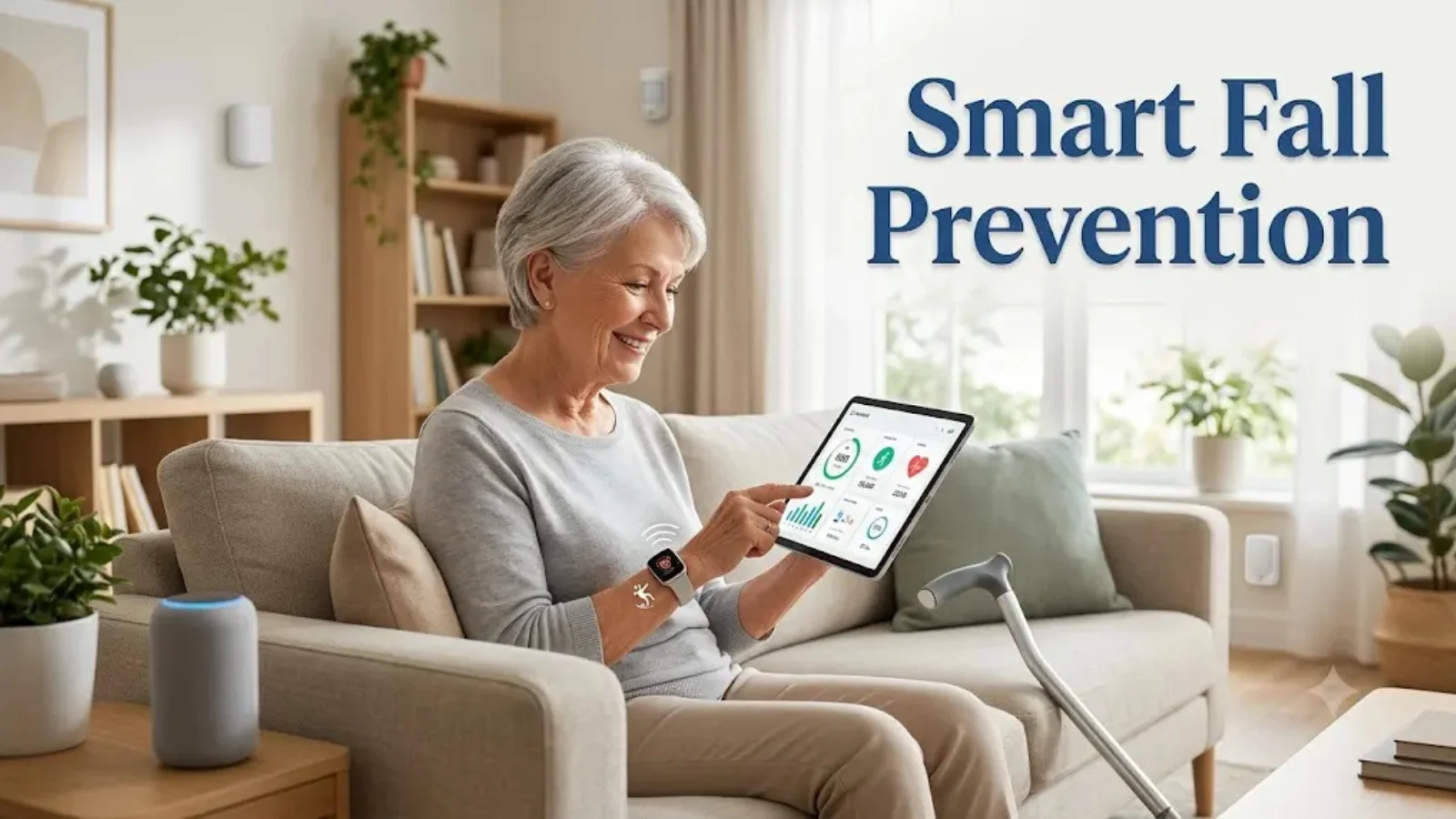
Fall-Proof Your Life
Home Safety, Wearable Technology & a Practical Action Plan
In Part 1, we covered the seven hidden reasons balance gets worse with age. In Part 2, we gave you a 17-exercise protocol to rebuild stability. Those two parts build your internal defenses.
At a Glance
- Home safety is covered room by room, with the bathroom treated as the highest-risk space.
- Footwear matters more than most people expect and has its own section.
- Smartwatch fall detection, medical alert systems and smart insoles are compared directly.
- AI-based fall prediction is emerging; the article separates what works now from what is coming.
- A complete action plan is broken into today, this week, this month and this quarter.
- There is a section written specifically for caregivers and family.
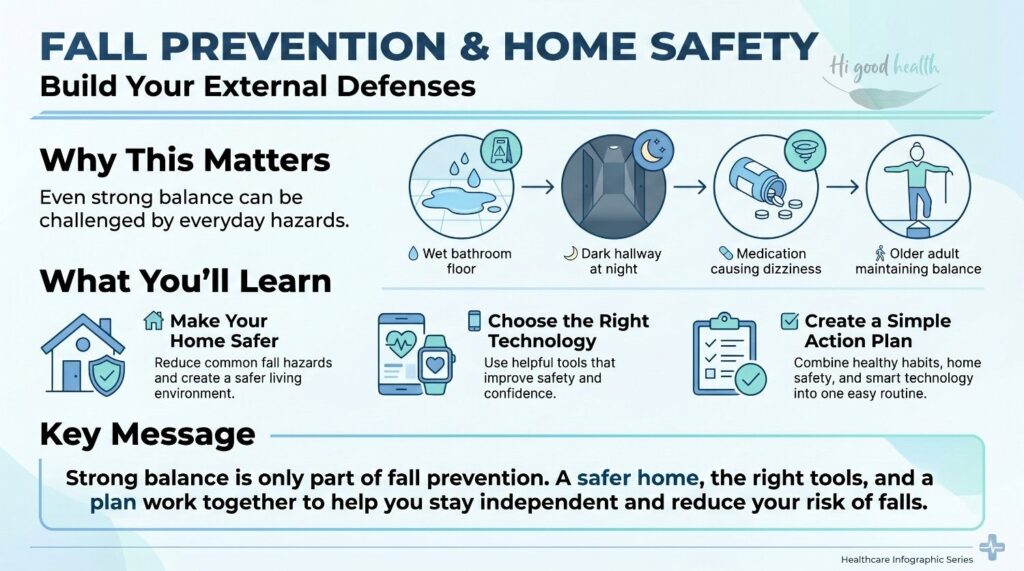
This final part builds the external ones. Because even the fittest senior can fall if their bathroom floor is wet, their hallway is dark at 2 AM, or their blood pressure medication makes them dizzy when they stand up.
We’ll cover three things: making your home safer, choosing the right technology, and putting it all together into a simple action plan.
Home Safety: Room by Room
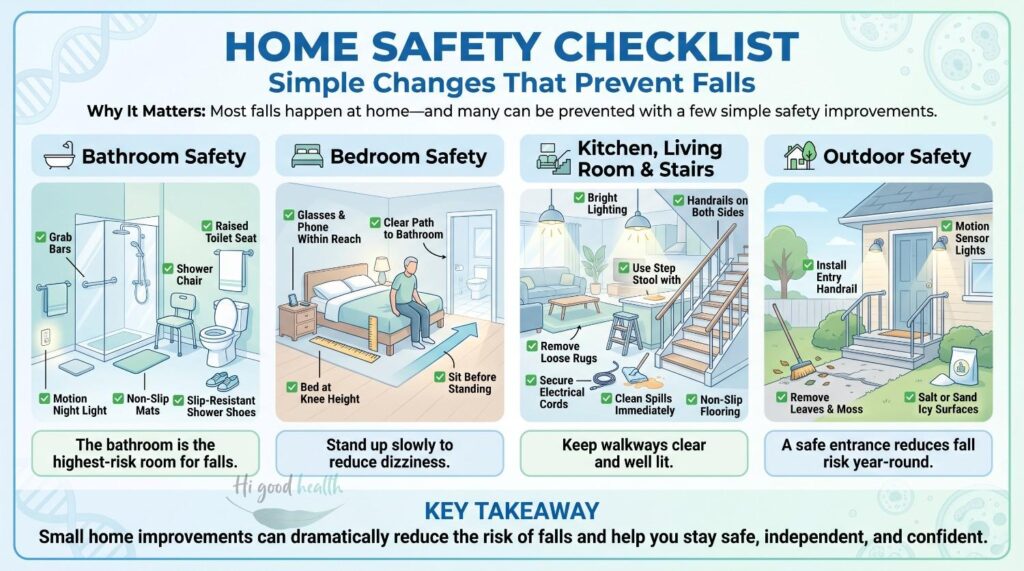
A large proportion of older-adult falls occur in or around the home, particularly among adults over 75. Most are caused by hazards that take minutes to fix.
Bathroom — The Most Dangerous Room
- Grab bars: Install next to the toilet and inside the shower. Use wall-mounted bars screwed into studs, not suction cups.
- Non-slip surfaces: Textured adhesive strips inside the tub. A non-slip mat outside. Replace any bath mat that slides.
- Slip-Resistant Shower/Pool Shoes: Specifically designed for bathrooms, pools, and wet environments, these feature deep, heavy-duty grooved rubber treads for maximum traction. Other options are Rubber/EVA Foam Slippers or Textured Water Shoes. One must avoid open slip-on styles without backstraps if you have balance issues; secure or adaptive footwear dramatically reduces fall risk.
- Shower chair: Removes the need to stand on a wet surface while reaching and turning. Not a sign of weakness — it’s smart risk management.
- Nightlight: A motion-activated LED on the bedroom-to-bathroom path. This addresses a common fall scenario: the 2 AM bathroom trip in the dark.
- Raised toilet seat: A 2–4 inch riser reduces the effort needed to stand up from the toilet.
Bedroom
- Bed height: When sitting on the edge, your feet should rest flat on the floor with knees at about 90 degrees.
- Bedside essentials: Phone, glasses, and a flashlight within arm’s reach. Put glasses on before getting out of bed — every time.
- Clear path: Nothing between bed and bathroom. No shoes, cords, books, or pet beds in the walking route.
- Getting up safely: Roll to your side, push up to sitting with your arms, sit for 10–15 seconds (to prevent a blood pressure drop), then stand.
Kitchen, Living Areas & Stairs
- Rugs: Remove all loose throw rugs, or tape them down with double-sided carpet tape. Curled rug edges are one of the most common trip hazards in fall investigations.
- Cords: Run them along walls, never across walking paths.
- Step stools: Use one with a handrail, never a chair. Better yet, move frequently used items to waist-to-shoulder height.
- Stairs: Handrails on both sides. Mark each step edge with contrasting tape. Good lighting at top and bottom.
- Spills: Clean immediately. Keep a towel within reach in the kitchen. Cooking oil on tile is extremely slippery.
- Non-slip surfaces: If the tiles or floor are slippery, you can quickly boost safety by applying a liquid anti-slip coating or placing down rubber bath mats.
To prevent slips, one should choose matte-finish tiles, textured anti-skid surfaces, or smaller tile layouts. Smaller tiles create more grout lines, which naturally increase underfoot grip.
Outdoors
- Repair cracked or uneven walkways. Clear moss and leaves regularly.
- At least one sturdy handrail at the entry. Motion-activated exterior lights.
- In winter, salt or sand before ice forms — not after.
Download a printable Room-by-Room Safety Checklist at HiGoodHealth.com.
The Right Shoes Matter More Than You Think
Your feet are your body’s contact point with the ground. The wrong shoes send your brain bad balance data.
Wear: Flat, firm-soled shoes with non-slip rubber outsoles and a snug fit. A thin sole gives your brain better feedback about the surface. Velcro or lace-up closures let you adjust for afternoon swelling.
Avoid: Walking in socks on hard floors (extremely slippery), flip-flops (no heel stability), worn-out shoes with smooth soles, and oversized slippers without a back strap.
Technology That Can Help
Smartwatch Fall Detection
The Apple Watch (Series 4 and later) detects hard falls using built-in motion sensors. If you don’t respond within 60 seconds, it automatically calls 911 and sends your GPS location to emergency contacts. Fall Detection can automatically enable based on age settings and can also be manually activated. Apple Fall Detection Support Documentation
Medical Alert Systems
Dedicated medical alert systems remain among the most widely used and clinically established options for older adults living alone. Many systems offer 24/7 professional monitoring with rapid emergency response coordination. Leading systems cost $20–$50 per month (NCOA reviews). For seniors living alone, these are strongly worth considering.
How They Compare
Medical Alert | Apple Watch | Smart Insoles | |
Accuracy | High (waist/pendant) | Moderate (wrist) | High (foot) |
Response | 24/7 monitoring center | Auto-calls 911 | Alerts caregiver app |
Cost | $20–$50/month | Watch + cell plan | Varies (emerging) |
Best for | High-risk, lives alone | Active, tech-comfortable | Early risk detection |
Smart Insoles and Gait Monitoring
This is the most exciting emerging category. Sensor-equipped insoles placed inside regular shoes track your walking patterns all day. AI algorithms detect subtle changes in gait speed, stride length, and weight distribution — potentially flagging elevated fall risk weeks before a fall happens. Several products are in clinical validation now.
AI-Powered Fall Prediction
Many experimental AI-based fall detection systems report high accuracy under controlled testing conditions, though real-world validation remains limited. More importantly, AI is shifting the field from detection (telling you a fall happened) to prediction (warning you a fall is likely).
These systems learn your personal movement patterns and alert when something changes — such as gradually slowing gait, wider stance, or more frequent stumbles. Frontiers in Public Health
Simple Smart Home Changes
- Motion-sensor lights: $10–30 per room. Eliminates walking in the dark to find a switch.
- Voice assistants: Amazon Echo, Google Nest, or Apple HomePod let you call for help, turn on lights, and set medication reminders — all by voice.
- Video doorbells: Let family check in remotely with two-way communication.
[Read our full guide on Wearable Health Technology for Seniors at HiGoodHealth.com.]
A Note for Caregivers and Family
If you’re reading this because you’re worried about a parent or partner, here’s how to approach it:
- Lead with love: “I want you to stay in your home as long as possible” works better than “I’m worried you’ll fall.”
- Focus on the home, not the person: “Let’s make the house safer” is less threatening than “You need help.”
- Collaborate, don’t instruct: “Can we walk through the house together with a checklist?”
- Start small: One grab bar. One nightlight. One medication conversation. Small wins build trust.
- Share this series: Giving someone information lets them make their own decisions — which is far more empowering than being told what to do.
Your Complete Action Plan
Everything from all three parts, in one place. Start at the top and work your way down.
Today
- Do the 5-Minute Daily exercises minimum from Part 2 (single-leg stance, calf raises, tandem walk).
- Install a nightlight on the bedroom-to-bathroom path.
- Remove one loose rug or trip hazard.
This Week
- Take the 5 balance self-tests from Part 2. Write down your scores.
- Walk through your home with the safety checklist above.
- List every medication, supplement, and OTC drug you take.
- Check your shoes against the footwear section above.
This Month
- Schedule a medication review with your doctor (the “Pill Cabinet Audit” from Part 1).
- Get an eye exam if it’s been over a year.
- Ask your doctor to check your Vitamin D level and B12.(if possible once in a year you should check your micronutrient profile including calcium, magnesium, omega 3 fatty acids (EPA/DHA) and folate level)
- Install bathroom grab bars.
- Begin Phase 1 exercises from Part 2.
This Quarter
- Progress through all 4 exercise phases.
- Re-test your balance. Compare to baseline.
- Consider a medical alert system or fall-detection smartwatch if you live alone.
- Improve gut health: more fiber, fermented foods, anti-inflammatory nutrition (Part 1) and take supplementation if prescribed by doctors.
- Prioritize 7–8 hours of sleep nightly.
The Final Word
Over three articles, we’ve covered ground that most health resources never reach. You now understand the seven biological processes that erode balance. You have a 17-exercise protocol backed by research showing 39–52% fall reduction. And you have a practical toolkit for making your home safer and choosing the right technology.
But none of it matters unless you act.
Start with one thing. One exercise. One grab bar. One medication conversation. The compound effect of small, consistent actions is what separates the person who falls from the person who doesn’t.
Your balance isn’t determined by your age. It’s determined by your daily choices.
If this series helped you, share it with someone who needs it.
Key Takeaways
- Changing the house is cheaper and more effective than buying a device.
- Most falls happen in rooms people consider safe.
- A device nobody wears or charges protects nobody.
- Start with the bathroom, then lighting, then stairs.
- Review the plan after any fall, near-fall or medication change.
Frequently Asked Questions
1. How accurate is Apple Watch fall detection?
It works best for hard, high-impact falls. It may miss slower, softer falls. Useful as one safety layer, but not a complete solution. Cellular connectivity is recommended.
2. Are medical alert systems worth the cost?
For seniors living alone, yes. Monthly costs of $20–50 are modest compared to a fall-related ER visit ($35,000+ for a hip fracture). Most systems now include GPS for outdoor use.
3. What’s the single most important home change?
Bathroom grab bars plus a motion-activated nightlight on the bedroom-to-bathroom path. The nighttime bathroom trip is the most common fall scenario.
4. Can AI really predict falls?
Yes, with caveats. AI systems analyzing continuous gait data can spot increasing risk days or weeks ahead. Most are still in clinical validation, but the technology is advancing fast.
5. Should I remove all the rugs?
Ideally, yes — especially loose throw rugs on hard floors. If you keep one, secure it with heavy-duty carpet tape and make sure edges the lie flat.
6. Apple Watch or medical alert system?
Active, tech-comfortable seniors may prefer the Apple Watch. Those wanting simpler, dedicated safety with 24/7 professional monitoring should choose a medical alert system. Some families use both.
Glossary
Term | Definition |
Accelerometer | A sensor measuring movement changes. Used in phones and watches to detect falls. |
Fall Detection | Technology that identifies when a fall has happened and triggers an alert. |
Fall Prediction | AI technology that spots increasing fall risk by tracking movement pattern changes over time, before a fall occurs. |
IMU | Inertial Measurement Unit — a sensor package combining accelerometer and gyroscope. The core of wearable fall detection. |
Orthostatic Hypotension | A blood pressure drop when you stand up, causing dizziness. Common medication side effect. |
Smart Insoles | Sensor-equipped shoe inserts that track walking patterns for fall risk analysis. |
TinyML | Machine learning small enough to run directly on a wearable device, no cloud connection needed. |
Sources
1. Fall Detection Technologies (2026 scoping review, 243 studies) — Frontiers in Public Health
2. Apple Watch Fall Detection — Apple Support
3. Best Medical Alert Systems (2026) — NCOA
4. Innovative Fall Prevention Approaches — Medical Journal of Australia, 2025
5. iSeFallED Trial: ED-Based Fall Prevention — BMC Geriatrics, 2026
6. AI for Fall Detection Survey — ScienceDirect, 2025
7. CDC Older Adult Fall Prevention — cdc.gov/falls
8. NCOA Falls Prevention — ncoa.org
Disclaimer
This article is for educational purposes only. Always consult your doctor before making changes to your health routine. Product mentions are informational and do not constitute endorsement. HiGoodHealth.com is not affiliated with any product manufacturer mentioned here. If you have a medical emergency, call 911.
About HiGoodHealth
HiGoodHealth helps communities make better health decisions through clean, credible, simple information. We bust myths, promote healthy living, and share evidence-based practices from around the world. Explore more at HiGoodHealth.com and share your feedback — your voice helps us serve you better.
