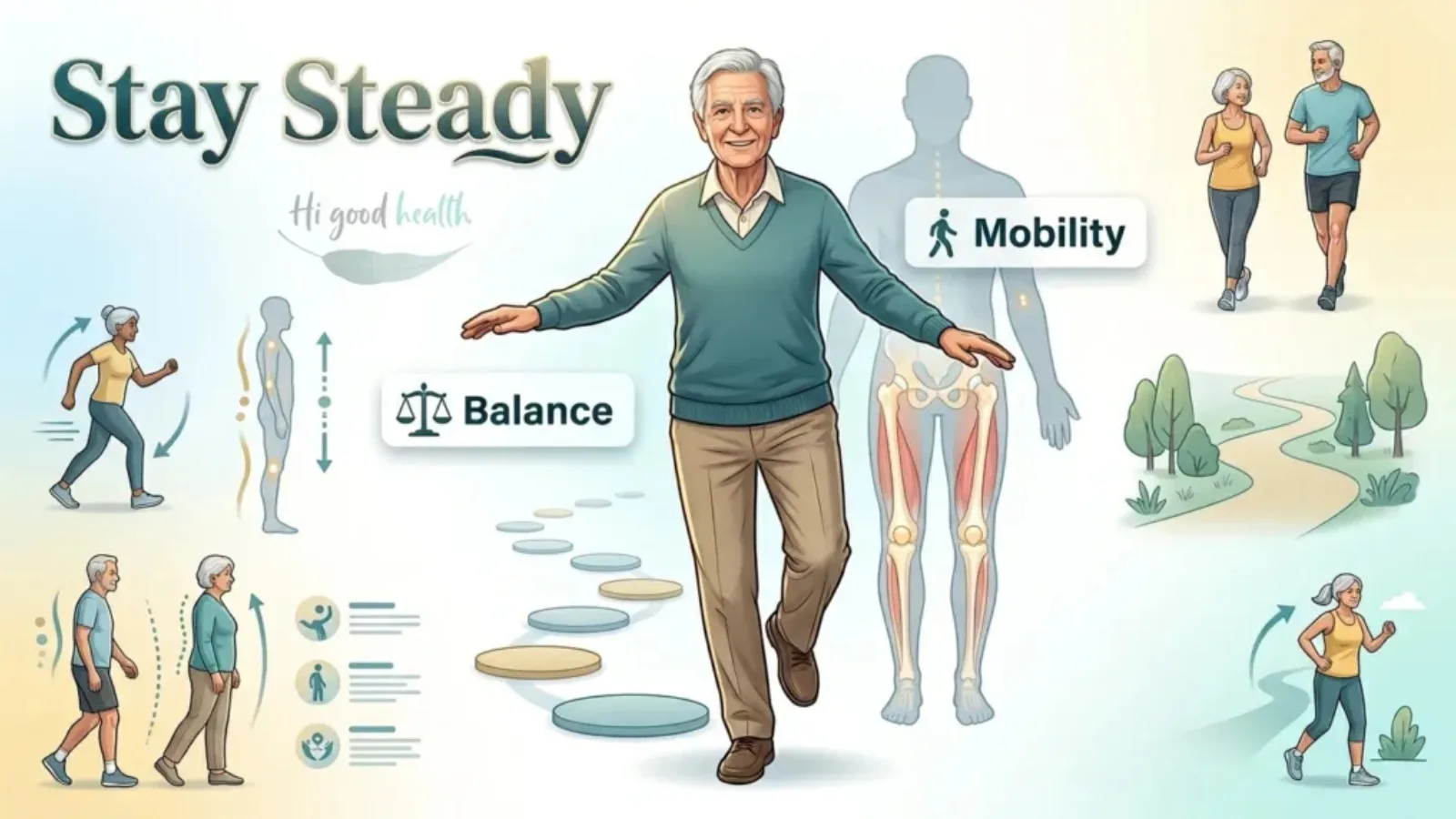
It Started with a Cup of Chai
Savitri is 72. One morning, she reached for her cup of chai — a movement she’s made thousands of times — and the room shifted. Her hand missed. The cup shattered. She grabbed the kitchen counter, heart pounding, wondering what just happened.
No stroke. No seizure. Just a moment where her body lost its sense of where it was in space. If that sounds familiar, you’re not alone — and it wasn’t random. At least seven things had been quietly chipping away at her balance for years.
This is Part 1 of our “Stop the Stumble” series. Part 2 gives you a 4-phase exercise plan. Home safety and wearable tech are covered in our guides to fall prevention and wearable health tech for seniors. But first — let’s understand why this happens.
At a glance
- Balance is not one sense but three systems working together, and ageing weakens all three at once.
- Seven things chip away at it quietly: the three balance systems, hearing loss, a shrinking cerebellum, wasting muscle, slower reflexes, medication, gut health and poor sleep.
- Medication is the most overlooked cause and the most fixable — an annual audit of the dawa cabinet is the single highest-value step.
- A near-fall is rarely random. It is the end of a long quiet process, not a sudden event.
- This is Part 1. Part 2 gives the 4-phase exercise plan; home safety and wearable tech are covered in separate guides.
The Numbers That Matter
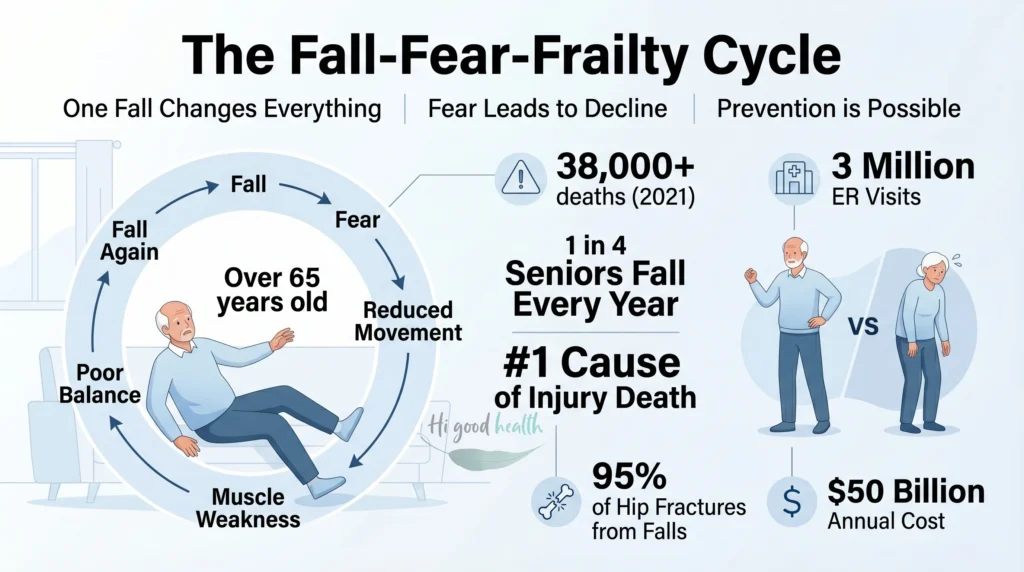
Falls are a serious and growing public health concern among older adults. According to data from the Longitudinal Aging Study of India (LASI), nearly 11.43% of over 28,000 elderly individuals experienced falls over a two-year period.
Females and those aged 80 and above were at the highest risk. A multicenter Indian trauma registry study found that in-hospital mortality from fall injuries was as high as 18% — more than four times the rate seen in comparable Western data.sciencedirect+1
Falls among the elderly lead to fractures, disability, loss of independence, and increased burden on families and the healthcare system. The pooled prevalence of fractures after falls among older adults in India is approximately 12.5%. Hip fractures in particular are associated with long periods of bed rest, complications, and significant mortality in our setting.pmc.ncbi.nlm.nih+1
The worst part? Most falls trigger a vicious cycle. You fall. Fear sets in. You stop moving. Your muscles get weaker. Your balance gets worse. You fall again. Researchers call this the Fall-Fear-Frailty Cycle, and it traps up to 60% of seniors who experience even a single fall. Understanding the root causes breaks that cycle. Let’s look at all seven.
Cause #1: Your Three Balance Systems Are Weakening
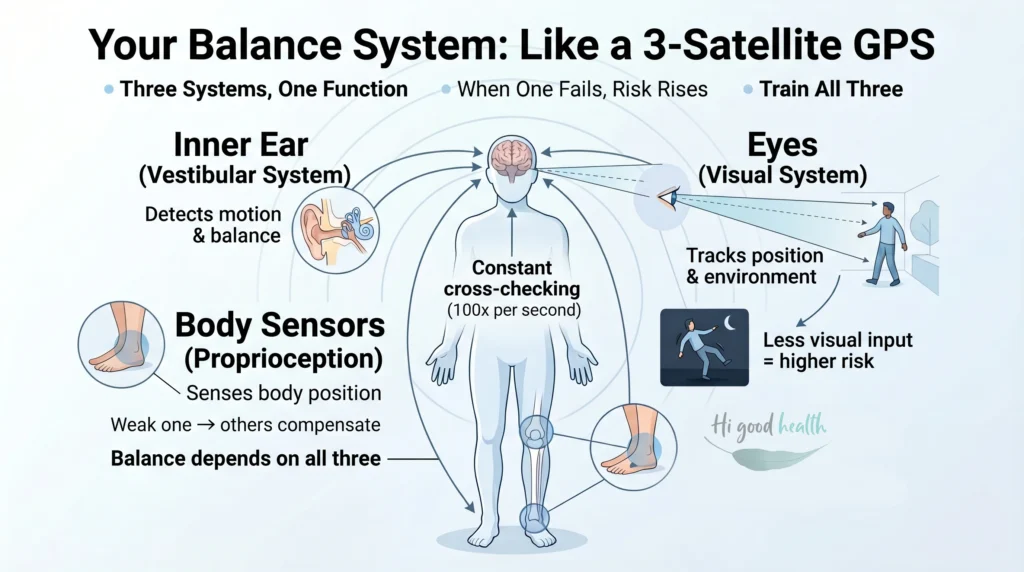
Your balance depends on three systems working like a GPS with three satellites:
- Inner Ear (Vestibular System): Fluid-filled canals in your ears detect whether you’re upright, tilting, or moving. When they degrade, you feel dizzy. Sometimes tiny calcium crystals (otoconia) dislodge and drift into these canals, triggering BPPV (Benign Paroxysmal Positional Vertigo) — brief but intense spinning episodes set off by head movements like rolling over in bed or looking up. BPPV is the most common vestibular disorder in adults over 60 and is often misidentified as a stroke or general ageing. It is highly treatable with specific repositioning maneuvers performed by a physiotherapist or doctor.
- Eyes (Visual System): Your eyes tell your brain where you are relative to walls, floors, and furniture. Poor lighting, outdated spectacles, or eye disease sends your brain bad data.
- Body Sensors (Proprioception): Tiny sensors in your ankles, feet, and joints tell your brain where your body is in space — without looking. This is why you can walk without staring at your feet.
Your brain continuously integrates information from the inner ear, vision, and body-position sensors to maintain balance. When one weakens, your brain leans harder on the others. That’s why balance often feels worse in the dark — your brain was relying on your eyes to compensate for weak body sensors, and now the lights are off.
Hearing Loss and Balance: An Overlooked Connection
Research consistently shows that seniors with even mild hearing loss are significantly more likely to fall. A study published in JAMA Internal Medicine found that for every 10-decibel increase in hearing loss, the odds of falling rose by 1.4 times. Older adults with even a minor loss of hearing (25 dB) are almost three times as likely to have suffered a fall as those with normal hearing.
The reason goes beyond distraction: hearing helps your brain build a real-time spatial map of your environment. Hearing loss may increase fall risk through reduced environmental awareness, greater cognitive load, and shared degeneration affecting auditory and balance pathways. When that signal fades, your brain has one less GPS satellite, and balance suffers — especially in noisy or unfamiliar surroundings.
The practical takeaway: annual hearing checks after age 60, and if hearing aids are prescribed, wearing them consistently — not just for conversations — can meaningfully reduce fall risk.
Cause #2: Your Brain’s Balance Computer Is Shrinking
At the base of your brain sits the cerebellum. It’s only 10% of your brain’s size, but it holds over half of all your brain’s neurons. Its job? Fine-tune every movement so it’s smooth and well-timed. Think of it as the quality controller that turns a rough command (“shift weight left”) into a precise, coordinated action.
Here’s the problem: a 2024 study in Aging and Disease found that the part of the cerebellum controlling posture and walking can lose up to 40.9% of its key neurons (Purkinje cells) with age. These cells don’t grow back, and a 2025 study showed this shrinkage may start before memory decline does.
Walking is not fully automatic and requires significant cognitive effort. When an elder performs a mental task while walking — such as carrying on a conversation or remembering a grocery list — their gait stability decreases. This is called dual-task interference. It occurs because the brain prioritises the mental task over the motor control needed for balance.
But there’s good news. Researchers at Italy’s Fondazione Santa Lucia found that your cerebellum builds a motor reserve — like a savings account — based on your lifetime movement history. Dancing, Yoga, Bharatanatyam, gardening on uneven ground, Tai Chi — the more varied your movements have been, the more backup circuits your cerebellum has built.
This enhances neural reserve and adaptability, potentially helping older adults compensate for age-related balance decline. It’s never too late to start adding to that account. Dual-task training — practicing physical movements while also doing mental exercises — can significantly reduce fall risk.cdc
Cause #3: Your Muscles Are Silently Wasting
Muscle loss (sarcopenia) starts around age 30 and speeds up after 60. But it’s not just about losing muscle bulk. Two things matter most for balance:
- The right muscles: Your ankle and hip muscles are your body’s “save team.” Small stumbles? Ankle muscles fix them. Bigger ones? Hip muscles fire. These are the first muscles to shrink with age and inactivity.
- The right type of fibres: Your muscles have slow fibres (for endurance) and fast fibres (for quick reactions). Ageing kills fast fibres first — the exact ones you need to catch yourself when you trip. That’s why someone can walk for miles but still fall when they step on a loose floor mat.
Cause #4: Your Reflexes Are Getting Slower
Your nerves carry signals more slowly as you age. A 25-year-old’s “save reaction” takes about 150 milliseconds. An 80-year-old’s can take 250+ milliseconds. That extra tenth of a second is the difference between catching yourself and hitting the ground.
It gets worse when you’re multitasking. Talking while walking, carrying heavy bags on stairs, turning to answer someone — your ageing brain struggles to handle balance and a mental task at the same time. Researchers call this the “dual-task bottleneck.” It’s not a sign of mental weakness — it’s a bandwidth issue that happens to everyone as the brain ages.
Think of your brain like a computer with a limited amount of RAM (processing power). As we age, both “programmes” — walking and thinking — require more “RAM” than they used to.
Cause #5: Your Medications May Be Stealing Your Balance
This might be the most overlooked cause of falls — and it is very relevant in our setting.
The pooled prevalence of polypharmacy (taking 5 or more medicines simultaneously) among older Indian adults is approximately 49%, according to a systematic review and meta-analysis. A more recent multi-city study found that about 33.7% of older adults across six Indian cities were on polypharmacy, with a significant proportion also self-medicating without medical guidance.
The problem isn’t any single drug — it’s that many common medicines cause dizziness, drowsiness, or slower reflexes. When you take several of these together, the balance-harming effects don’t just add up — they multiply.
The biggest offenders: blood pressure pills (cause dizziness when you stand up), anxiety and sleep medications (sedate you and slow coordination), older antihistamines including over-the-counter allergy tablets (drowsiness), pain relievers (suppress reflexes), and some antidepressants (dizziness and unsteady gait).
The cumulative effect of these drugs is known as the anticholinergic burden. High levels of this burden are significantly associated with increased rates of falls and fractures in older populations.
Even worse is the “prescribing cascade”: a drug causes dizziness, so another drug is prescribed for the dizziness, which causes fatigue, which gets yet another prescription. Each new pill adds more fall risk.jccpractice
Action Step: The Annual Dawa Cabinet Audit
- List every medicine, supplement, and OTC tablet you take.
- Book an appointment specifically to review this list with your doctor or pharmacist.
- Ask about each one: “Is this still needed? Could it affect my balance?”
- Never stop a medicine without medical guidance — but always ask the question.
Cause #6: Your Gut Is Quietly Undermining Your Stability
This is the part most doctors don’t know about yet. It’s cutting-edge 2025–2026 research, and virtually no health resource covers it.
Emerging research suggests that age-related changes in the gut microbiome may contribute to chronic inflammation, muscle loss, and frailty. Scientists are actively studying whether these gut changes influence mobility and balance in older adults, although the evidence is still evolving.
As you age, your body develops a slow-burning, low-level inflammation that scientists call “inflammaging.” A major driver of this is your gut. When the balance of bacteria in your digestive system shifts — fewer good bugs, more inflammatory ones — it triggers body-wide inflammation that breaks down muscles and slows nerve function.sciencedirect
“We should think about ageing-microbiome interactions as a two-way street. Gut bacterial community changes as the host ages, and the ageing gut becomes more susceptible to inflammation and tissue damage.” — Shuo Han, Ph.D., Duke University (ASM.org, 2025)pubmed.ncbi.nlm.nih
Studies of long-living people in Japan, China, and Italy found that those who live the longest keep more diverse gut bacteria. Their gut bacteria produce special compounds that fight inflammation and protect muscles. What can you do about it? Eat more fibre (dal, oats, sabzi), fermented foods (curd/dahi, kanji, idli, dhokla), and anti-inflammatory foods (haldi/turmeric, amla, akhrot/walnuts, alsi/flaxseed).the.evidencejournals+1
Older adults require higher protein levels than younger individuals to maintain muscle mass due to lower rates of post-meal muscle protein synthesis. Research indicates that enriching amino acid intake with a high proportion of leucine can specifically reverse the blunted muscle growth response often seen in the elderly.
Aim for 1.0–1.2 g of protein per kg of body weight daily from sources like tofu, chana/chickpeas, paneer, moong dal, and peanut butter.
[Older adults with chronic kidney disease should discuss protein goals with their physician or dietitian.]
Cause #7: Poor Sleep Makes You Unsteady
Poor sleep doesn’t just make you tired — it directly wrecks your balance. A study in PLOS ONE found that sleep-deprived older adults swayed further and faster than rested ones, pushing dangerously close to their stability limits. The effect was worst with eyes closed — which is exactly the situation you face during a 2 AM bathroom trip.pubmed.ncbi.nlm.nih
A 2022 systematic review in Frontiers in Neuroscience confirmed that both one bad night and chronic poor sleep impair balance. Sleep wrecks your visual processing, slows your vestibular reflexes, and makes your brain worse at managing balance when conditions are tough (darkness, uneven surfaces).
Don’t Overlook These
- Vitamin D: Studies show 70–90% of Indians are Vitamin D deficient — a strikingly high proportion even in a sun-rich country, largely due to indoor lifestyles, dark skin pigmentation, and poor dietary intake. Vitamin D supports both bone strength and nerve-muscle signalling. Ask your doctor for a blood test.
- Dehydration: Common in seniors because the thirst sensation fades with age. Causes dizziness and foggy thinking — both bad for balance. Drink water regularly even if you don’t feel thirsty.
- Foot problems: Bunions, neuropathy, and ill-fitting footwear change how your feet send signals to your brain. Flat, snug, non-slip chappals or shoes help. Avoid walking barefoot on slippery floors.
- Vision: Annual eye check-ups after 60. Outdated spectacle prescriptions feed your brain wrong spatial information.
- Orthostatic Hypotension: A sudden drop in blood pressure that occurs when you stand up after sitting or lying down — causing dizziness because gravity pulls blood toward your legs, temporarily reducing oxygen-rich blood reaching your brain. It affects approximately 20% of older adults and is often worsened by dehydration or blood pressure medications.pmc.ncbi.nlm.nih
- Chronic Conditions — Diabetes and Heart Disease: Diabetes is one of the leading causes of peripheral neuropathy — nerve damage that begins in the feet and directly disrupts proprioception, the sense your body uses to know where your feet are at any moment. Seniors with poorly controlled blood sugar often lose feeling in their feet before they notice any other symptom, making falls far more likely. Heart disease and uncontrolled BP reduce the heart’s ability to maintain steady blood flow to the brain. This can trigger lightheadedness and sudden drops in stability, particularly when rising from a chair or climbing stairs. If you have either condition, work with your physician to optimise control — doing so is a direct investment in fall prevention.pmc.ncbi.nlm.nih
⚠️ RED FLAGS — See a Doctor Immediately If You Have:
- Sudden dizziness with headache, vision changes, or slurred speech (possible stroke)
- Weakness or numbness on one side of your body
- Balance that gets steadily worse over days or weeks
- Falls with even brief loss of consciousness
- Balance changes after any head injury
What’s Next: The Fix Starts in Part 2
Now you know it’s not one thing causing your balance to change — it’s seven or more processes hitting you at once. Cerebellar shrinkage, muscle loss, slower reflexes, fading body sensors, too many medications, gut inflammation, and poor sleep.
The good news? Every one of these is treatable or improvable. In Part 2, we give you a 4-phase exercise protocol to rebuild stability. Home safety, wearable tech, and practical tools to prevent falls are covered in our fall prevention and wearable health tech guides.
Your balance isn’t something you lose. It’s something you stop practising. Part 2 shows you how to start again.
Key takeaways
- Treat a stumble as information, not bad luck.
- Ask about hearing. Hearing loss and balance are connected, and the link is routinely missed.
- Muscle wasting and slower reflexes respond to training. They are not a fixed consequence of age.
- Review every medicine once a year with a doctor — several common ones quietly cost you stability.
- Sleep and gut health influence steadiness more than most people expect.
Frequently Asked Questions
Is it normal to lose balance as I age?
Some change is natural, but frequent stumbles or falls are not. They point to specific issues that can usually be improved.
Why is my balance worse in the dark?
Your brain compensates for weaker body sensors by relying on your eyes. In the dark, that backup disappears. Poor sleep makes it even worse.
Can medicines affect my balance?
Yes — blood pressure tablets, sleep aids, anxiety medicines, pain relievers, and even over-the-counter allergy tablets can impair balance. The risk multiplies with each additional drug.
What’s the gut-balance connection?
New research (2025–2026) shows that an imbalanced gut microbiome drives chronic inflammation and muscle loss, both of which directly hurt your balance.the.evidencejournals+1
What is cerebellar reserve?
A new concept suggesting that varied movement throughout life — Bharatanatyam, Yoga, Tai Chi, gardening — builds backup circuits in your brain’s balance centre. You can still build reserve at any age.cdc
Can balance exercises help prevent dementia?
Emerging evidence says yes. The cerebellum plays a role in thinking, and exercises that challenge both body and brain seem to support broader brain health.
How does BPPV differ from general dizziness?
BPPV causes sudden, intense spinning that lasts seconds to a minute and is triggered by specific head movements (like rolling over in bed). General dizziness tends to be more constant. A doctor can diagnose BPPV with a simple bedside test (Dix-Hallpike) and treat it in one or two visits with repositioning maneuvers.
Can hearing aids really reduce fall risk?
Emerging evidence says yes. Hearing aids improve the spatial information your brain receives, freeing up cognitive resources that would otherwise be diverted to compensating for poor hearing. Talk to an audiologist if you’ve been putting off a hearing evaluation.
Does managing diabetes help prevent falls?
Yes. Better blood sugar control slows the progression of peripheral neuropathy, preserving the foot sensation your balance system depends on. Regular check-ups with a podiatrist and appropriate footwear are also key for people with diabetes.pmc.ncbi.nlm.nih
Glossary
Term | Plain-Language Definition |
|---|---|
BPPV (Benign Paroxysmal Positional Vertigo) | The most common vestibular disorder in seniors. Caused by displaced calcium crystals in the inner ear. Highly treatable with repositioning maneuvers. |
Cerebellum | The brain’s balance and coordination centre. Holds more than half of all brain neurons. |
Cerebellar Reserve | Backup brain circuits built through varied movement over your lifetime. |
Inflammaging | Slow-burning body-wide inflammation that worsens with age, partly driven by gut changes. |
Peripheral Neuropathy | Nerve damage, most commonly caused by diabetes, that reduces sensation in the feet and disrupts proprioception and balance. |
Polypharmacy | Taking 5+ medicines at the same time. Common in older adults, linked to higher fall risk. |
Proprioception | Your body’s ability to sense where it is in space without looking. |
Purkinje Cells | Key brain cells in the cerebellum that coordinate movement timing. Don’t regrow once lost. |
Sarcopenia | Age-related muscle loss, especially the fast-twitch fibres needed for quick reactions. |
SCFAs | Short-chain fatty acids — helpful compounds your gut bacteria make from fibre. Reduce inflammation. |
Sources
- Hearing Loss and Fall Risk —JAMA Internal Medicine
- Cerebellum and Ageing — Aging and Disease, 2024
- Cerebellar Reserve — Frontiers in Cellular Neuroscience, 2026
- Cerebellar Volume Loss — Human Brain Mapping, 2025
- Gut Microbiota and Ageing — Frontiers in Aging, 2025
- Gut Microbiome and Longevity — Gut Microbes, 2025
- Microbiome’s Second Act — ASM.org, 2025
- Polypharmacy in Older Adults in India —Frontiers in Pharmacology, 2021
- Polypharmacy and Self-Medication in Indian Cities — Scientific Reports, 2025
- Sleep and Postural Control — PLOS ONE
- Sleep and Balance Review — Frontiers in Neuroscience, 2022
- Cumulative Anticholinergic Burden — PubMed
- Falls Among Elderly in India — LASI / Evidence Journal, 2024
- Peripheral Neuropathy and Falls in Diabetes — Diabetes Care
- Vitamin D Deficiency in India — PMC/NIH
- Mortality from Fall — Indian Trauma Registry — ScienceDirect
Disclaimer
This article is for educational purposes only and is not a substitute for professional medical advice. Always consult your doctor before making changes to your medication, exercise, or health routine. If you think you may have a medical emergency, call 112 immediately.
About HiGoodHealth
HiGoodHealth helps communities make better health decisions through clean, credible, simple information. We bust myths, promote healthy living, and share best practices from around the world. Explore more at HiGoodHealth.com — and share your feedback and topic ideas. Your voice helps us serve you better.
