Which tests to add, and what the numbers actually mean
Part 1 argued that in India the problem is not getting tested but choosing what to test and knowing what the report means. This part is the list, and it starts with the TSH test.
For each test: what it measures, what a normal Indian lab report will say, what a doctor is likely to act on, and whether it is worth your money.
One caution before the numbers. You will see “optimal ranges” quoted all over the internet, usually narrower than the lab’s own range and usually attached to a supplement. Some are supported by evidence. Many are somebody’s opinion. Where a target is contested, this article says so instead of presenting it as settled.
At a glance
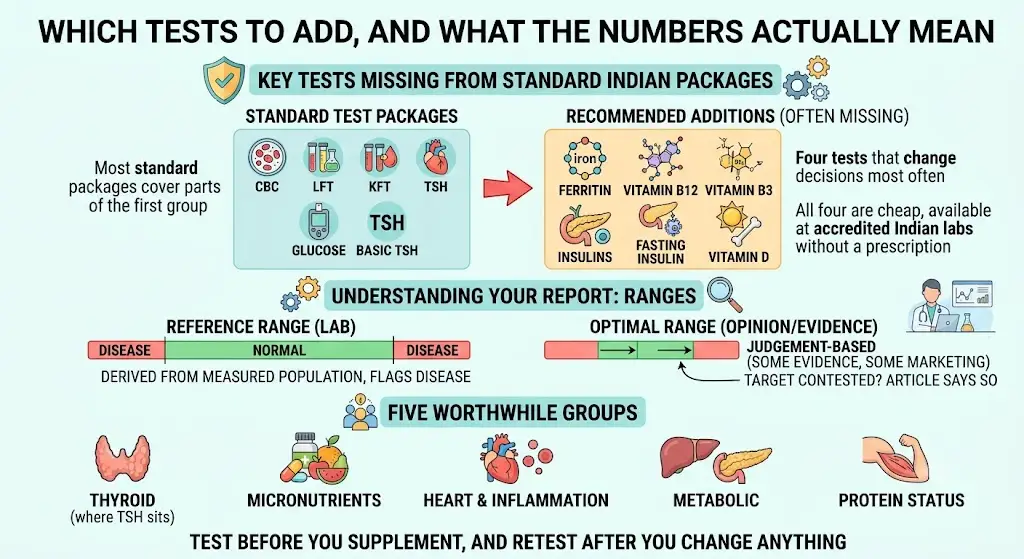
Five groups are worth knowing about: thyroid, where the TSH test sits, then micronutrients, heart and inflammation markers, metabolic markers, and protein status. Most standard Indian packages cover parts of the first and none of the rest properly.
The four that change decisions most often here are ferritin, vitamin B12, fasting insulin and vitamin D. All four are cheap, all four are available at any accredited Indian lab without a prescription, and all four are usually missing from the package.
A reference range and an “optimal range” are different things. The reference range comes from a measured population and flags disease. An optimal range is a judgement, sometimes evidence-based and sometimes marketing.
Test before you supplement, and retest after you change anything. Iron taken without a diagnosis can hide a bleed, high-dose vitamin D causes harm, and a B12 result corrected without asking why it was low can mask an absorption problem.
Group 1: The thyroid, and the anti thyroid peroxidase test
Thyroid disease is common in India, and most packages run a TSH test and stop there.
The TSH test measures the signal from the pituitary telling the thyroid to work. It is not the hormone doing the work. Free T4 is the stored form, Free T3 is the active one, and the conversion between them can go wrong.
So a person can have an acceptable TSH test result and still be symptomatic, because Free T3 is low or Reverse T3, which blocks the active hormone, is high.
| Test | Usual reference range | What it tells you |
|---|---|---|
| TSH | 0.5-4.5 mIU/L | The pituitary signal. Most labs and doctors act below 0.5 or above 4.5 |
| Free T4 | 0.8-1.8 ng/dL | The stored hormone |
| Free T3 | 2.3-4.2 pg/mL | The active hormone, and what symptoms track |
| Reverse T3 | 8-25 ng/dL | The inactive blocker. Usually only tested if symptoms persist |
| Anti-TPO antibodies | Under 35 IU/mL | Autoimmune thyroid disease, which is common in India |
| Anti-thyroglobulin | Under 20 IU/mL | The second autoimmune marker |
⚠️ Where opinion enters. Online sources commonly quote an “optimal” TSH of 0.5 to 2.5. That narrower target is not the standard used by Indian endocrinologists, and treating a TSH of 3.2 in someone without symptoms is not routine practice here. Symptoms plus the full panel decide, not a number off a chart.
Worth adding to a standard package: Free T3 and anti-TPO, if you have persistent tiredness, weight change, hair fall or a family history of thyroid disease. Both are inexpensive here.
The anti thyroid peroxidase test, and when to ask for it
If your TSH comes back high and the doctor says the test should be repeated, the anti thyroid peroxidase test is the one worth adding to that repeat. It tells you why the thyroid is struggling, not just that it is.
Anti-TPO antibodies appear when the immune system attacks the thyroid’s own enzyme. In India that autoimmune process, Hashimoto’s thyroiditis, is now the commonest reason for an underactive thyroid, ahead of iodine deficiency.
What the result actually means
A negative anti thyroid peroxidase test alongside a mildly raised TSH usually means watchful waiting and a repeat in a few months. A clearly positive one changes the picture: progression to full hypothyroidism becomes much more likely, and you get followed more closely.
The number matters less than positive or negative. Most Indian labs report under 35 IU/mL as negative, but read the range printed on your own report. Laboratories differ and the assays are not interchangeable.
Who should actually have one
Anyone with a raised TSH on two occasions. Anyone with a goitre or a family history of thyroid disease. And anyone planning a pregnancy or newly pregnant, because a positive result lowers the threshold at which treatment starts.
It is not a screening test for someone with normal thyroid function and no symptoms. Ordered out of curiosity, it produces a number nobody will act on.
Getting it done in India
It needs no referral, no fasting, and any NABL-accredited laboratory will run it for a few hundred rupees. Ask for it on the same sample as the repeat TSH rather than making a second visit for a second needle.
One caution. A positive anti thyroid peroxidase test does not by itself mean you need thyroxine. It is one input into a decision that belongs with a doctor who knows your TSH trend, your symptoms and your plans.
Group 2: The micronutrients that actually go wrong in India
Vitamin D
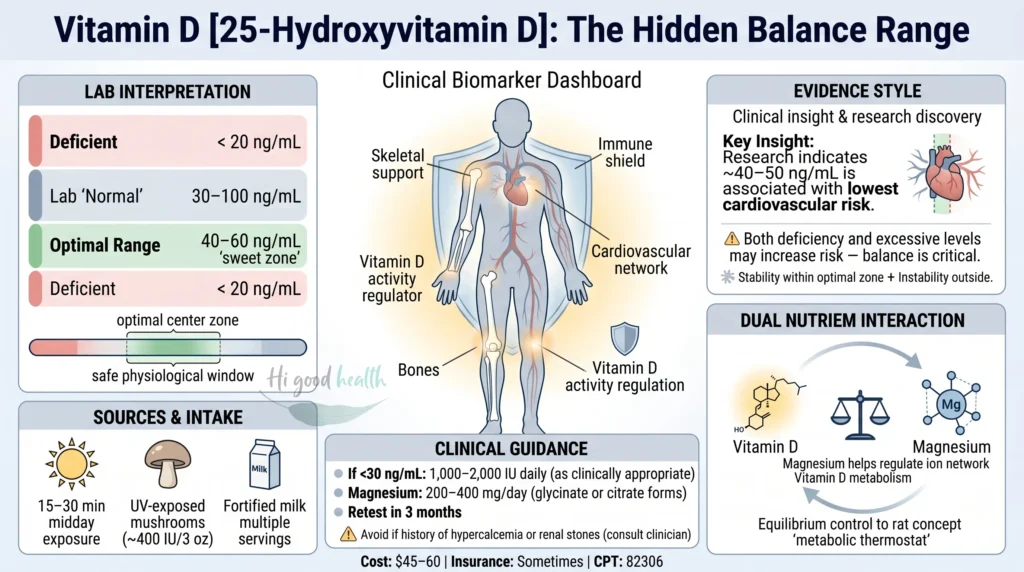
| Level | What it usually means |
|---|---|
| Under 20 ng/mL | Deficient |
| 20-30 ng/mL | Insufficient |
| 30 ng/mL and above | Generally treated as sufficient in Indian and international guidance |
Deficiency is widespread in India despite the sunshine. Darker skin needs longer exposure, urban life keeps people indoors, and covered clothing and sunscreen reduce it further.
⚠️ Where opinion enters, and where it can do harm. Targets of 40-60 or even 40-80 ng/mL circulate widely online. They are not the Indian standard, and very high doses are not harmless. Vitamin D toxicity from mega-dose sachets is something Indian doctors actually see, and it causes high calcium, kidney stones and kidney damage.
The sensible position: correct a deficiency under medical advice, retest after about three months, and do not chase a high number. If you have a history of kidney stones or high calcium, do not supplement without asking a doctor first.
Food and sun: midday sun on arms and legs for 15-30 minutes several times a week does most of the work for most people here. Fortified milk and UV-exposed mushrooms contribute a little.
Vitamin B12, and why it matters more here
This is the single most India-relevant test in this article.
B12 comes almost entirely from animal foods. In a largely vegetarian population, deficiency is common, often long-standing, and frequently missed.
| Test | Usual reference range | Note |
|---|---|---|
| Serum B12 | 200-950 pg/mL | A result in the low-normal band can still be a functional deficiency |
| Methylmalonic acid (MMA) | 87-400 nmol/L | Rises when cells genuinely lack B12. Settles a borderline B12 result |
The reason to care is not only anaemia. Prolonged B12 deficiency damages nerves and affects memory and balance, and some of that damage does not fully reverse. In an older Indian vegetarian with tingling feet, unsteadiness or memory complaints, this should be checked early rather than last.
Practical note: vegetarians and vegans in India generally need a supplement or fortified food. Diet alone rarely fixes it. Correcting a low B12 without asking why it was low can also mask an absorption problem, so take the result to a doctor.
Iron, and the trap that is specific to India
A complete blood count tells you whether you are anaemic. It does not tell you whether your iron stores are empty, and it does not tell you why.
| Test | Usual reference range | What it adds |
|---|---|---|
| Ferritin | Roughly 30-300 ng/mL (men), 15-200 ng/mL (women) | Stored iron. Falls long before haemoglobin does |
| Serum iron | 50-170 ug/dL | Circulating iron, varies through the day |
| TIBC | 250-450 ug/dL | Capacity to carry iron |
| Transferrin saturation | 15-50% | How much iron is actually available for use |
Ferritin below about 30 ng/mL is generally taken as iron deficiency, and many doctors act on anything under 45 in a symptomatic older patient.
Two cautions, both of which matter here.
First, ferritin rises with inflammation, so infection, injury or chronic illness can push it up and hide a real deficiency. Read it alongside CRP and transferrin saturation.
Second, and this is the Indian one: a small red cell here does not automatically mean iron deficiency. Beta-thalassaemia trait is common across much of the country, and sickle cell trait in several tribal and central Indian populations. Both produce small cells and a mildly low haemoglobin that looks exactly like iron deficiency.
If iron does not fix a small-cell anaemia, ask about haemoglobin electrophoresis or HPLC rather than taking more iron. Someone with thalassaemia trait gains nothing from iron and may accumulate iron they cannot excrete.
Food: dal, rajma, chana, spinach, ragi and jaggery all contribute. Pair with something rich in vitamin C, lemon on the dal, amla, guava, citrus. Tea and coffee block a large share of iron absorption, which matters in a country that drinks chai with meals. Leave a gap of an hour or two.
RBC magnesium
Standard labs measure serum magnesium, which is about 1% of the body’s total. It can read normal while cellular stores are low. RBC magnesium measures the cellular pool.
It is available in India but less widely, and it costs more than the tests above. This is a second-tier test. Worth considering if you have persistent cramps, poor sleep or palpitations, or if vitamin D will not rise despite supplementation, which is the situation where magnesium status genuinely matters.
Food first: pumpkin seeds, spinach, black beans, whole grains such as bajra and jowar, and nuts.
Group 3: Heart and inflammation, past the standard lipid profile
Apolipoprotein B
A lipid profile measures how much cholesterol is being carried. ApoB counts the number of plaque-forming particles, and particle count tracks risk better than the cholesterol figure.
A person can have an acceptable LDL and a high ApoB. Commonly used targets are under 90 mg/dL for general risk, with lower targets for people who already have heart disease.
Worth doing in India, particularly with a family history of early heart attack, which is common in Indian families and arrives a decade earlier here than in Europe. It is available at the larger labs and does not cost much.
Lipoprotein(a)
Largely genetic, mostly unaffected by diet and exercise, and it raises cardiovascular risk independently. Levels above about 50 mg/dL are generally treated as high risk.
Test once in a lifetime. If it is high, nothing lowers it much, so the response is to be stricter about everything you can control: blood pressure, ApoB, sugar, tobacco.
Especially worth doing if a parent or sibling had a heart attack or stroke young.
High-sensitivity CRP
Ordinary CRP looks for infection. The high-sensitivity version measures low-grade inflammation, which tracks with cardiovascular and metabolic risk. Under 1.0 mg/L is generally considered low risk, over 3.0 mg/L high.
It is cheap and it adds information to a lipid profile. It rises with any recent illness, so a raised result during or just after an infection means nothing and should be repeated.
Homocysteine
Reflects B-vitamin status, particularly B12 and folate, and is associated with cardiovascular and cognitive risk. Under about 10 umol/L is the usual target.
Relevant in India for the same reason B12 is — in a vegetarian population, a raised homocysteine often points straight back to B12.
Group 4: Metabolic markers, where India differs most
Fasting insulin, and HOMA-IR
This is the highest-value addition on the whole list for an Indian reader.
Indians develop insulin resistance and diabetes earlier and at lower body weights than Europeans. A normal weight, a normal BMI and a normal fasting sugar can all sit alongside insulin resistance that has been building for years.
The sequence is: insulin rises first, HbA1c later, fasting glucose last. Standard packages test the last one and sometimes the second. Almost none test the first.
Fasting insulin, combined with fasting glucose, gives HOMA-IR, a calculated score for insulin resistance. Commonly quoted thresholds put a fasting insulin under about 5 uIU/mL as favourable and a HOMA-IR above roughly 2 as suggestive of resistance, though laboratories and clinicians vary.
Why it is worth it: at the insulin stage the problem is still largely reversible with food and exercise. By the time fasting glucose is abnormal, years have passed.
HbA1c
Gives an average of blood sugar over about three months. Prediabetes is 5.7 to 6.4%, diabetes 6.5% and above.
Usually included in Indian packages, and it should be. Given how early diabetes arrives here, it is worth having from your thirties rather than your fifties.
Group 5: Protein status
A plasma amino acid panel is a specialist test, expensive, and not something most people need.
The Indian version of this question is more practical than a test. A typical Indian vegetarian diet is easy to get wrong on protein: heavy on cereals, light on legumes, and often short of the total needed to hold muscle after fifty.
A cheaper answer than a test: aim for protein at roughly 1.0 to 1.6 g per kg of body weight depending on activity, spread across the day, from dal, rajma, chana, soya, paneer, curd, eggs where acceptable, and nuts. Vary the legume rather than eating the same dal daily.
Test only if there is unexplained fatigue or muscle loss despite eating well, and then with a doctor deciding what to order.
Reference range against “optimal range”: how to read this honestly
A reference range is built from a measured population and is designed to flag disease. It is wide by design.
An “optimal range” is a judgement about where a healthy person should sit. Sometimes it rests on good evidence. Often it does not, and it is narrower than the reference range for commercial reasons.
The test to apply: if a range arrives attached to a product, treat it as marketing until you see the study. Be especially wary of any panel whose recommendation, whatever your result, is a bundle of capsules.
And the pattern that should make you sceptical: every marker slightly out of an “optimal” range, every one requiring a supplement, all from the same seller.
The order to do this in
Test first, while not taking supplements, except B12 if you are vegetarian and already on it, since stopping is not sensible.
Take the report to a doctor. Bring old reports; a trend across three years is worth more than a single reading.
Fix food first where the deficiency is mild, and give it six weeks.
Supplement only what is confirmed low, at a dose a doctor sets, not one from a label.
Retest after about three months. Changing something and never rechecking is the most common waste in this whole area.
Key takeaways
A TSH test on its own is not a thyroid panel. Free T4, Free T3 and anti-TPO antibodies explain the symptoms a normal TSH test result leaves unexplained, and autoimmune thyroid disease is common in India.
The four additions worth making to any Indian health package are ferritin, vitamin B12, fasting insulin and vitamin D. All are cheap, available without a prescription, and usually absent from the standard panel.
Fasting insulin is the highest-value test on the list for Indians, because insulin resistance appears here early and at normal body weights, and it is still reversible at that stage.
B12 deserves particular attention in a largely vegetarian population, and a small red cell in India can mean thalassaemia trait rather than iron deficiency, which iron will not fix and may make worse.
Vitamin D targets promoted online are higher than Indian guidance, and high-dose supplementation causes real harm. Correct a deficiency with medical advice; do not chase a number.
An “optimal range” attached to a product is marketing until proven otherwise. Test with a question, take the report to a doctor, and retest after changing anything.
Frequently asked questions
1. Which tests should I add if I can only add a few?
Ferritin, vitamin B12, fasting insulin and vitamin D, plus Free T4 and Free T3 if a TSH test has ever come back abnormal. They are inexpensive, available at any accredited Indian laboratory without a prescription, are usually missing from standard packages, and each one can change what you do.
2. Is the “optimal” vitamin D range of 40 to 60 ng/mL correct?
It is not the standard used in India, where about 30 ng/mL is generally treated as sufficient. High-dose supplementation is not harmless and vitamin D toxicity is seen in practice here. Correct a deficiency under medical advice and retest rather than aiming for a high number.
3. My TSH is normal but I still feel tired. What next?
TSH is the pituitary signal, not the active hormone. Free T3, Free T4 and anti-TPO antibodies give a fuller picture, and all are inexpensive in India. Take the results to a doctor, because a borderline number with symptoms is a clinical judgement, not an arithmetic one.
4. My haemoglobin is low and iron has not helped. Why?
It may not be iron deficiency. Beta-thalassaemia trait is common in India and produces a similar picture, and inflammation can block iron use even when stores look adequate. Ask your doctor whether haemoglobin electrophoresis or HPLC is worth doing rather than taking more iron.
5. Why is fasting insulin worth testing when my sugar is normal?
Because insulin rises years before glucose does, and Indians develop insulin resistance early and at normal weights. A normal fasting sugar does not rule it out, and at the insulin stage the problem is still largely reversible through diet and exercise.
6. Do I need to stop my supplements before testing?
Generally yes for a baseline, so the result reflects your body rather than the tablet, with the exception of B12 if you are vegetarian and already taking it. Ask your doctor how long to stop for, because it varies by supplement.
7. How often should I repeat these tests?
About three months after starting or changing anything, to see whether it worked. Once things are stable, once a year is enough for most people.
References
- Anjana RM, et al. Metabolic Non-Communicable Disease Health Report of India: the ICMR-INDIAB National Cross-Sectional Study. The Lancet Diabetes and Endocrinology. 2023.
- International Institute for Population Sciences and ICF. National Family Health Survey (NFHS-5), 2019-21: India. Mumbai: IIPS.
- Ministry of Health and Family Welfare, Government of India. National Sickle Cell Anaemia Elimination Mission. 2023.
- Indian Council of Medical Research. ICMR Guidelines for Management of Type 2 Diabetes.
- Sniderman AD, et al. Apolipoprotein B Particles and Cardiovascular Disease: A Narrative Review. JAMA Cardiology. 2019.
- Nordestgaard BG, et al. Lipoprotein(a) as a cardiovascular risk factor: current status. European Heart Journal.
- World Health Organization. Haemoglobin concentrations for the diagnosis of anaemia and assessment of severity.
Disclaimer
This article is for general information and does not replace medical advice, diagnosis or treatment. Reference ranges differ between laboratories, so always read your result against the range printed on your own report. Discuss any test result, supplement or dose with a qualified doctor who knows your history. Never diagnose yourself from a lab value alone.
