There is one line in this whole article that is more important in India than anywhere else, so it goes first.
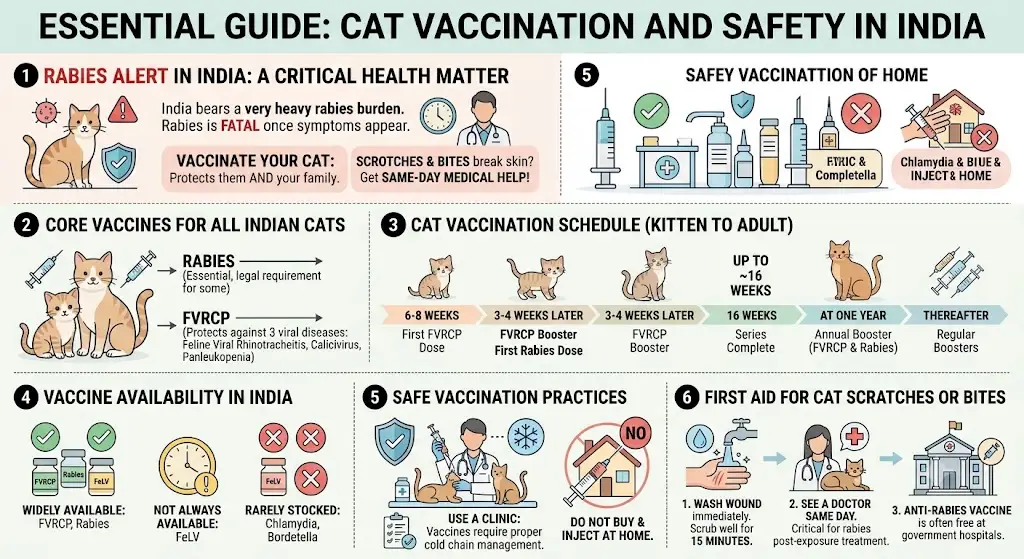
India carries one of the world’s heaviest rabies burdens, and rabies is essentially always fatal once symptoms begin. Vaccinating your cat protects your household as much as it protects the cat. And if a cat, yours or any other, bites or scratches you and breaks the skin, that is a same-day medical matter for you as well.
Everything else here follows from that: what the core vaccines are, what the cat vaccination schedule looks like from kittenhood onwards, which vaccines you can actually get in India, and what to do when a cat that spends half its life on the terrace does not fit the tidy indoor-cat model these articles are usually written for.
At a glance
Rabies and FVRCP are the two that matter for every cat in India, whether it goes out or not.
Most Indian cats are not indoor-only. Balconies, terraces, open windows, building corridors and community cats mean the “she never goes outside” reassurance is usually not accurate here.
The cat vaccination schedule starts at 6 to 8 weeks and runs to about 16 weeks, with doses every three to four weeks, then a booster at one year.
Availability is the Indian constraint. FVRCP and rabies vaccines are widely available. FeLV vaccine is not always, and Chlamydia and Bordetella vaccines are rarely stocked.
Get the vaccine given at a clinic, not bought and injected at home. These vaccines need an unbroken cold chain, and that is the part that goes wrong here.
If you are scratched or bitten, wash the wound with soap under running water for fifteen minutes and see a doctor the same day. Anti-rabies vaccine is available free at government hospitals.
Rabies: why this section is longer than the international version
Rabies causes thousands of human deaths in India every year, more than in almost any other country. Most cases follow dog bites, but cats transmit rabies too, and a cat that goes out, fights, or interacts with community animals is exposed.
Two things follow, and they are different things.
Vaccinate the cat. The first rabies dose is given at around 14 to 16 weeks, boosted a year later, and then according to the product and to local rules. In many Indian municipalities a rabies vaccination certificate is also required for pet registration.
And know what to do if a cat breaks your skin. This is the part Indian pet articles usually leave out, and it is the part that saves lives.
After a bite or a scratch that breaks the skin
- Wash the wound with soap under running water for fifteen minutes. Not thirty seconds. This single step removes a large part of the risk and it is the most under-done thing in India.
- Do not apply chilli powder, turmeric, oil, mud or a herbal paste, and do not have the wound stitched immediately. These are common and they make it worse.
- See a doctor the same day for post-exposure prophylaxis. Anti-rabies vaccine is available free at government hospitals and health centres under the national programme, and rabies immunoglobulin is given for deeper or higher-risk wounds.
- Do this even if the cat is your own and vaccinated, and let the doctor decide. Vaccination status of the animal is one input, not a reason to skip an assessment.
- A licked open wound or a scratch counts. So does a bite from a kitten.
Rabies is preventable before symptoms and untreatable after them. That is the entire reason for the urgency.
How vaccines work
A vaccine shows the immune system a harmless version of a virus so that the body learns to recognise it before the real one arrives. The immune system then keeps memory cells, and if the disease turns up later the response is faster and stronger.
Protection fades over time, which is why boosters exist. A booster is a refresher, not a repeat of a failed dose.
Core vaccines: what every Indian cat needs
FVRCP
One injection covering three viruses.
- Feline viral rhinotracheitis (FHV-1), a herpesvirus causing sneezing, eye discharge and long-running upper respiratory illness. Extremely common in Indian street and shelter cats.
- Calicivirus (FCV), which causes respiratory signs, fever and painful mouth ulcers.
- Panleukopenia (FPV), feline distemper. Severe vomiting, diarrhoea and dehydration, often fatal in kittens, and the disease most likely to kill an unvaccinated Indian kitten.
Panleukopenia deserves the emphasis. It spreads easily, it survives a long time in the environment, and it is common in Indian cat populations. Treatment is expensive and often fails. The vaccine works.
Rabies
Covered above. Core for every cat in India without exception.
Non-core vaccines, and what is actually available in India
This is where the international guidance and Indian reality diverge, so it is worth being concrete.
| Vaccine | Who it is for | Availability in India |
|---|---|---|
| FVRCP | Every cat | Widely available |
| Rabies | Every cat | Widely available and inexpensive |
| FeLV (feline leukaemia) | Cats that go out, or live with an FeLV-positive cat | Not reliably stocked; ask your vet in advance |
| Chlamydia felis | Multi-cat households, catteries, shelters with known problems | Rarely available here |
| Bordetella | Boarding and high-density settings | Rarely available here |
FeLV is the one worth a conversation. It spreads between cats through saliva, bites and shared bowls, and free-roaming Indian cats are exposed.
If your cat goes out, or you are bringing in a new cat, ask your vet about testing for FeLV and FIV first. Testing is more widely available here than the vaccine, and it is the more useful step before introducing a new cat to an existing one.
The cat vaccination schedule for kittens
Kittens are born with some protection from the mother’s first milk. It fades over the first weeks, and it also blocks vaccination if a dose is given too early, which is why the series starts at a particular point and repeats.
| Age | What is given |
|---|---|
| 6-8 weeks | First FVRCP |
| 10-12 weeks | FVRCP booster, and FeLV if the risk and the supply allow |
| 14-16 weeks | Final kitten FVRCP, FeLV booster if used, and the first rabies dose |
| Around 1 year | Booster of FVRCP and rabies |
| Every 1-3 years after | Core boosters as the vet advises; FeLV yearly if it is being used |
Two Indian notes.
Deworm alongside. Worms are near-universal in Indian kittens and a heavy worm burden blunts the response to vaccination as well as making the kitten unwell. Our separate guide on deworming schedules covers this.
And rescued kittens with an unknown history are the common Indian situation. If the age is uncertain and the history is unknown, the vet will usually start the series from scratch. That is not wasted; it is the safe choice.
Adult cats and the three-year question
After the one-year booster, modern guidance moves the core FVRCP vaccine to roughly a three-year cycle for most adult cats. This reduces unnecessary injections without leaving cats unprotected.
Rabies is the exception to treat carefully in India. The interval depends on the specific vaccine used and on local rules, and in a high-rabies country there is a reasonable argument for staying on the schedule the vet recommends rather than stretching it. Ask, and follow what your vet says for the product they are using.
Non-core vaccines such as FeLV, where used, are given yearly.
Senior cats
Older cats are not finished with vaccines, but the plan needs more thought. The immune system responds less strongly with age, and kidney disease, which is very common in older cats, changes the picture.
The approach is quality over quantity: keep the protection that matters, particularly rabies, and do not add things that do not.
The Indian practicalities nobody writes about
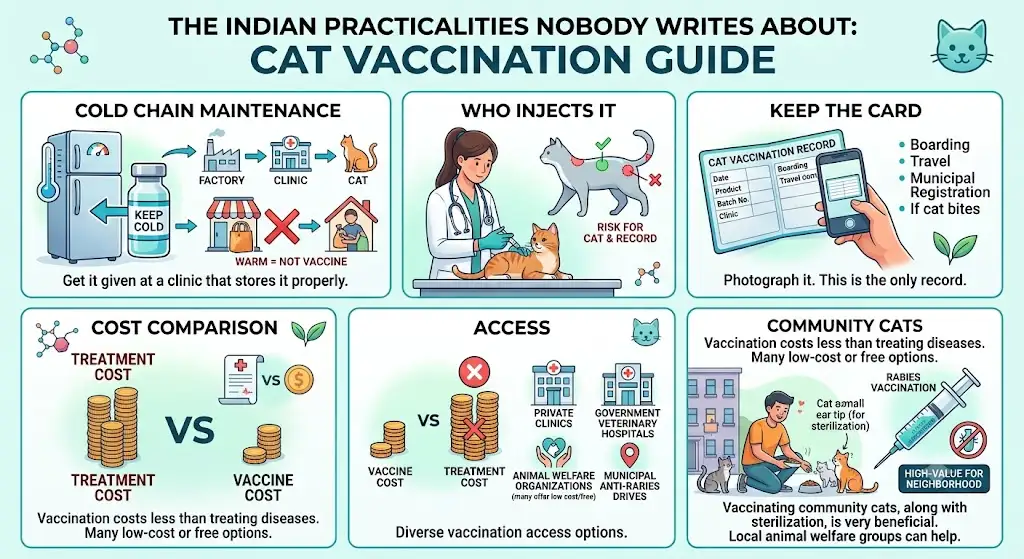
Cold chain. Cat vaccines must be kept refrigerated from the factory to the injection. In India it is common for someone to buy a vaccine at a shop, carry it home in a bag, and have it injected there. A vaccine that has been warm is not a vaccine. Get it given at a clinic that stores it properly.
Who injects it. A vaccine given by someone unqualified, in the wrong place, is a risk both for the cat and for the record. Injection site matters, for FISS and for anything that goes wrong later.
Keep the card. A vaccination card with dates, product names and batch numbers is the only record that exists. Photograph it. You will need it for boarding, for travel, for municipal registration, and if the cat ever bites someone.
Access. Vaccination costs very little compared with treating any of these diseases. Where a private clinic is difficult, government veterinary hospitals and animal-welfare organisations vaccinate at low cost or free, and municipal anti-rabies drives happen in many cities.
Community cats. If you feed cats in your building or lane, vaccinating them against rabies, along with sterilisation, is one of the highest-value things anyone can do for a neighbourhood. Local animal welfare groups usually help with this.
The “she never goes outside” problem
The international version of this article treats indoor-only as the normal case and outdoor access as the exception. In India that is usually the wrong way round.
Most Indian homes have balconies, grilles, terraces, open kitchen windows and shared corridors. Cats slip out. Community cats come in. A cat that has never left the flat can still meet another cat through a grille, and viruses come home on shoes and clothes.
So the honest position is: assume some exposure, vaccinate the core vaccines, and have the FeLV conversation based on what your cat actually does rather than what you intend.
Side effects, and what is not normal
Most cats are fine. The usual after-effects are a quiet day, a small firm lump at the injection site, mild fever, or eating less for a day.
Call the vet the same day for: swelling of the face, hives, repeated vomiting, difficulty breathing, collapse, or a cat that is very dull for more than a day.
Feline injection-site sarcoma (FISS) is a rare tumour that can develop at an injection site. Current practice manages it by choosing vaccines carefully, injecting in a limb rather than between the shoulder blades, and not vaccinating more often than needed.
Any lump at an injection site that is still there after three months, is bigger than two centimetres, or is growing, should be shown to a vet.
In the Indian heat, also watch for the ordinary things: keep the cat cool and quiet for the rest of the day, and offer water.
Common beliefs worth correcting
“Indoor cats do not need vaccination.” In an Indian home, almost no cat is genuinely sealed off, and rabies vaccination is a household safety measure as much as a cat one.
“My cat is vaccinated so a scratch is nothing.” Wash it, and see a doctor. Vaccination status of the animal is information for the doctor, not a substitute for the assessment.
“Fewer injections is safer.” Over-vaccinating is not the goal, and neither is under-vaccinating. The right number is the one matched to this cat’s life.
“Street cats are naturally immune.” They are not. They are more exposed, which is why panleukopenia and respiratory viruses spread so easily in free-roaming populations.
Key takeaways
Rabies vaccination is not optional in India, for the cat’s sake and for the household’s.
If a cat breaks your skin: soap and running water for fifteen minutes, then a doctor the same day. Free anti-rabies vaccine is available at government hospitals.
FVRCP and rabies are core for every Indian cat. Panleukopenia is the disease most likely to kill an unvaccinated kitten here.
The cat vaccination schedule starts at 6 to 8 weeks, repeat every three to four weeks to about 16 weeks, then boost at one year.
FeLV vaccine is not always available in India. Testing for FeLV and FIV before introducing a new cat is often the more practical step.
Get vaccines given at a clinic. The cold chain is the weak point here, and a warm vaccine does nothing.
Keep the vaccination card and photograph it. It is the only record, and you will need it.
Deworm alongside vaccination, because worms are near-universal in Indian kittens.
Frequently asked questions
My cat never goes outside. Does she still need vaccines?
Yes. In an Indian home with balconies, grilles and open windows, few cats are genuinely isolated, and viruses also come in on shoes and clothes. Rabies vaccination is also a household safety measure, not just a cat one.
What should I do if my cat scratches or bites me?
Wash the wound with soap under running water for a full fifteen minutes, do not apply anything to it, and see a doctor the same day. Anti-rabies vaccine is available free at government hospitals. Do this even if your cat is vaccinated.
Which vaccines are on the cat vaccination schedule in India?
FVRCP and rabies for every cat. FeLV if the cat goes out or lives with an FeLV-positive cat, subject to availability. Chlamydia and Bordetella vaccines are rarely stocked here and are rarely needed.
When do kitten vaccinations start?
First FVRCP at six to eight weeks, then boosters every three to four weeks until about sixteen weeks, with the first rabies dose at fourteen to sixteen weeks, and a booster of both at one year.
I rescued a kitten and do not know its history. What now?
The vet will usually estimate the age and start the series from the beginning. That is the safe approach, and it is common here. Deworming is normally done alongside.
Is the three-year booster interval right for India?
For FVRCP, generally yes after the one-year booster. For rabies, follow the interval your vet recommends for the specific vaccine used and your local rules, because the exposure risk here is higher than in the countries these guidelines come from.
Can I buy the vaccine and have it injected at home?
It is a poor idea. These vaccines must stay refrigerated from manufacture to injection, and that chain breaks the moment a vial travels home in a bag. A warm vaccine does nothing, and you will not know.
Is the FeLV vaccine available in India?
Not reliably. Ask your vet in advance. Testing your cat for FeLV and FIV, particularly before introducing a new cat, is often more useful and is more widely available.
What does vaccination cost?
Very little compared with treating any of these diseases. Government veterinary hospitals and animal welfare organisations vaccinate at low cost or free, and many cities run anti-rabies drives.
There is a lump where the injection was given. Should I worry?
A small firm lump for a few days is common. Show it to a vet if it is still there after three months, is larger than about two centimetres, or is growing. That is the standard rule for spotting injection-site sarcoma early.
Should I vaccinate the community cats I feed?
Rabies vaccination and sterilisation of community cats is one of the most useful things anyone can do for a neighbourhood. Local animal welfare organisations usually run programmes and will help.
Glossary
Core vaccine: a vaccine recommended for every cat because the disease is serious or widespread. In India, FVRCP and rabies.
Non-core vaccine: a vaccine given according to the individual cat’s exposure and lifestyle.
FVRCP: the combination vaccine against feline viral rhinotracheitis, calicivirus and panleukopenia.
Panleukopenia: feline distemper. Severe, highly contagious, often fatal in unvaccinated kittens.
FeLV: feline leukaemia virus, spread between cats through saliva, bites and shared bowls.
FIV: feline immunodeficiency virus, spread mainly by bite wounds between cats.
Booster: a repeat dose that refreshes protection.
FISS: feline injection-site sarcoma, a rare tumour at an injection site.
Post-exposure prophylaxis: the wound washing, vaccine and, where needed, immunoglobulin given to a person after a possible rabies exposure.
Cold chain: the unbroken refrigeration a vaccine needs from manufacture to injection.
Disclaimer
This article is for general education only and does not replace personalised veterinary advice. Vaccine choices should be made with a registered veterinarian who can assess your cat’s age, health, environment and exposure. Any bite or scratch that breaks human skin should be assessed by a doctor the same day, regardless of the animal’s vaccination status.
References
- National Rabies Control Programme, National Centre for Disease Control, Government of India.
- World Health Organization. Rabies fact sheet and post-exposure prophylaxis guidance.
- National Action Plan for Dog Mediated Rabies Elimination from India by 2030.
- AAHA and AAFP Feline Vaccination Guidelines.
- ABCD, European Advisory Board on Cat Diseases. Vaccination guidelines.
- Guidelines on feline injection-site sarcoma.
- Animal Welfare Board of India. Guidance on community animal vaccination and sterilisation.
