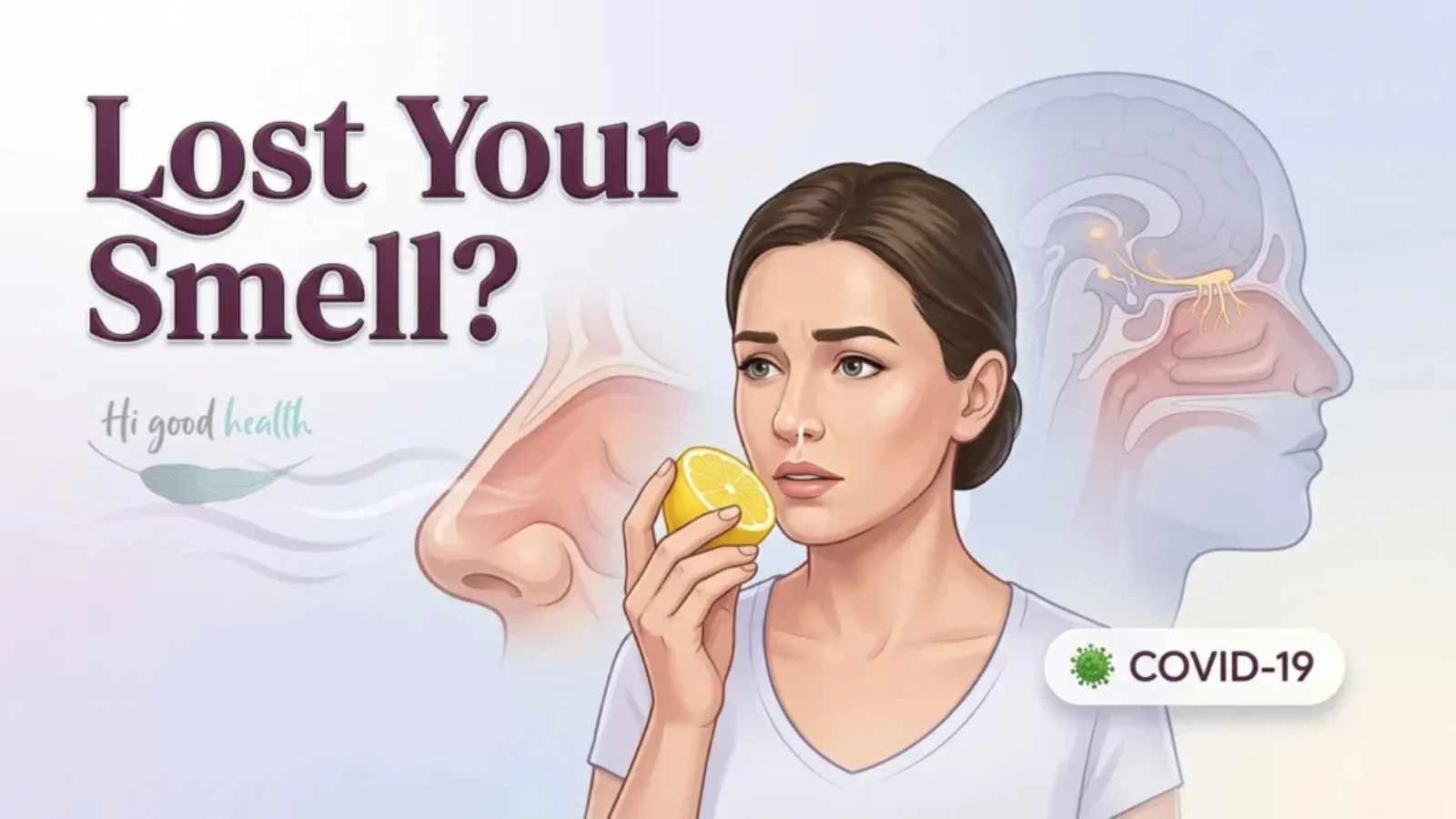
Losing your sense of smell after COVID can be more than annoying — it can affect safety, appetite, mood, and daily life, and for some people it lasts far longer than expected.
Can’t Smell Anything? The Hidden Side of COVID You Shouldn’t Ignore
One day, coffee smells rich and familiar. The next, everything seems strangely blank. That sudden change can feel unsettling, and in the case of COVID-19, it was one of the most talked-about warning signs early in the pandemic.
Smell loss is more than a sensory inconvenience — it reflects disruption within a complex neuro-olfactory network that influences safety, nutrition, and quality of life.
It can be a clue that something is happening in the olfactory system — the network that helps your brain recognise odours — and in some people it lasts for months or even longer. The good news is that many people improve over time, especially when they use a structured recovery approach.
At a glance
There are two different problems and they have different names. Anosmia is losing your sense of smell altogether. Parosmia is smell becoming distorted — coffee smelling of petrol, onions of sewage, your own kitchen turning repulsive.
Parosmia usually arrives after anosmia, and however alarming it feels, it is generally a sign that the nerves are regenerating rather than a sign of harm.
Most people recover, and most recover within weeks. A minority take months, and a small number are left with lasting change. The single intervention with real evidence behind it is smell training — and it is free.
What is not smell loss: a blocked nose from a cold usually blunts smell for a few days and returns as the congestion clears. Smell that disappears with no blockage at all, or that has not returned after several weeks, is worth a doctor’s opinion — particularly if it is on one side only.
Parosmia and Anosmia: What the Two Words Actually Mean
If everything has started smelling wrong rather than smelling of nothing, the word you are looking for is parosmia. It is the distortion of smell — a familiar odour registering as something else, and almost always as something worse. Coffee, meat, onions, garlic, toothpaste and petrol are the triggers people report most,
The distorted smell is typically described as rotten, chemical, burnt or sewage-like.
The related terms are worth knowing, because they are what a doctor will use:
- Anosmia — complete loss of smell. Nothing registers at all.
- Hyposmia — reduced smell. Things register, but faintly.
- Parosmia — distorted smell. Something is there, but it is wrong.
- Phantosmia — smelling something that is not there at all, often smoke or burning.
- Ageusia and dysgeusia — the same pair for taste: complete loss, and distortion.
Why parosmia is usually a good sign, even though it feels like the worst part. The olfactory nerves can regenerate, and as they do they reconnect imperfectly at first — the wiring is right but the labelling is scrambled, so the brain reads a familiar molecule as the wrong smell.
That is why parosmia so often appears weeks or months after the initial loss rather than at the start. It is unpleasant, sometimes genuinely distressing, and it usually settles as the connections mature.
The loss of taste that comes with it is mostly not taste at all. The tongue detects five things — sweet, salt, sour, bitter and umami. Everything else people call flavour is smell, arriving through the back of the nose while you chew.
That is why food goes flat when smell goes, and why people describe it as losing their sense of taste when the tongue is working perfectly well.
How to Regain Smell and Taste: Smell Training, Step by Step
Smell training is the only self-directed measure with a real evidence base behind it. It is not a cure and it does not work for everyone, but it is free, it has no side effects, and the trials supporting it are reasonable.
The idea is simple: repeated, deliberate exposure to a small set of strong smells, giving the recovering nerves something consistent to relearn against.
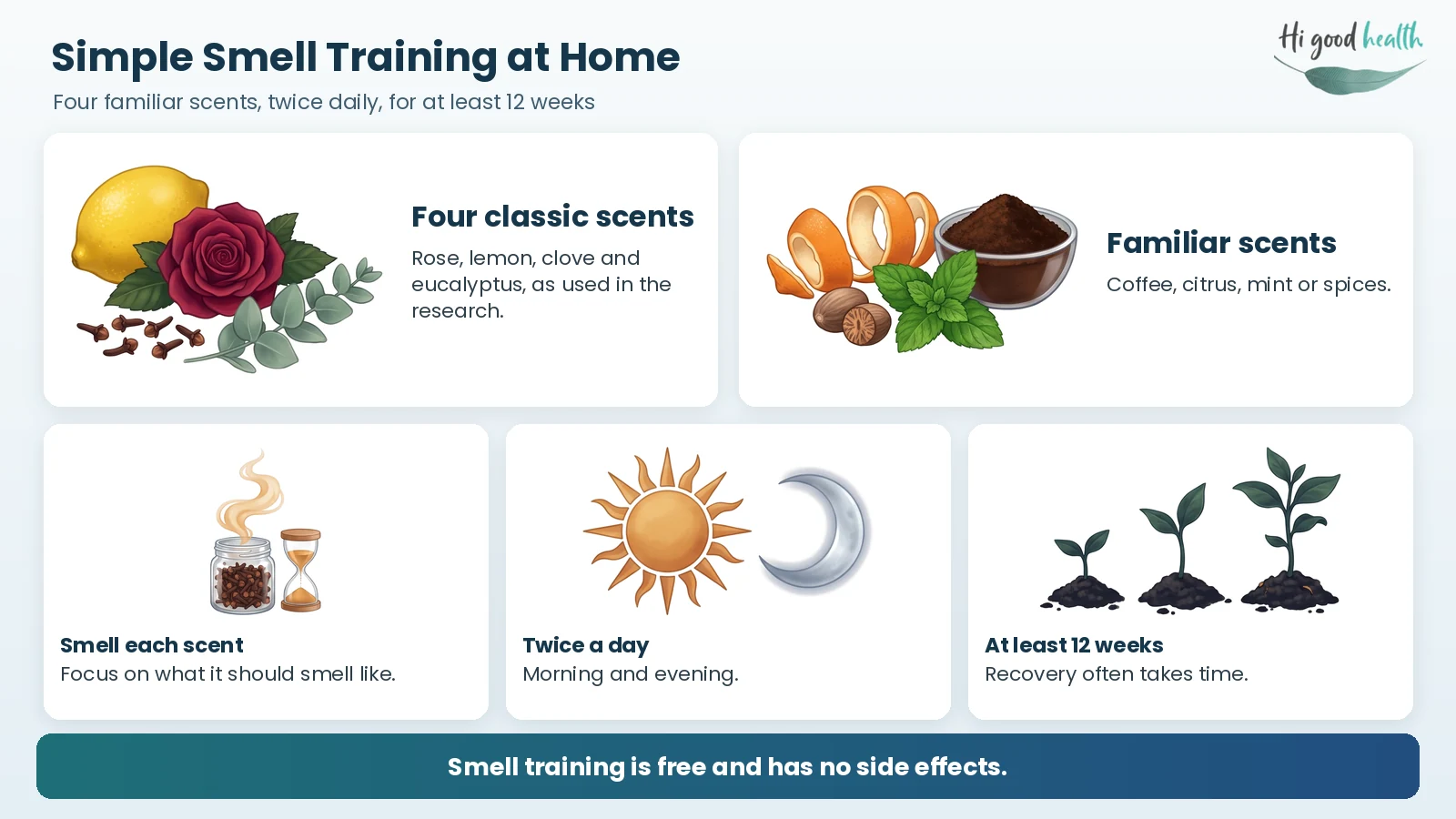
The classic four scents used in the research are rose, lemon, clove and eucalyptus — chosen because they represent four different odour families rather than because they are magic.
In an Indian kitchen the practical equivalents are close at hand: rose water or gulab, lemon or nimbu peel, laung (clove), and eucalyptus or nilgiri oil. Essential oils work; so do the spices and peels themselves.
How to do it:
- Hold one scent under your nose and sniff gently for about 20 seconds.
- While you sniff, concentrate on the memory of what it should smell like. The attention appears to matter.
- Rest for around 30 seconds, then move to the next scent.
- Work through all four, twice a day, morning and night.
- Keep going for at least three months, and change the four scents after about twelve weeks.
What to expect. Nothing at all for the first few weeks is normal. Progress is usually gradual and uneven, and one scent often returns long before the others. Recovery is not linear, and a bad week does not undo the work.
Living with parosmia while you wait. If particular foods have become intolerable, eat around them rather than forcing them — cold or room-temperature food releases fewer aroma molecules and is often easier than hot food, and bland proteins, yoghurt, rice and plain khichdi are what most people fall back on.
Nutrition matters here: appetite loss from parosmia is real, and unintended weight loss is worth mentioning to a doctor.
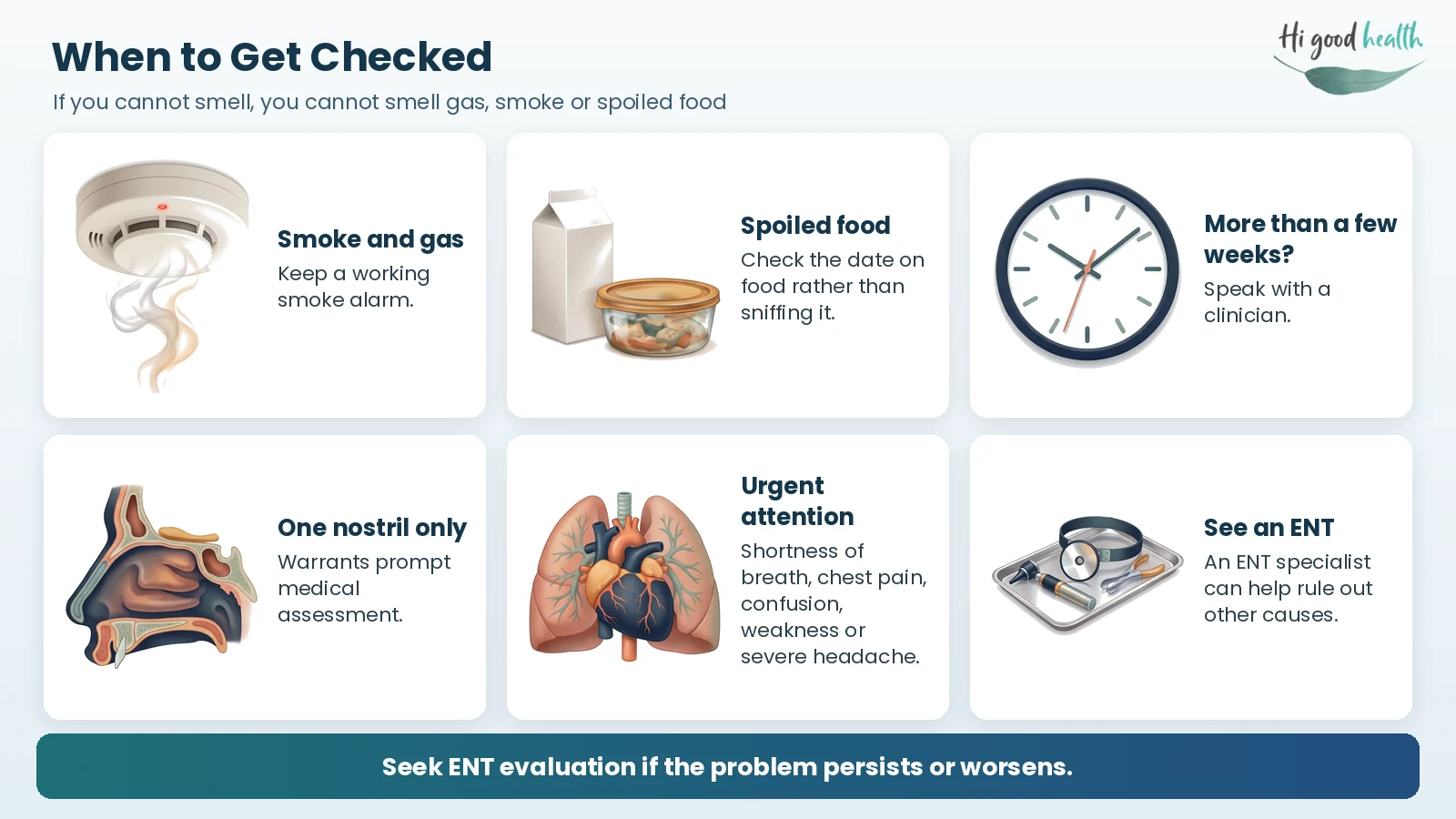
A safety point that gets overlooked. If you cannot smell reliably, you cannot smell a gas leak, smoke, or food that has spoiled. Check the date on food rather than sniffing it, and make sure there is a working smoke alarm — this matters more in a home with an LPG cylinder.
Cold, Flu or COVID? Telling Smell Loss Apart
The pattern usually distinguishes them better than the severity does.
A cold or sinus infection blocks smell mechanically. The nose is congested, odour molecules cannot reach the receptors, and smell returns as the blockage clears — typically within a few days to a week. If your nose is streaming and blocked, that is almost certainly what is happening.
COVID-related smell loss is different because it is often sudden, frequently near-total, and commonly happens with a clear nose. That combination — no congestion, no smell — is the distinctive one, and it is also why parosmia tends to follow weeks later as the nerves recover.
Other causes worth ruling out if there is no recent infection at all: allergic rhinitis and nasal polyps, head injury, certain medications, heavy smoking, and — less commonly but importantly — the early stages of Parkinson’s or Alzheimer’s disease, where smell loss can precede other symptoms by years.
Smell loss affecting one nostril only is the pattern that most warrants prompt medical assessment.
Why Smell Loss Happens
Smell loss, or anosmia, can happen for several reasons, not only COVID-19. A common cold may block odour molecules with swelling and mucus, but COVID-related smell loss often happens even when the nose is not stuffed up.
Research suggests SARS-CoV-2 usually affects the support cells in the olfactory epithelium rather than directly destroying the smell neurons themselves. When those support cells are damaged, the smell system temporarily loses its normal chemistry, support, and signal flow. That helps explain why many people lose smell suddenly and then recover as the tissue heals.
A major review in Trends in Neurosciences explains that the most plausible mechanism is injury to support cells, which disrupts mucus composition, cilia function, and energy supply to the smell receptors. In plain English: the smell sensors may still be there, but they cannot work properly until the surrounding environment recovers.
In people with long-lasting symptoms, researchers have also found evidence of persistent inflammation and changes in the olfactory tissue that may contribute to ongoing dysfunction even after the virus is no longer detectable.
Why COVID Feels Different
COVID-related smell loss became widely recognised because it often arrived fast and without the classic signs of congestion. Earlier variants were more likely to affect the olfactory region, while later omicron-lineage variants tended to cause smell loss less often.
That does not mean smell changes are gone. Research still shows that prior COVID infection can be linked to ongoing olfactory dysfunction, and some people never fully recover. In other words, the symptom may be less frequent now, but it still matters.
Scientists have also learned that the virus behaves differently depending on the variant. Johns Hopkins researchers reported that newer variants changed the way the virus interacts with the nose, helping explain why smell loss patterns evolved over time. This is one reason the symptom can look different today than it did in the earliest waves of COVID.
What Recovery Looks Like
For many people, smell returns within days or weeks. For others, recovery can take months, and some develop distorted smells such as parosmia or phantom smells called phantosmia. These changes can be especially frustrating because they often make familiar foods or everyday scents smell unpleasant, metallic, burnt, or wrong.
That matters because smell is tied to more than flavour. It helps you notice smoke, gas leaks, spoiled food, and even subtle changes in your environment. When smell goes missing, daily life gets smaller in ways people do not always expect.
A 2024 study found that 14.9% of participants still had persistent smell loss after COVID-19, and more than half reported some smell disturbance after recovery. The same study found emotional distress, eating changes, and social impact among those affected, showing that this is not a minor symptom for many patients.
What Helps Most
The strongest practical strategy is olfactory training, often described as smell therapy. The idea is simple: repeatedly expose yourself to a small set of distinct scents so the smell system receives repeated stimulation and has a better chance to recover.
A common routine is to smell four familiar scents twice daily for at least 12 weeks, focusing on each one for about 20 seconds.
Research reviews and clinical studies support olfactory training as a useful approach for post-viral and post-COVID smell loss, although not every study shows the same size of benefit. That mixed evidence is normal in medicine; it means the method is promising, but recovery still varies by person and timing.
One 2024 systematic review in Frontiers in Human Neuroscience concluded that olfactory training alone can significantly improve chronic smell dysfunction, and that combination approaches may help even more in some patients. Another 2025 study reinforced that olfactory training remains a recommended treatment for COVID-related smell dysfunction.
Simple Smell Training at Home
1. Choose four familiar scents such as coffee, citrus, mint, or spices.
2. Smell each scent for about 20 seconds, focusing on what it should smell like.
3. Repeat with all four scents.
4. Practice twice daily, morning and evening.
5. Continue for at least 12 weeks, as recovery often takes time.
Tip: Keep track of any changes in your sense of smell, even small improvements.
When to Get Checked
You should speak with a clinician if smell loss is sudden, lasts more than a few weeks, or comes with other concerning symptoms. An ENT specialist can help rule out sinus disease, nasal polyps, medication effects, head injury, or neurological causes.
If smell loss is paired with shortness of breath, chest pain, confusion, weakness, or severe headache, that needs urgent medical attention. If it is simply lingering after COVID, a structured recovery plan and medical evaluation are still worthwhile.
A persistent loss of smell can sometimes overlap with other health issues too, so it should not automatically be blamed on COVID without a proper checkup. That is especially true if there is no clear infection history, if symptoms are getting worse, or if only one side of the nose seems affected.
Can Smell Loss Be Part of Long COVID?
Long COVID, or post-COVID-19 condition, refers to a wide range of new, returning, or ongoing health problems that people experience at least four weeks and typically three months after first being infected with the SARS-CoV-2 virus. Anyone who has had COVID-19 can develop it, and symptoms can last for months or even years.
Researchers have identified ongoing inflammatory changes, altered gene activity, and immune-cell infiltration within the olfactory tissue of some patients with long-lasting symptoms.
Studies have also found that objective smell testing often detects persistent deficits even in people who believe their sense of smell has returned to normal. These findings suggest that post-COVID smell dysfunction may represent a distinct form of Long COVID in some individuals and remains an active area of research.
Real-Life Impact
Smell disorders can affect mood, appetite, and confidence in ways people often underestimate. Many people report fear about gas leaks or spoiled food, less enjoyment during meals, and emotional distress from not adapting quickly.
A 2024 quality-of-life study found that patients with persistent smell problems often felt worried, isolated, frustrated, and less satisfied with food and social life. That matters because smell is connected to memory, comfort, relationships, and even emotional regulation.
This is also why we discuss topics like this at HiGood Health: to help the community with simple, credible health information, bust myths, share best practices from different countries, and encourage healthier living. We also invite readers to explore other areas of the website and share the topics they want covered next.
Latest Science in Simple Terms
The latest research points to a few important ideas. First, COVID smell loss is often tied to injury in the nose’s support system rather than complete destruction of smell nerves.
Second, inflammation can delay recovery and may help explain long-lasting symptoms. Third, some people who think their smell is normal still test abnormally on formal smell testing, which means hidden loss can go unnoticed without evaluation.
Scientists are also learning that the recovery process is not always a straight line. Some people regain smell quickly, while others improve slowly or develop distorted smells first. This can happen because the smell system has to rebuild not just nerve function, but also the support environment around those nerves.
Put simply: your nose may recover slowly, your brain may need time to relearn smell patterns, and some people need more than patience alone.
Practical Steps
– Start olfactory training consistently for at least 12 weeks.
– Keep the nose healthy with saline spray if advised by a clinician, and avoid smoke and strong irritants.
– Track changes in smell, taste, appetite, and mood so you can describe them clearly at a visit.
– Seek ENT evaluation if the problem persists or worsens.
– Use extra food safety habits, such as checking expiration dates and asking another person to confirm spoiled-food smells if your smell is weak.
For some people, the biggest win is consistency. A few minutes of daily smell training may seem small, but recovery from nerve-related symptoms is often about steady repetition, not quick fixes.
What Researchers Have Found
Researchers have identified several possible reasons COVID affects smell. A major NIH-linked review explains that the virus can damage sustentacular support cells, alter mucus, affect glucose supply, and trigger cilia retraction in the olfactory epithelium. These changes can temporarily disable smell signaling even when many smell neurons survive.
Another important point is that smell recovery can happen before the entire tissue looks perfectly normal. That suggests the system can reboot function in stages, which is good news for patients who feel stuck early on. At the same time, a subset of people continue to struggle, which is why persistent symptoms deserve real attention.
The 2024 quality-of-life paper showed that smell loss can affect daily routines, emotional health, and social participation. In other words, persistent olfactory dysfunction should be recognised as a meaningful post-viral health concern rather than a minor inconvenience.
Key Takeaways
- Anosmia is smell gone; parosmia is smell gone wrong. Parosmia usually comes later, and it generally means the nerves are regenerating rather than deteriorating.
- What most people call lost taste is lost smell. The tongue only detects sweet, salt, sour, bitter and umami — everything else is aroma.
- Smell training is the one self-directed measure with real evidence behind it, and it costs nothing: four scents, 20 seconds each, twice a day, for at least three months.
- Gulab, nimbu peel, laung and nilgiri oil work as well as the rose, lemon, clove and eucalyptus used in the studies.
- A blocked nose that dulls smell for a few days is a cold. Smell that vanishes with a clear nose is the pattern that points elsewhere.
- Safety: if you cannot smell, you cannot smell gas, smoke or spoiled food. Check dates rather than sniffing, and keep a working smoke alarm — more so with an LPG cylinder in the house.
- See a doctor if there is no improvement after about four weeks, if only one nostril is affected, if it followed a head injury, or if parosmia is stopping you eating properly.
Frequently Asked Questions
Why can’t I smell anything even though my nose isn’t stuffy?
Unlike many respiratory infections, COVID-19 can impair smell perception even when nasal airflow remains normal because it often affects support cells in the smell lining rather than just blocking airflow.
Can smell loss become permanent?
Most people improve, but a minority have prolonged or persistent dysfunction.
Does smell training really work?
It is one of the best-supported non-drug approaches and is widely recommended in the literature, though results vary. The likelihood of recovery varies depending on the severity of the initial loss, age, and other individual factors.
Can distorted smells happen during recovery?
Yes. Parosmia is common during the recovery phase and can be very distressing, but it may also indicate that the smell system is still healing.
Do steroid sprays help?
Topical nasal steroids have been studied as a treatment for post-COVID smell loss, but the evidence remains mixed. Some specialists may consider them in selected cases, particularly when other nasal inflammatory conditions are present, but they are not universally recommended for all patients with post-COVID smell dysfunction. Decisions about steroid treatment should be individualised and made with a healthcare professional.
What is parosmia, and why does everything smell wrong?
Parosmia is distorted smell rather than absent smell: coffee registering as petrol, onions as sewage, a familiar kitchen turning repulsive. It usually appears weeks or months after an initial loss of smell, not at the same time. The reason it feels like a worsening is misleading — the olfactory nerves regenerate, and as they do they reconnect imperfectly, so the wiring is right but the labelling is scrambled and the brain reads a familiar molecule as the wrong smell. Distressing as it is, parosmia is generally a sign of repair in progress rather than of damage, and it usually settles as the connections mature.
How do I do smell training, and does it work?
Smell training is the only self-directed measure with a real evidence base. Take four strong scents from different odour families — the research uses rose, lemon, clove and eucalyptus, and in an Indian kitchen gulab or rose water, nimbu peel, laung and nilgiri oil work just as well. Sniff one gently for about 20 seconds while concentrating on the memory of what it should smell like, rest 30 seconds, then move on. All four, twice a day, morning and night, for at least three months, changing the set after about twelve weeks. Expect nothing for the first few weeks; progress is gradual, uneven, and one scent usually returns before the others. It does not work for everyone, but it is free and it has no side effects.
Is it my sense of taste or my sense of smell that I have lost?
Almost always smell. The tongue detects only five things: sweet, salt, sour, bitter and umami. Everything else people call flavour is smell, reaching the nose from the back of the mouth while you chew. So when food goes flat, the tongue is usually working perfectly and the aroma is missing. A quick self-check: if you can still tell sugar from salt from lemon, your taste is intact and it is your smell that has gone. Complete loss of true taste is called ageusia and is much rarer.
How do I tell smell loss from a cold apart from COVID smell loss?
By the pattern rather than the severity. A cold or sinus infection blocks smell mechanically — the nose is congested, odour cannot reach the receptors, and smell returns within days as the blockage clears. COVID-related smell loss is often sudden, frequently near-total, and characteristically happens with a clear, unblocked nose. That combination of no congestion and no smell is the distinctive one, and it is also why parosmia often follows weeks later. If there has been no infection at all, other causes are worth ruling out, and smell loss affecting only one nostril should be assessed promptly.
When should I see a doctor about losing my sense of smell?
If smell has not started to return after about four weeks, if the loss came on with no congestion or infection to explain it, if it affects one nostril only, or if it arrived after a head injury. Also see someone if parosmia is severe enough to stop you eating properly or is causing unintended weight loss — that is a nutritional problem, not just an unpleasant one. An ENT specialist can examine the nasal passages for polyps or other obstruction and check whether anything treatable is behind it. Do not start steroids or any other medication on your own; that decision belongs with a doctor who has examined you.
Glossary
– Anosmia: Complete loss of smell.
– Hyposmia: Reduced sense of smell.
– Parosmia: Distorted smell perception.
– Phantosmia: Smelling something that is not present.
– Olfactory epithelium: Smell tissue inside the nose.
– Sustentacular cells: Support cells that help smell neurons function.
– Olfactory training: Repeated smelling practice used to help recovery.
External References
– Johns Hopkins Medicine, on how COVID variants affect the nasal passages:
– NIH / PubMed review on olfactory dysfunction in COVID-19:
– NIH / PubMed study on persistent smell disorders after COVID-19:
– PubMed article on olfactory training for COVID-related smell dysfunction:
– Frontiers in Human Neuroscience on chronic olfactory dysfunction and training:
– Long-Term Olfactory Dysfunction in COVID-19 Patients: A Systematic Review:
– Olfactory training at home: https://www.smelltaste.org.uk/smell-training/using-what-you-have-at-home/
Disclaimer
This article is for health education only and does not replace medical advice, diagnosis, or treatment from a qualified healthcare professional.
At HiGood Health, our mission is to share clean, credible health information in simple language, bust myths, and encourage healthier living. We want readers to understand not just what happens, but why it happens and what they can do next.
