
At a glance
The core dog vaccination schedule in the United States runs DHPP at 6–8 weeks, 10–12 weeks and 16–18 weeks, rabies at 16–18 weeks, and a booster for both at 12–16 months. After that, core boosters are usually every three years and lifestyle vaccines every year.
Rabies is required by law in almost every state. Leptospirosis moved from optional to core for North American dogs in AAHA’s 2024 update, so a plan written before then is out of date.
Which non-core shots your dog needs depends on how it lives, not on a universal rule. That part of the dog vaccination schedule is a conversation with your own veterinarian, who knows the disease pressure where you live.
Imagine two dogs at a park. One is fully vaccinated, chasing a ball, sniffing every corner, and splashing through puddles without much risk beyond muddy paws.
The other looks just as healthy on the outside but is vulnerable to invisible threats in the grass, the soil, and the water—threats like contagious viruses and bacteria that can turn an ordinary day into a medical emergency.
That is the hidden power of canine immunizations: when they work, nothing dramatic happens, and that quiet outcome is exactly the point.
In the U.S., dogs are family. They share couches, cars, bedrooms, sidewalks, and routines. So when veterinarians talk about vaccination, they are not just talking about a “vet requirement” for boarding, grooming, or daycare. They are talking about a practical shield that helps protect the dog, the household, and in some cases the wider community.
That point matters more now because pet owners are flooded with mixed messages. Some sources make it sound like every dog needs every shot without question. Others suggest indoor dogs barely need protection at all.
The truth is more useful than either extreme: every dog needs a vaccine plan, but the right plan should be based on science, age, lifestyle, and local risk.
Built upon a foundational framework and updated with the latest U.S. clinical standards, this guide demystifies canine immunization. It covers everything from essential vaccine schedules to managing side effects, giving you the tools to make informed, stress-free decisions for your dog’s future.
What Are Dog Vaccines and How Do They Actually Work?
A vaccine is like a training manual for the immune system. It introduces the body to a harmless version of a virus or bacterium, or to a piece of it, so the immune system can learn what the “bad guy” looks like without the dog having to suffer the full itself.
Once the immune system has seen that training material, it creates memory. Those memory cells act like experienced security guards. If the real infection shows up later, the body can recognize it faster and respond much more effectively.
This is also why boosters matter. Immunity developed can weaken with time, and not every vaccine lasts the same length of time. The AAHA 2024 update emphasizes that vaccine recommendations should consider a dog’s previous vaccination immune status and the expected duration of immunity, which is a more precise and evidence-based way to protect dogs than using a one-size-fits-all schedule.
That is why vaccines should be given to healthy, disease-free dogs. A healthy immune system is able to respond better to vaccination and develop effective protection against infectious diseases.
In simple terms, the goal is not to give more shots than necessary. The goal is to give the right protection at the right time and refresh it when needed.
Core vs Lifestyle Vaccines: What Vaccines Do Dogs Need?
One of the easiest ways to understand a vaccine plan is to divide it into two groups: core vaccines and lifestyle vaccines. Core vaccines are the non-negotiables for most dogs because the diseases are either highly dangerous, highly contagious, or important to public health.
Lifestyle vaccines depend more on where the dog goes, what the dog does, and what risks are common in that environment.
Canine Core Vaccines: The Non-Negotiables
Vaccination against the rabies virus is the most critical in public health sense. It is a fatal viral disease, and once symptoms begin, it has no cure. That is why rabies vaccination is treated so seriously by public health authorities and why laws often require it.
In addition, viruses like canine distemper, adenovirus, and parvovirus are also considered core and are usually included in combination vaccines such as DAPP or DHPP. These diseases can be aggressive, especially in puppies and dogs with no protection.
A major recent update involves leptospirosis. AAHA’s 2024 update states that leptospirosis vaccination should be considered a core vaccine for dogs in North America because the disease can be life-threatening and has zoonotic relevance. AAHA also publicly noted that leptospirosis has officially moved from non-core to core in the updated guidance.
The lifestyle-based choices: Non-core Vaccines
Some vaccines depend on how a dog lives. A social dog that goes to daycare, boarding, grooming, or training sessions may need Bordetella and canine influenza vaccination because respiratory infections spread more easily in shared dog spaces.
A dog that hikes, visits wooded trails, or lives in a tick-heavy region may benefit from Lyme vaccination. A dog that explores puddles, farms, urban runoff, wet parks, or wildlife-prone areas may face more leptospirosis exposure.
The key idea is that “optional” does not mean unimportant. It simply means the recommendation is driven by exposure rather than the same rule for every single dog.
Dog Vaccination Schedule: The Puppy and Adult Timeline
In the U.S., the standard dog vaccination schedule is divided into core vaccines (essential for all dogs) and non-core vaccines (recommended based on lifestyle). Because maternal antibodies can interfere with early shots, puppies require a specific series of boosters to ensure long-term immunity.
Puppy Vaccination Schedule (6–16+ Weeks)
The goal for puppies is to create a “bridge” of protection as their mother’s natural immunity fades.
Puppy’s Age | Core Vaccinations | Non-Core Vaccinations |
|---|---|---|
6 — 8 weeks | Distemper, parvovirus | Bordetella |
10 — 12 weeks | DHPP (vaccines for distemper, adenovirus [hepatitis], parainfluenza, and parvovirus) | Influenza, Leptospirosis, Bordetella, Lyme disease per lifestyle as recommended by veterinarian |
16 — 18 weeks | DHPP, rabies | Influenza, Lyme disease, Leptospirosis, Bordetella per lifestyle |
12 — 16 months | DHPP, rabies | Coronavirus, Leptospirosis , Bordetella, Lyme disease |
Note: Some veterinarians now recommend a final DHPP booster at 18–20 weeks for certain high-risk breeds or environments to ensure the “immunity gap” is fully closed.
Adult Dog Booster Schedule
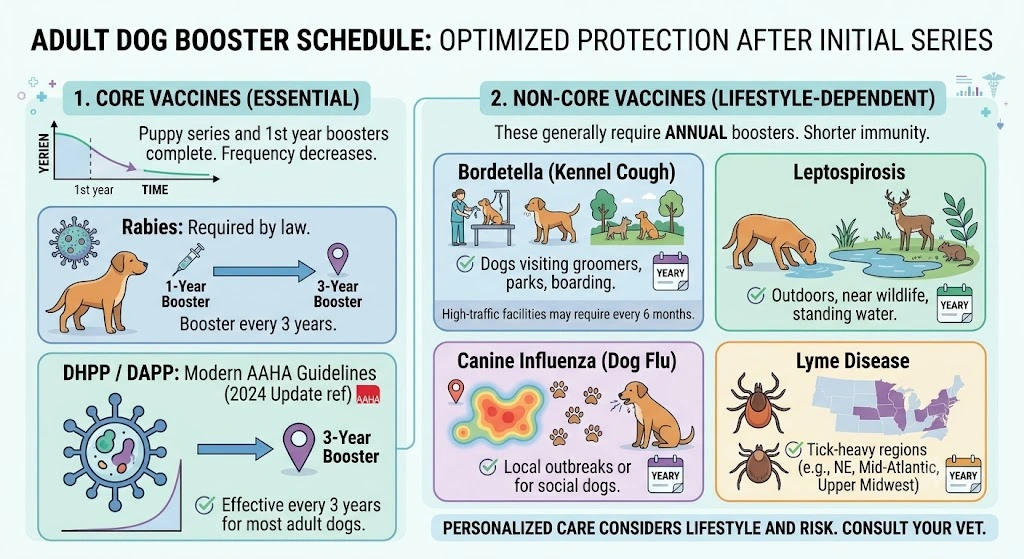
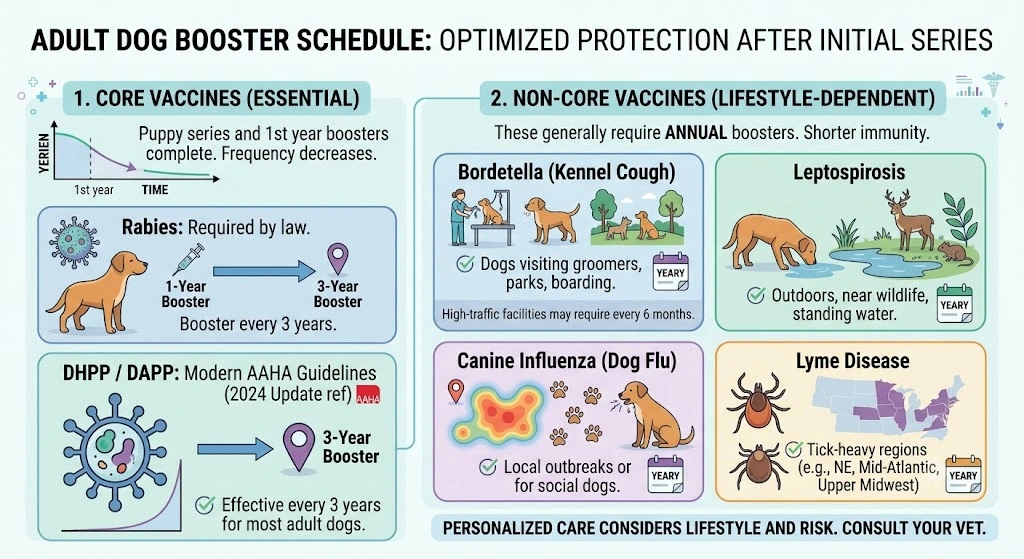
Once the puppy series and the 1-year boosters are complete, the frequency of shots typically decreases for core vaccines.
1. Core Vaccines (Essential)
- Rabies: Required by law in almost every state. After the 1-year booster, dogs typically receive a booster every 3 years.
- DHPP / DAPP: Modern guidelines from the AAHA (American Animal Hospital Association) suggest these are effective for every 3 years in most adult dogs.
2. Non-Core Vaccines (Lifestyle-Dependent)
These generally require annual (yearly) boosters because the immunity they provide doesn’t last as long as core vaccines:
- Bordetella (Kennel Cough): Recommended for dogs visiting groomers, parks, or boarding. Some high-traffic facilities may require this every 6 months.
- Leptospirosis: Crucial for dogs that spend time outdoors, near wildlife, or standing water.
- Canine Influenza (Dog Flu): Recommended during local outbreaks or for social dogs.
- Lyme Disease: Essential in tick-heavy regions (e.g., Northeast, Mid-Atlantic, and Upper Midwest).
Making a Smart Decision
Not every dog needs every shot. A “lifestyle-based” approach means a city dog living in a high-rise might skip the Lyme vaccine but absolutely needs Bordetella, whereas a rural dog frequenting the woods might prioritize Leptospirosis.
Titer Testing: If you are concerned about over-vaccination for an adult dog, you can ask your vet for a titer test. This blood test measures the level of existing antibodies in your dog’s system to determine if a booster is actually necessary for Distemper or Parvo. (Note: This cannot be used in place of the Rabies vaccine for legal requirements).
DHPP Vaccine for Dogs: What It Covers and When It Is Due
DHPP is the combination shot that does most of the work in the core dog vaccination schedule. One injection covers four diseases, which is why it appears three or four times on a puppy chart while rabies appears only once.
The letters stand for distemper, hepatitis (canine adenovirus), parainfluenza and parvovirus. Some clinics label the same vaccine DAPP or DA2PP, and the naming varies by manufacturer rather than by what is inside the vial. If your paperwork says something different from what you expected, ask the clinic which diseases the shot covers rather than assuming a different product was used.
Two of those four are the reason the puppy series exists at all. Parvovirus is highly contagious and can kill an unprotected puppy within days, and distemper can leave permanent neurological damage in dogs that survive it.
The timing follows maternal antibodies rather than the calendar. A puppy is born with borrowed immunity from its mother, and that immunity both protects the puppy and blocks the vaccine from taking hold.
Nobody can tell without testing exactly when that borrowed immunity fades, so the series repeats every two to four weeks until roughly 16 weeks, by which point it has almost certainly gone.
This is also why a puppy that has had “its shots” at eight weeks is not protected. The last dose in the series is the one that counts, and until it is given plus about two weeks, the puppy should stay away from dog parks, pet stores and any ground where unknown dogs have been.
For adults, AAHA’s guidance is a booster one year after the puppy series and then every three years, not annually. If your clinic still recalls adult dogs yearly for DHPP, it is reasonable to ask why — there may be a good local reason, and there may not be.
Rabies Shot for Dogs: The Law, the Timing and the Cost
The rabies shot for dogs is the one part of the dog vaccination schedule that is not a medical judgement call. Almost every U.S. state requires it by law, and the requirement sits with the owner, not with the veterinarian.
The usual timing is a first dose at 16 weeks or older, a booster one year later, and then either a one-year or a three-year vaccine depending on the product used and on what your state and county allow. The three-year vaccine is not a stronger shot; in most cases it is the same vaccine licensed for a longer interval.
Where the law bites is after an incident. If an unvaccinated dog bites someone, or is bitten by a wild animal, the options open to your family are far worse than they would be for a vaccinated dog — quarantine periods are longer, and in some jurisdictions the outcomes are much harder still.
A current rabies certificate is the document that keeps those decisions in your hands. Keep a photograph of it on your phone as well as the paper copy.
Travel and boarding are the other practical reason. Kennels, groomers, daycare, apartment buildings, airlines and international travel all ask for proof, and the CDC has its own rules for dogs entering the United States.
Cost is rarely the obstacle here. Rabies is typically one of the cheapest vaccines on the invoice, and many counties run low-cost rabies clinics precisely because public health depends on coverage rather than on who can afford it. If cost is a problem, call your county animal services before skipping the shot.
How Much Do Puppy Vaccines Cost in the U.S.?
Cost is the question owners ask last and worry about first. Prices vary widely by state, by clinic type and by whether vaccines are bundled into a puppy package, so treat the ranges below as a way to spot an outlier rather than as a quote.
Vaccine | Typical cost per dose | Doses in the first year |
|---|---|---|
DHPP / DAPP | $25 – $50 | 3 – 4 |
Rabies | $15 – $30 | 1, plus a booster at 12–16 months |
Leptospirosis | $20 – $40 | 2 |
Bordetella | $20 – $45 | 1 – 2 |
Canine influenza | $30 – $60 | 2 |
Lyme | $30 – $60 | 2 |
The exam fee is the part people forget. Most clinics charge roughly $50 to $80 for the visit itself, and a puppy needs three or four visits, so the appointments can cost as much as the vaccines do. Ask whether your clinic offers a puppy package that bundles the visits, and ask what it excludes.
Low-cost options are real and worth using. County rabies clinics, humane society vaccine days, shelter wellness clinics and some pet retail chains run vaccination services at a fraction of full-practice pricing, though they will not give you the same continuity of care.
Set against that, a single parvovirus hospitalization commonly runs into four figures and is not guaranteed to succeed. Completing the dog vaccination schedule is one of the few decisions in pet care where the cheap option and the right option are the same one.
Why the Dog Vaccination Schedule Matters More Than Owners Think
The biggest misunderstanding about dog vaccines is that risk only exists when a dog is obviously exposed to other sick animals. In reality, many infectious threats are tougher, sneakier, and closer to home than people realize.
A dog can be exposed on a routine walk, in a shared apartment hallway, at the groomer, in a boarding kennel, near standing water, or in a backyard visited by wildlife.
Rabies is the clearest example of why prevention matters. The CDC says pet owners can lower their risk by keeping pets up to date on anti-rabies vaccination and by keeping pets away from wild animals as much as possible.
The CDC also says preventing infected dogs from entering the United States is a public health priority and recommends that all dogs be vaccinated against dog rabies.
Then there is leptospirosis, often called “lepto,” which many owners still underestimate. AVMA explains that leptospirosis is a potentially life-threatening disease that dogs can catch from contaminated water, soil, or urine from infected animals, and it can also infect people.
That means a dog’s vaccine plan is not just about pet wellness. In some cases, it is part of family protection too.
Protecting Your Family: The Zoonotic Connection
Zoonotic disease means a disease which can spread between animals and people. That may sound technical, but the basic idea is simple: what affects a dog can sometimes affect the humans who live with that dog too.
Rabies is the most famous example. Because it can spread from infected animals to humans, rabies vaccination acts like a community shield as much as an individual pet vaccine. When a vaccinated dog has an encounter with a rabid animal, the outcome is very different from what it would be in an unvaccinated dog.
Leptospirosis matters for families in a different way, as it spreads from contaminated water or soil, infected dogs can create environmental contamination risks. AVMA notes that vaccinating dogs can help protect people from infection too.
Dog Vaccine Myths vs Reality
Myth 1: “My dog stays in a fenced yard, so the risk is low.”
A fence keeps a dog contained, but it does not keep disease out. Wildlife, contaminated soil, runoff water, and even other small animals can introduce infectious risks into a yard.
Myth 2: “My dog is indoors, so vaccines are not necessary.”
Indoor dogs are not sealed off from the outside world. People carry contamination on shoes, clothes, bags, and hands, and indoor dogs still go to the vet, use shared apartment spaces, and step outside for walks or bathroom breaks.
Myth 3: “Vaccines are more dangerous than the diseases.”
It is reasonable for owners to worry about side effects, but the balance of risk still strongly favors vaccination. The diseases being prevented can be severe or fatal, while serious vaccine reactions are much less common. AVMA specifically notes that leptospirosis vaccines are no more likely to cause side effects than other common vaccines.
Dog Vaccine Side Effects: What Is Normal and What Is Not
Most dogs do very well after vaccination. Some may be a little sleepy, less excited about a walk, mildly sore at the injection site, or less interested in food for a short period. That is often a normal sign that the immune system is responding.
A useful rule is the “24-hour lens.” Mild lethargy, slight soreness, and a temporary dip in appetite are usually expected and often pass quickly. These are the kinds of signs many dogs show after their immune system has been given new instructions.
Still, owners should know the warning signs that need prompt veterinary attention. Facial swelling, hives, repeated vomiting, diarrhea, collapse, or difficulty breathing are not normal post-vaccine reactions and should be treated seriously.
Knowing this difference helps reduce panic without ignoring real danger. That balance is important for owner confidence and for good decision-making.
What the Latest Science Says About Dog Vaccines
The latest guidance is not just telling owners to vaccinate. It is telling veterinarians to think more carefully about who needs what and when. The AAHA 2024 update emphasizes individualized vaccination based on immune status, risk exposure, and duration of immunity.
The most important change for many readers is the stronger recommendation around leptospirosis. AAHA now recognizes leptospirosis vaccination as core in North America, and expert consensus statements have recommended annual vaccination for all dogs starting at 12 weeks of age after an initial two-dose series.
AVMA client education materials say experts recommend all dogs be vaccinated against leptospirosis, beginning at 12 weeks of age, with two vaccinations spaced four weeks apart and annual boosters after that.
This matters because older internet advice often treated lepto as something only “farm dogs” needed. Newer evidence and guidance paint a different picture: the disease is broader, the public health implications are real, and routine discussion belongs in mainstream dog care.
A Practical Prevention Plan for Owners
Every dog is unique, and the best protection plan should be unique too. That does not mean the process has to be complicated. It simply means the plan should match the dog’s actual life.
A helpful way to approach the next vet visit, and to build the dog vaccination schedule around the dog you actually have, is to ask:
- Which vaccines are core for this dog right now?
- Which lifestyle vaccines fit this dog’s routine?
- Vaccination schedule for new puppies
- Which boosters are due, and when?
- What mild reactions are normal, and what symptoms mean the clinic should be called immediately?
That short conversation can prevent a lot of confusion. It can also save owners from relying on generic social media advice that does not reflect their dog’s age, environment, or health history.
If there is one action step worth taking today, it is this: check your dog’s records. Open the vet app, pull out the paperwork, or call the clinic and ask what is due. A few minutes of planning now can provide years of healthier, safer living later.
Why Vaccination Is an Investment in Longevity
It is easy to focus on the needle because it is the visible part of the appointment. But the true value of vaccination is what happens after that moment: fewer preventable diseases, lower emergency risk, stronger public health protection, and better odds that the dog remains a happy part of the family for years to come.
That is the big picture from the outline, and it still holds. Vaccination is not about overmedicalizing normal life. It is about proactive wellness—choosing prevention before a painful or expensive crisis forces the issue.
At Hi Good Health, the goal is to make this kind of information simple, credible, and useful. Families deserve guidance that cuts through myths, explains the science clearly, and helps them make practical everyday health decisions for the animals they love.
Key Takeaways
- The core dog vaccination schedule is DHPP at 6–8, 10–12 and 16–18 weeks, rabies at 16–18 weeks, and a booster for both at 12–16 months.
- The last dose in the puppy series is the one that counts. A puppy is not protected after its first shot and should avoid dog parks and shared ground until about two weeks after the final dose.
- Rabies is a legal requirement in almost every state, not a judgement call, and a current certificate is what protects your options if there is ever an incident.
- Leptospirosis is now core for North American dogs under AAHA’s 2024 update. Advice written before then is out of date.
- Adult core boosters are generally every three years, not annually. Non-core vaccines such as Bordetella, Lyme and canine influenza are yearly.
- A day of mild lethargy, soreness or reduced appetite is expected. Facial swelling, hives, repeated vomiting, collapse or difficulty breathing is not — call the clinic straight away.
- Which non-core shots your dog needs is decided by how it lives and where you live. Build the dog vaccination schedule with your own veterinarian rather than from a chart found online.
Frequently Asked Questions
What is the dog vaccination schedule for puppies in the U.S.?
Core shots are DHPP at 6–8 weeks, 10–12 weeks and 16–18 weeks, plus rabies at 16–18 weeks, followed by a booster for both at 12–16 months. Non-core vaccines such as Bordetella, leptospirosis, Lyme and canine influenza are added according to where the puppy lives and what it does. Your veterinarian sets the final schedule.
What does the DHPP vaccine for dogs cover?
DHPP protects against distemper, hepatitis (canine adenovirus), parainfluenza and parvovirus in a single injection. Some clinics label the same vaccine DAPP or DA2PP. Puppies need the full series because maternal antibodies can block earlier doses, and adults generally need a booster every three years rather than every year.
How often does a dog need a rabies shot?
A first dose at 16 weeks or older, a booster one year later, then every one or three years depending on the vaccine used and on state and county law. Rabies is a legal requirement in almost every U.S. state, so the interval is set by legislation as much as by medicine.
How much do puppy vaccines cost?
Expect roughly $25–$50 per DHPP dose, $15–$30 for rabies and $20–$60 for lifestyle vaccines, plus a $50–$80 exam fee for each of the three or four puppy visits. County rabies clinics and humane society vaccine days cost considerably less. Prices vary by state and clinic, so ask for a written estimate.
What are the side effects of dog vaccines?
Mild lethargy, soreness at the injection site and a smaller appetite for a day are expected and usually pass quickly. Facial swelling, hives, repeated vomiting, diarrhea, collapse or difficulty breathing are not normal and need veterinary attention straight away.
Do indoor dogs really need vaccines?
Yes. Indoor dogs still go to the vet, use shared building spaces and step outside for walks, and people carry contamination indoors on shoes and clothing. Parvovirus in particular survives in soil for months. Rabies is also a legal requirement regardless of whether a dog goes outdoors.
External sources
- CDC: Rabies Prevention and Control
- CDC: Information for Veterinarians | Rabies
- CDC: Bringing a Dog into the U.S.
- AAHA 2024 Update PDF: 2022 AAHA Canine Vaccination Guidelines (2024 Update)
- AAHA update on leptospirosis vaccine status
- AVMA: Leptospirosis in dogs
- Rabies Status by Country | Rabies | CDC
- https://www.aaha.org/resources/2022-aaha-canine-vaccination-guidelines/recommendations-for-core-and-noncore-canine-vaccines/
- Booster: A repeat vaccine dose used to refresh protection over time.
- Core vaccine: A vaccine recommended for most or all dogs because the disease risk is serious or broadly relevant.
- Distemper: A serious viral disease of dogs covered by core vaccination.
- Leptospirosis: A bacterial disease dogs can catch from contaminated water, soil, or urine; it can also infect people.
- Lifestyle vaccine: A vaccine recommended based on a dog’s activities, geography, or exposure risk.
- Parvovirus: A highly contagious viral disease that can be especially dangerous in puppies.
- Zoonotic disease: A disease that can spread between animals and humans.
This article is for educational purposes only and does not replace personalized veterinary advice. Vaccine decisions should always be made with a licensed veterinarian who can assess a dog’s age, medical history, local disease patterns, and lifestyle risk.
