Your Body Has a Deadline. Your Calendar Might Not.
You plan your career. Your finances. Your vacations. But most people spend more time researching a smartphone purchase than understanding the biological timeline that will determine whether — and how — they become a parent.
At a Glance
- Fertility declines on a biological timetable that rarely matches a life plan.
- The article starts with establishing your reproductive baseline, for men as well as women.
- Carrier screening comes before preservation, not after.
- How egg and sperm preservation actually works is set out step by step.
- Everyday factors quietly damaging reproductive health are named.
- The psychological side of preservation is covered, along with when to see a specialist.
Here is the uncomfortable truth: a woman is born with all the eggs she will ever have.
Egg quality begins declining in the late 20s — gradually, then sharply after 35. For men, sperm production continues throughout life, but sperm quality is quietly affected by diet, heat, stress, and chemical exposure long before most men think about it. Biology does not wait for life to be “ready.”
Fertility preservation — freezing eggs, sperm, or embryos — is not a last resort. It is proactive insurance. Egg freezing cycles in the U.S. have surged nearly 40% year-over-year as more people recognize the mismatch between biological and life timelines. (Source: Cofertility, 2025). Males and females should know the status of infectious and STD screening.
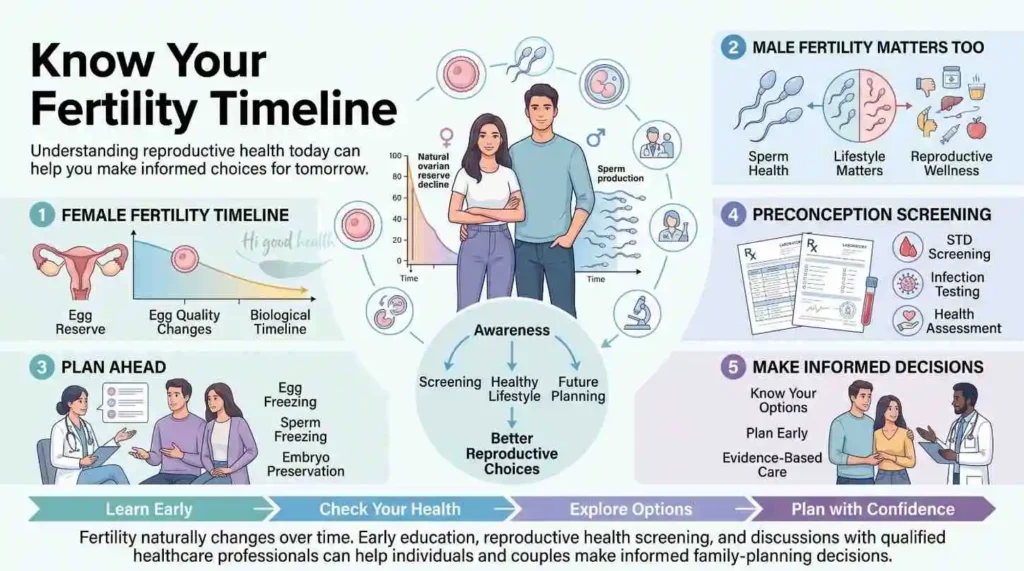
📌 Who this is for: Anyone in their late 20s to 30s not yet ready for parenthood. Anyone facing a medical treatment that could impair fertility. LGBTQ+ individuals planning future family paths. Men who have never considered that their reproductive health matters too. |
|---|
1. Know Where You Stand: Your Reproductive Baseline
Before deciding whether to preserve, you need to know what you are working with. A simple set of tests — most available through an OB-GYN or reproductive endocrinologist — gives you a clear snapshot.
For Women
Common Tests-
- AMH (Anti-Müllerian Hormone): A blood test that reflects the size of your remaining egg pool. Can be done at any point in your cycle. It is the most reliable single marker of ovarian reserve. (Source: ASRM, 2020)
- Antral Follicle Count (AFC): A quick ultrasound that counts small resting follicles in your ovaries. Normal range by age: 12–30 follicles in your 20s, dropping to 10–15 by your late 30s. Under 10 signals diminished reserve. (Source: Pacific Northwest Fertility, 2025)
- FSH + Estradiol (Day 3 blood test): Elevated FSH signals the brain is working harder to stimulate the ovaries — often an early indicator of declining reserve.
- TSH, Free T3 and Free T4 (Thyroid): Thyroid dysfunction is a correctable, often-missed cause of ovulatory problems. Should be part of every reproductive baseline screen.
- Prolactin – Elevated levels disrupt ovulation.
- LH & FSH – Helps diagnose PCOS or impending menopause.
- Progesterone (day 21) – Confirms ovulation.
Deep reproductive assessment tests –
- Transvaginal ultrasound (TVS) – For Ovarian & Uterine Structural Assessment, TVS helps to rule out fibroids, polyps, ovarian cysts, adenomyosis.
- Saline infusion sonography (SIS) or Hysteroscopy – Evaluate uterine cavity for adhesions, polyps, septum.
- HyCoSy (hysterosalpingo-contrast sonography) or HSG (hysterosalpingography) – Tubal Patency (if indicated it checks if fallopian tubes are open.
*Hormonal tests are critical and can be done first in some low-risk, younger patients with no symptoms. For comprehensive reproductive assessment—especially when planning late conception—ultrasound is equally important as a first-line tool, not an afterthought
For Men
- Semen analysis: Measures count, motility, and morphology. WHO 2021 reference: count ≥16 million/mL; total motility ≥42%; normal morphology ≥4%.
- Sperm DNA Fragmentation (DFI): Standard semen analysis can look normal while DNA inside the sperm is damaged — affecting fertilization and miscarriage risk. A 2025 study in Human Reproduction found a targeted 3-month supplement regimen reduced DFI by 37.9%. (Source: Human Reproduction, 2025)
Hormonal Profile (If semen analysis is abnormal)
- Testosterone (total & free) – Low levels reduce sperm production
- LH & FSH– Differentiates testicular failure (high FSH) from hormonal deficiency (low FSH/LH)
- Prolactin– Elevated levels can suppress testosterone
- Estradiol– High levels can impair spermatogenesis
Micronutrients — For Both Partners
- Vitamin D: Receptors are present in both ovarian follicles and sperm. A 2024 PMC study found low Vitamin D significantly increases sperm DNA fragmentation. Optimal reproductive levels: 40–60 ng/mL — well above the standard clinical “normal” of 20 ng/mL. (Source: PMC, 2024)
- Folate and B12: Critical for DNA synthesis in both eggs and sperm. Low levels increase chromosomal abnormalities and neural tube defect risk.
- Zinc and Selenium: Essential for sperm motility and testosterone synthesis. Deficiency is common and correctable.
⚡ Key insight: These tests are not treatments — they are information. Knowing your baseline lets you decide: freeze now, optimize first then freeze, or simply monitor. Acting without this information means making a major reproductive decision in the dark. |
|---|
2. Screen Before You Freeze: Carrier Screening as a Decision Point
Both should go for infectious and STD screening before making a knot.
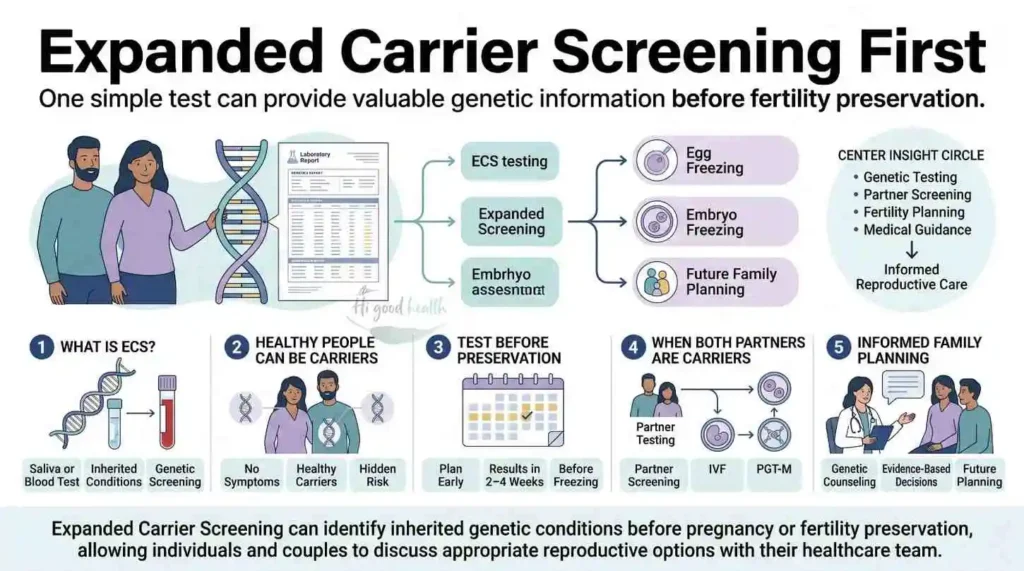
One of the most overlooked steps before preservation is Expanded Carrier Screening (ECS) — a single saliva or blood test that screens for 200–500 inherited conditions simultaneously.
Over 80% of babies born with serious inherited genetic diseases come from families with no known prior history. Both parents are healthy carriers, and the risk only becomes visible when two carriers conceive together.
Why does this matter before freezing? If you discover you are a carrier, a future partner can also be screened. If you are both carriers for the same condition, IVF with Preimplantation Genetic Testing (PGT-M) can select unaffected embryos before transfer — but only if embryos are available. Screening after freezing eggs (not embryos) closes that option.
ACOG recommends ECS for all individuals regardless of ethnicity or family history. Testing takes 2–4 weeks. Complete it before — not during — a preservation cycle. (Source: ACOG; Wiley Andrology, 2024)
3. How Preservation Actually Works
Egg Freezing: The Essentials
The process takes 2–3 weeks: 10–14 days of self-injected hormone medications to stimulate the ovaries to produce multiple eggs simultaneously; a 20–30 minute outpatient retrieval under light sedation; then vitrification — ultra-rapid flash-freezing that achieves ~89% post-thaw egg survival rates, compared to under 60% with older techniques. (Source: US Fertility, 2025)
Costs in the U.S.: $10,000–$15,000 per retrieval cycle, plus $3,000–$6,000 for medications, and $500–$1,000/year for storage. Most reproductive endocrinologists recommend banking 10–15 mature eggs for a reasonable probability of at least one live birth.
Age at Freezing | Approx. Live Birth Rate per Egg |
|---|---|
Under 35 | 5–7% |
35–37 | 3–5% |
38–40 | 2–4% |
Over 40 | 1–2% |
Sperm Banking: Simple, Fast, Chronically Underused
Collection across 2–3 sessions. Processing and cryo-storage cost $300–$1,000 upfront; $200–$500/year to store. The entire process takes under two weeks. Men who should consider it proactively: those facing cancer treatment, military deployment, occupational heat or toxin exposure, or simply in their late 30s without a clear parenthood timeline.
4. Your Choices Today Shape Your Child’s Biology: The Epigenetics Factor
Smoking, junk food, and alcohol damage both male and female fertility by harming gamete quality and inducing epigenetic changes—altered DNA methylation and RNA profiles in eggs and sperm that can be passed to offspring.
In females, they disrupt egg maturation, ovulation, and mitochondrial function; in males, they lower sperm count, motility, and increase DNA fragmentation. These epigenetic modifications mean the negative effects can extend beyond the individual to future generations. (Source -Progress in Biophysics and Molecular Biology, volume 118, 2015)
Sperm take ~72 days to fully mature. Eggs undergo their final maturation in the months before ovulation. This creates a critical 90-day preconception window — what both parents eat, how they sleep, what toxins they are exposed to, and how stressed they are leaves epigenetic marks on their reproductive cells that may directly influence a child’s long-term health.
This is not speculative. A 2025 review in Clinical Epigenetics synthesized evidence that a father’s diet, body weight, stress, and chemical exposures alter sperm DNA methylation patterns in ways linked to adverse health outcomes in offspring.
A 2024 Nature study found that a father’s diet before conception can alter epigenetic marks in sperm that influence offspring testosterone levels — a direct intergenerational biological pathway. (Source: News-Medical/Clinical Epigenetics, 2025; Nature, 2024)
The takeaway is not that perfect health is required before conception. It is that the 90-day preconception window is a high-leverage moment — for both partners — that most healthcare systems do not adequately highlight.
5. What Is Quietly Damaging Your Reproductive Cells
Endocrine Disruptors (EDCs)
BPA (found in plastic food containers and can linings), phthalates (in flexible plastics and fragrances), PFAS (“forever chemicals” in non-stick cookware), and pesticides are now documented to impair both egg quality and sperm parameters.
Practical reductions: switch to glass or stainless food storage; avoid heating food in plastic; choose fragrance-free personal care products; opt for organic produce for high-pesticide crops. (Source: Remembryo, 2024; Natural Womanhood, 2025)
Heat (For Men)
Healthy sperm production requires the testes to stay ~2–4°C below core body temperature. Chronic heat exposure — from laptops on the lap, frequent hot tubs, tight underwear, or certain occupations — impairs sperm count and DNA integrity. Many of these are easily fixed.
6. The Conversation Nobody Has: Psychological and Financial Planning
Reproductive Life Planning (RLP)
Recommended by both the CDC and ACOG, RLP is simply a structured conversation — with yourself or a partner — about whether, when, and how you want children. Most people have never had it explicitly. The answers directly shape which preservation decisions are relevant to you.
The Real Financial Picture
Cost is a documented barrier — a 2024 PubMed study found financial concerns were a primary driver of preservation delays. (Source: PubMed, 2024) What helps:
- Check your employer benefits: A growing number of U.S. employers — particularly in tech, finance, and healthcare — now offer fertility benefits of $5,000–$40,000 lifetime coverage. Check your HR portal explicitly for “fertility” or “family planning benefits” before assuming you have no coverage.
- FSA/HSA: Fertility preservation expenses, including medications, may be eligible for pre-tax reimbursement through a Flexible Spending Account or Health Savings Account.
- Medical financing: Fertility-focused lenders (CapexMD, Prosper Healthcare Lending) offer loans specifically for ART procedures.
7. The Technology That Is Changing What’s Possible
Fertility technology has transformed rapidly. Three developments worth knowing:
- Digital cycle tracking: FDA-cleared wearables (e.g., Tempdrop, Natural Cycles) track basal body temperature to identify the precise fertile window and confirm ovulation. At-home LH surge tests, combined with cycle apps, can identify irregular patterns worth investigating before a problem becomes serious.
- PGT-A and PGT-M: For those moving to IVF: PGT-A screens embryos for chromosomal abnormalities (the leading cause of failed transfers and miscarriage); PGT-M tests for a specific inherited mutation identified through carrier screening. Together, these tools significantly improve IVF success rates, especially after 35.
- AI-assisted embryo selection: Several leading U.S. clinics now use time-lapse AI analysis of embryo development to identify which embryos have the highest implantation potential. Evidence is promising; large-scale RCT data continues to accumulate.
Should You Preserve? A Quick Decision Guide
- In your late 20s–early 30s, not ready yet: Get your AMH and AFC tested as a baseline. Age-appropriate results may mean monitoring is sufficient for now. Lower-than-expected AMH suggests preserving sooner is smarter.
- Facing cancer treatment: This is an oncofertility emergency. Preserve before chemotherapy or radiation begins. Expedited cycles are available.
- Have PCOS, endometriosis, or diminished ovarian reserve: Consult a reproductive endocrinologist now. Serial AMH testing tracks your rate of decline and helps time preservation optimally.
- LGBTQ+ planning future family paths: Preserving your own gametes now expands your future options significantly, regardless of the path you eventually choose.
- A man who has never thought about this: Start with a semen analysis — fast, inexpensive, and informative. If you are in your late 30s or in a high-risk occupation, banking is low-burden, high-value insurance.
- Approaching 35 with an uncertain timeline: This is the key decision window. Live birth rates from frozen eggs begin declining meaningfully after 35.
When to See a Specialist
- Reproductive endocrinologist: AMH below age-expected range; AFC under 10; approaching 35 without a clear parenthood timeline; any medical condition affecting fertility.
- Genetic counselor: Positive carrier screening result; family history of inherited disease; considering embryo banking with PGT-M.
- Registered dietitian or integrative specialist: Micronutrient deficiencies on baseline testing; seeking preconception nutrition guidance.
“The best time to ask these questions is before you need the answers.” — HiGood Health Reproductive Wellness Series
Key Takeaways
- Baseline testing tells you whether preservation is urgent or optional.
- Success rates depend heavily on age at freezing, not age at use.
- Storage costs are ongoing and worth understanding before you start.
- Men have a biological clock too, and it is routinely ignored.
- A fertility specialist should guide any decision here.
Frequently Asked Questions
1. What tests tell me where my fertility stands right now?
For women, AMH is a blood test reflecting the remaining egg pool and can be done at any point in the cycle; it is the most reliable single marker of ovarian reserve. Antral Follicle Count is a quick ultrasound: 12–30 follicles in your 20s, dropping to 10–15 by your late 30s, and under 10 signals diminished reserve. For men, semen analysis measures count, motility and morphology against the WHO 2021 reference of ≥16 million/mL, ≥42% total motility and ≥4% normal morphology.
2. Why does carrier screening come before freezing rather than after?
Expanded Carrier Screening lets unaffected embryos be selected before transfer — but only if embryos are available. Screening after freezing eggs rather than embryos closes that option. ACOG recommends ECS for all individuals regardless of ethnicity or family history, and testing takes two to four weeks, so it should be completed before a preservation cycle rather than during one.
3. How does egg freezing actually work, and how long does it take?
The process takes two to three weeks: 10–14 days of self-injected hormone medications to stimulate the ovaries, a 20–30 minute outpatient retrieval under light sedation, then vitrification — ultra-rapid flash-freezing that achieves around 89% post-thaw egg survival, compared with under 60% using older techniques.
4. What does egg preservation cost in the United States?
Roughly $10,000–$15,000 per retrieval cycle, plus $3,000–$6,000 for medications and $500–$1,000 a year for storage. Most reproductive endocrinologists recommend banking 10–15 mature eggs, which for some people means more than one cycle.
5. Can a normal semen analysis still miss a problem?
Yes. A standard semen analysis can look normal while the DNA inside the sperm is damaged. Sperm DNA Fragmentation testing measures that damage, which affects both fertilisation and miscarriage risk, so it is a separate question from count, motility and morphology.
6. Does what I do in the months before conception really matter?
Sperm take about 72 days to fully mature and eggs undergo their final maturation in the months before ovulation, which creates a critical 90-day preconception window. Smoking, alcohol and poor diet harm gamete quality and induce epigenetic changes in eggs and sperm. Low vitamin D significantly increases sperm DNA fragmentation; the optimal reproductive range of 40–60 ng/mL sits well above the standard clinical “normal” of 20 ng/mL.
Glossary
- AMH: Anti-Müllerian Hormone — blood marker reflecting remaining egg pool size.
- AFC: Antral Follicle Count — ultrasound count of resting follicles; key ovarian reserve indicator.
- DFI: Sperm DNA Fragmentation Index — measures DNA damage in sperm, independent of standard semen parameters.
- DOHaD: Developmental Origins of Health and Disease — the science linking preconception and prenatal environment to offspring health.
- EDCs: Endocrine-Disrupting Chemicals — substances that interfere with hormonal signaling and impair reproductive health.
- ECS: Expanded Carrier Screening — screens for 200–500 inherited conditions from one saliva or blood sample.
- Epigenetics: How environmental factors influence which genes are expressed, without changing DNA sequence.
- PGT-A / PGT-M: Preimplantation Genetic Testing — screens embryos for chromosomal errors (A) or a specific mutation (M) before transfer.
- Vitrification: Ultra-rapid flash-freezing technique; the gold standard for egg and embryo preservation.
Sources
- ASRM — Testing and Interpreting Measures of Ovarian Reserve (2020). asrm.org
- ASRM — Optimizing Natural Fertility (2022). asrm.org
- ASRM — Fertility Preservation in Patients with Medical Indications (2026). asrm.org
- ACOG — Carrier Screening for Genetic Conditions. acog.org
- Pacific Northwest Fertility — Guide to Antral Follicle Count (2025). pnwfertility.com
- PMC — Vitamin D and Sperm DNA Fragmentation (2024). ncbi.nlm.nih.gov/articles/PMC12377413
- Human Reproduction — Nutraceutical Supplementation and Sperm DNA Integrity (2025). academic.oup.com/humrep
- Clinical Epigenetics / News-Medical — Paternal Lifestyle and Sperm Epigenetics (2025). news-medical.net
- Nature — Pre-Conceptional Paternal Diet and Offspring Testosterone (2024).
- ScienceDirect — The Paternal Contribution to Future Generations Health (2024). sciencedirect.com
- Remembryo — Endocrine Disruptors and Fertility (2024). remembryo.com
- Natural Womanhood — EDCs and Male Fertility (2025). naturalwomanhood.org
- PubMed — Financial Costs and Fertility Preservation Decisions (2024). pubmed.ncbi.nlm.nih.gov/38294823
- Wiley Andrology — Carrier Screening and PGT (2024). onlinelibrary.wiley.com
- Cofertility — State of Egg Freezing 2025. cofertility.com
- US Fertility — Egg Freezing Outcomes 2025. usfertility.com
⚠️ Disclaimer: This article is for general health education only and does not constitute medical advice, diagnosis, or treatment. Always consult a qualified reproductive endocrinologist, genetic counselor, or licensed healthcare provider before making any decisions. Statistical figures represent population-level estimates and should not be interpreted as guarantees of individual outcomes. HiGood Health does not endorse any specific clinic, product, or service referenced in this article.
