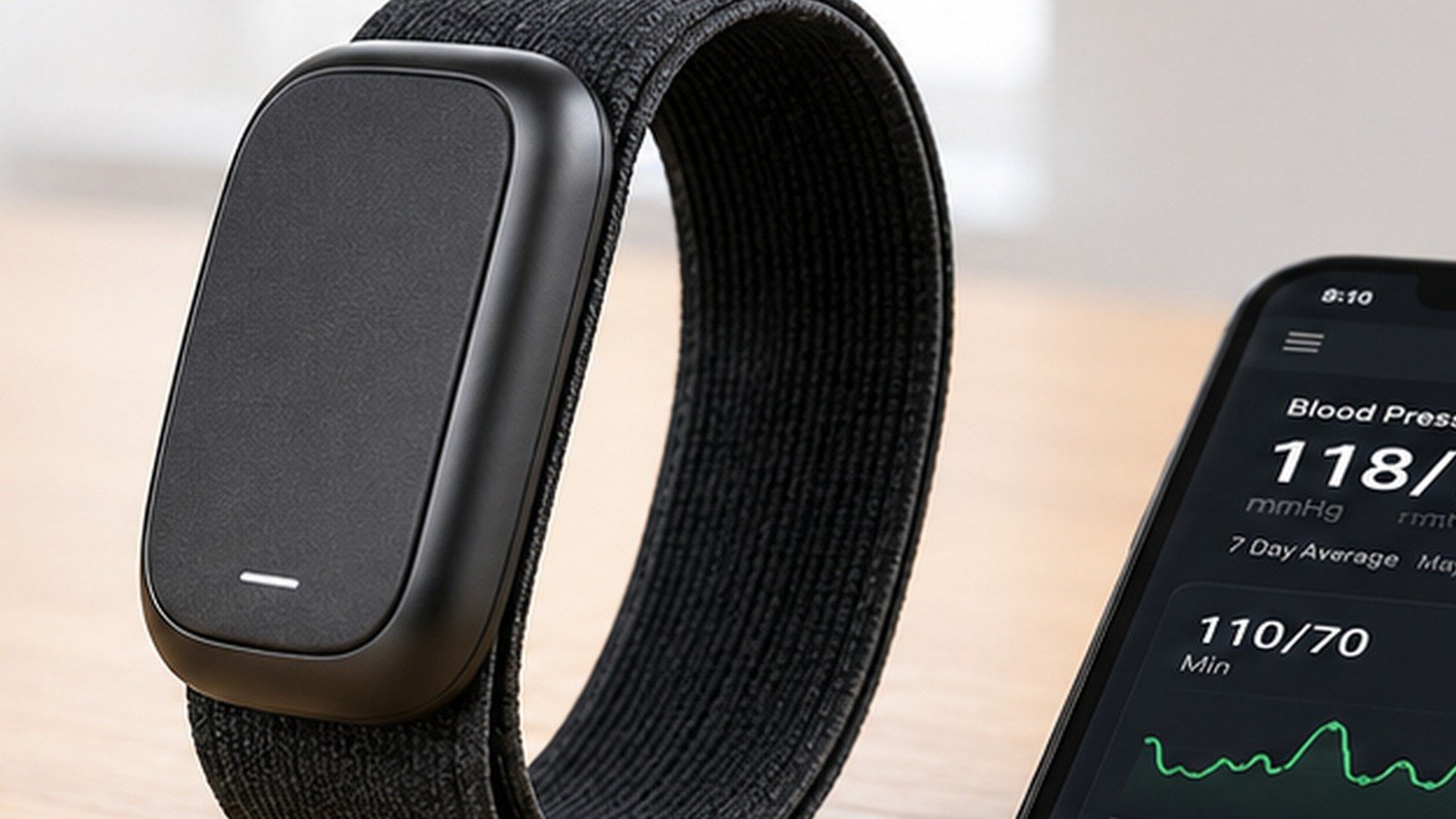
The Hilo band is no longer a device you have to wait for. It went on sale in the United States on 21 July 2026, and it is the first cuffless blood pressure wearable most American buyers can actually walk up and purchase.
This review covers what you get for the money, what the FDA did and did not clear, and where a wrist-worn monitor genuinely helps — and where it does not. For the wider category, see our guide to home blood pressure monitoring.
At a glance
The Hilo band went on sale in the United States on 21 July 2026, through hilo.com and Amazon. Hilo Core is $89.99 for the hardware plus a $149.99 annual subscription, which is $239.98 in the first year, and it is HSA and FSA eligible. The box holds the band, an upper-arm cuff for monthly calibration, and the app.
It reads blood pressure from the wrist using optical sensors, taking 30 to 35 readings a day without inflating anything, and it is designed to be worn around the clock. The cuff in the box is not optional: the band has to be recalibrated against it about once a month.
The FDA clearance is not what most buyers assume. Hilo states plainly that Hilo Core is a general wellness product in the United States — not FDA-cleared as a medical device. The cleared device is the Aktiia G0 system, from the same team and the same technology.
So it does not replace a cuff. Use it for patterns across days and weeks, and confirm anything unusual with a validated upper-arm cuff before you or your doctor act on it.
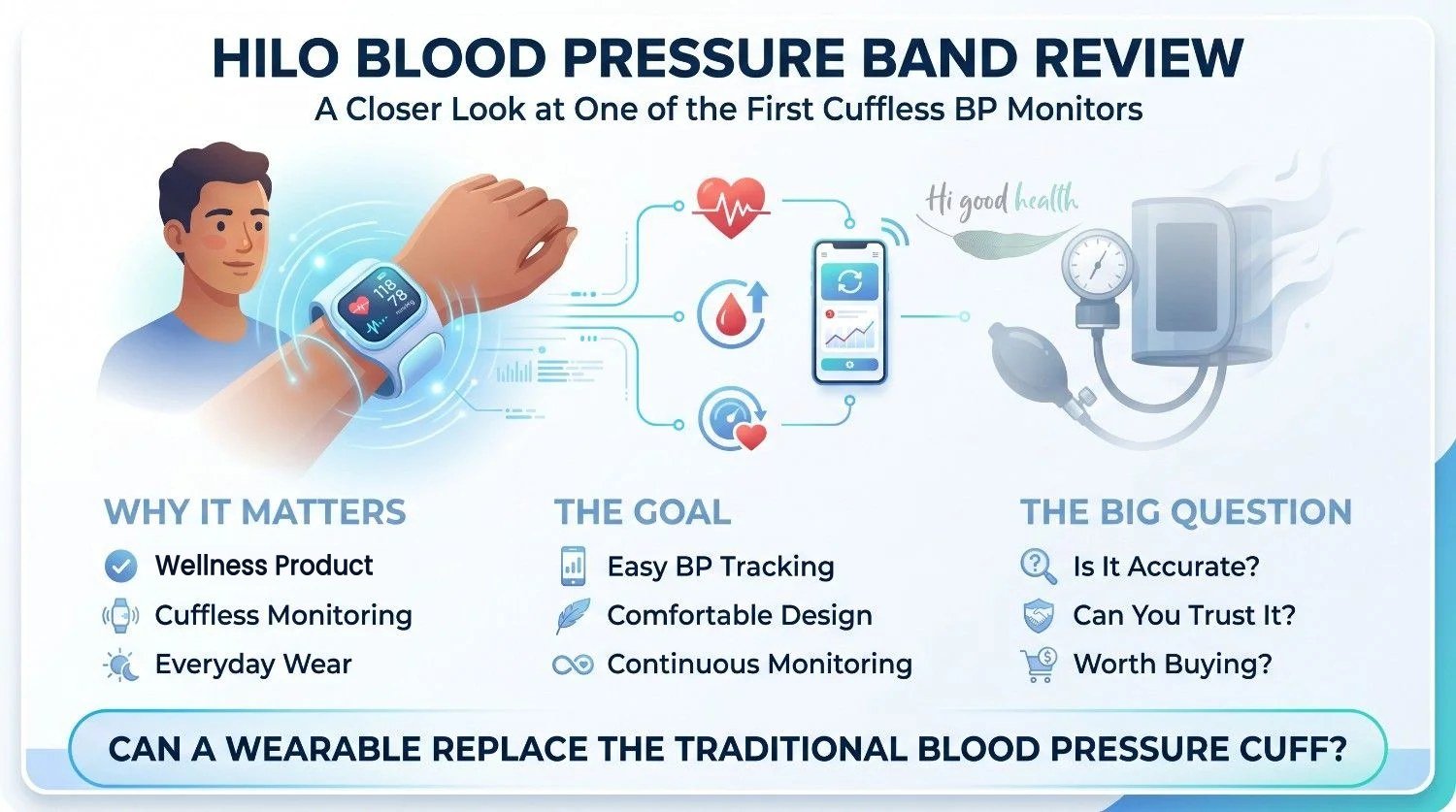
What You Can Buy Today: Hilo Core, Price and Availability
Hilo Core went on sale in the United States on 21 July 2026. It is sold direct at hilo.com and through Amazon.
The pricing is split, and it is worth understanding before you buy. The hardware — the Hilo band and its connected upper-arm cuff — is $89.99.
The app and the pattern analysis that make the band useful run on a $149.99 annual subscription. First-year total: $239.98. The system is HSA and FSA eligible, which for many US buyers takes the sting out of it.
The subscription is not a nice-to-have. The band is screen-free by design: it has no display and shows you nothing on its own. Everything you actually see happens in the app.
In use, the band is worn continuously, day and night, and takes roughly 30 to 35 readings a day using optical sensing at the wrist. Once a month you put on the supplied cuff, take three conventional readings, and the app recalibrates the band for the next month. That monthly step is mandatory, not optional.
One practical limitation worth knowing: the smartphone camera-based measurement feature does not work on every handset, and at launch it did not support iPhone 17 Pro models. Check your phone before you buy.
Is the Hilo Band FDA-Cleared? The Distinction That Matters
This is the question we get asked most, and the honest answer is more interesting than a simple yes or no.
In July 2025 the FDA cleared the Aktiia G0 Blood Pressure Monitoring System — the first over-the-counter cuffless blood pressure device cleared in the United States. That was a genuine milestone, and it is the achievement almost every article about this technology refers to.
But the product you can buy in the US today is Hilo Core, and Hilo’s own position is explicit.
In their words: “Hilo Core is a general wellness product in the United States — not FDA-cleared as a medical device.” It operates under the FDA’s General Wellness guidance for low-risk products, and Hilo state it is not intended to diagnose, cure, mitigate, treat or prevent any disease.
Both things are true at once. The cuffless technology inside Hilo Core is the same technology that underpins the cleared Aktiia G0. The upper-arm cuff in the box was validated in peer-reviewed research. But the integrated system you buy is sold as a wellness product, not a cleared medical device.
Why this matters: if you are managing diagnosed hypertension and you are buying on the strength of “FDA-cleared”, you should know exactly what that phrase attaches to.
It does not change whether the band is useful. It does change what you should rely on it for — and it means your treatment decisions still belong with a validated cuff and your doctor.
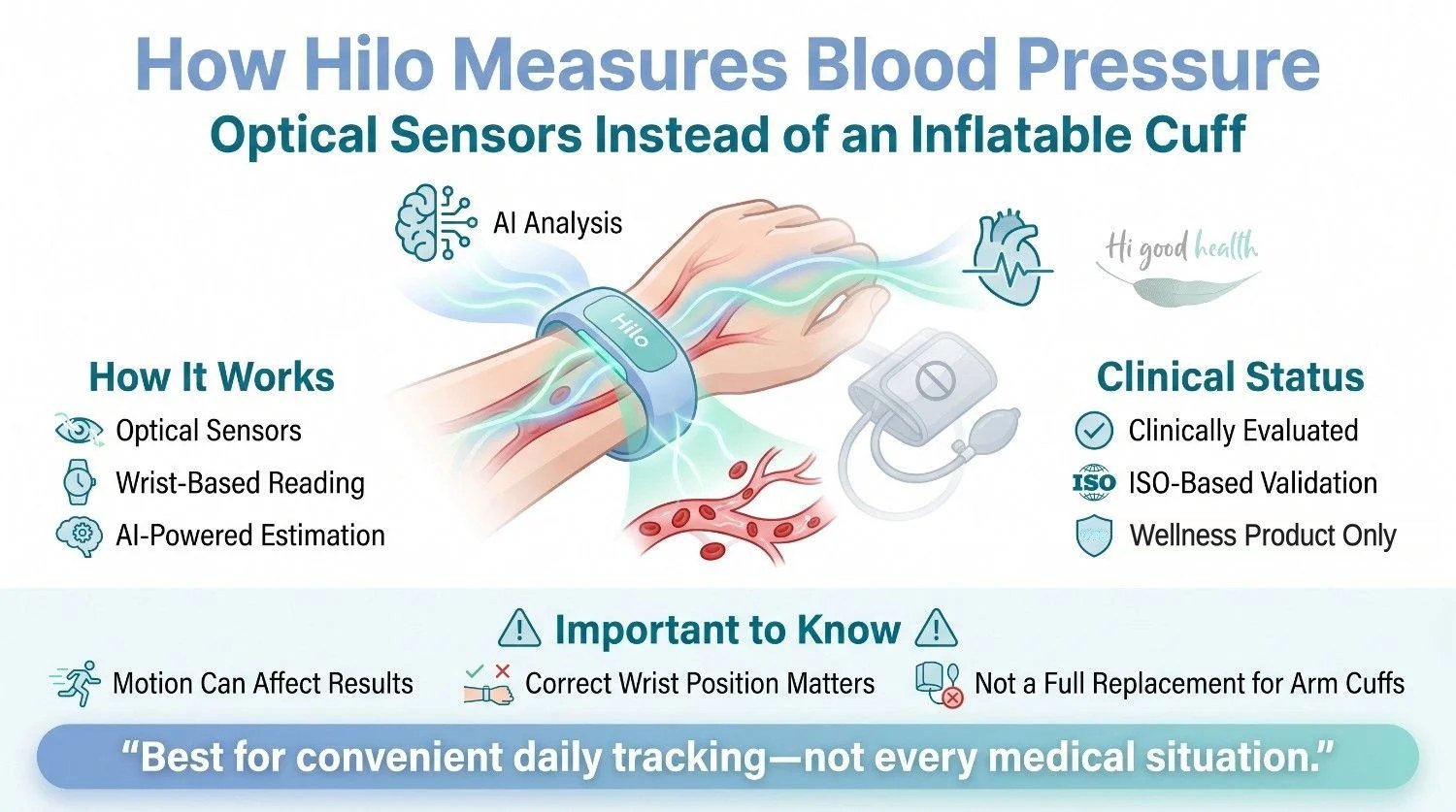
How the Hilo Band Works
The Hilo band uses optical sensing and software to estimate blood pressure from the wrist, rather than inflating a cuff around the arm. Aktiia reports validation across eight clinical studies against ISO 81060-2 reference methods, the same standard used for traditional monitors, and says more than 200,000 people are using the system globally.
There is a real caveat in that, and it is not Aktiia’s fault: the internationally accepted validation frameworks were written for cuff-based devices. Standards designed specifically for cuffless technology are still being developed.
The American Heart Association’s position is worth reading before you buy. Cuffless devices can be influenced by motion, body position, sensor placement, and pressure changes caused by gravity. The AHA does not consider them ready to replace standard cuff-based devices in every situation.
What Makes the Hilo Band Different
Most wearables track general wellness data. The Hilo band is trying to do something narrower: make blood pressure tracking comfortable enough that people actually keep doing it. The best monitor is usually the one that does not end up in a drawer.
There is some evidence behind that framing. In a study of more than 30,000 users of the European version of the app, greater engagement was associated with up to fivefold greater reductions in systolic blood pressure over six months compared with less engaged users.
That is an association rather than proof that the device causes the improvement. The finding is relevant because it suggests that frequent monitoring and user engagement may be associated with better blood-pressure trajectories, but it does not yet establish that cuffless monitoring itself improves hypertension control.
A randomized trial would be needed to determine whether the technology produces a clinically meaningful benefit beyond usual home monitoring and care.
What the Evidence Says
The strongest argument for Hilo is that it is not a startup concept. The system has been through eight clinical studies, is CE-marked as a class IIa medical device in Europe, and its cuffless technology cleared the FDA’s bar for over-the-counter use in the Aktiia G0.
The honest counterweight: researchers have not yet shown that using a cuffless monitor leads to better cardiovascular outcomes than established approaches. Whether these devices improve hypertension control, reduce cardiovascular events, or meaningfully improve long-term adherence is still an open question.
Who the Hilo Band May Help Most
It suits people who want day-to-day awareness of their blood pressure without the friction of repeated cuff checks, and who care about trends over weeks rather than single numbers. If you are the kind of person who bought a cuff and stopped using it by week two, that is exactly the problem this is designed for.
It is a poor fit if you need a device for diagnosis, or if you are making treatment decisions from individual readings. For those, a validated upper-arm cuff or ambulatory monitoring remains the safer standard.
What to Be Careful About
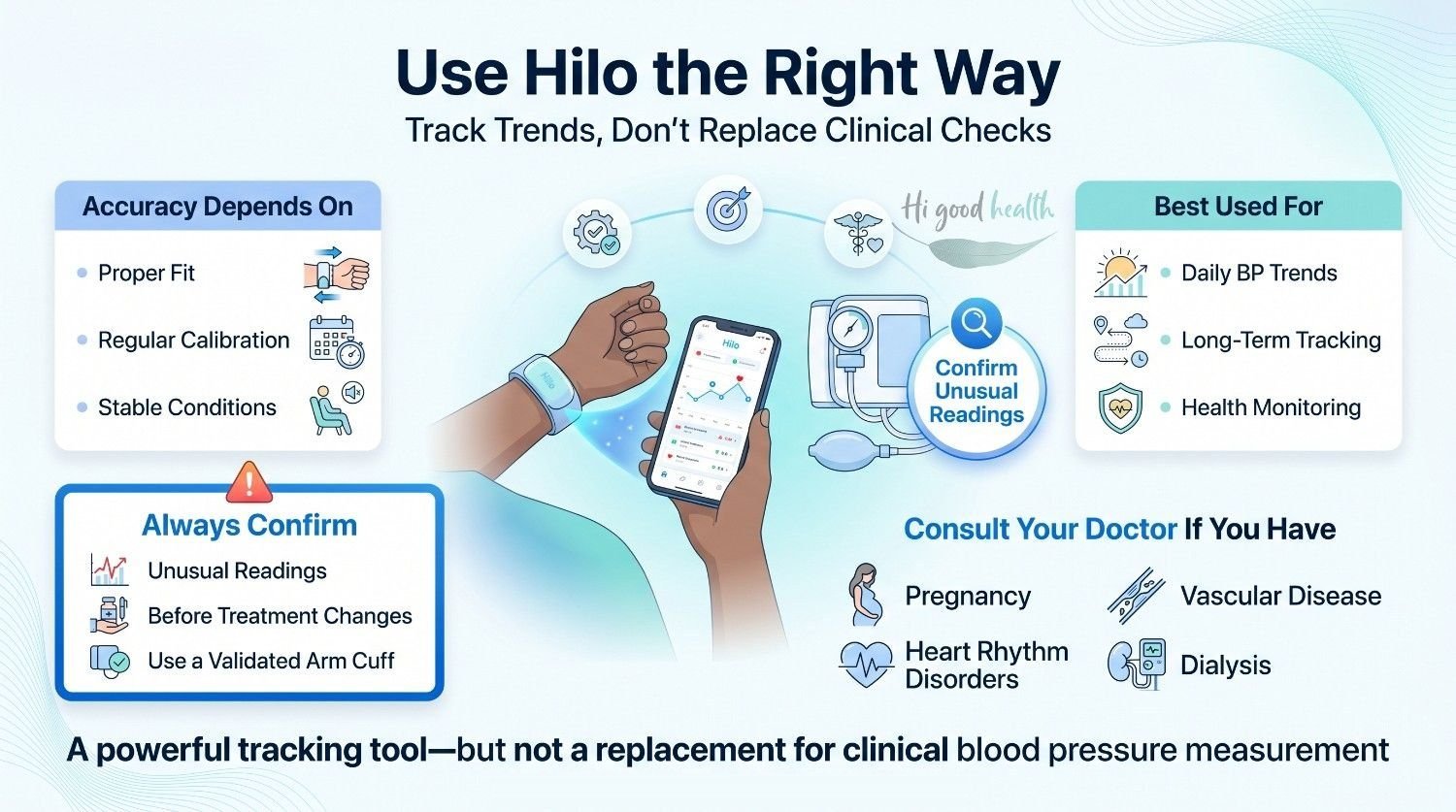
The biggest mistake is assuming a regulatory clearance means accurate in every setting. Accuracy still depends on correct wear, on keeping up the monthly calibration, and on reasonably stable conditions.
How much accuracy drifts between calibrations is genuinely unresolved for every cuffless device. Vascular aging, medication changes, illness and other shifts in cardiovascular physiology can all affect performance, which is why the monthly recalibration exists and why it matters that you do it.
Evidence is more limited in certain groups — pregnant people, those with significant cardiac arrhythmias, advanced vascular disease, and people undergoing dialysis. If you are in one of those groups, talk to your healthcare team before relying on cuffless readings.
Why This Matters for Readers
For people with hypertension, the hard part is not taking a reading. It is taking enough readings, often enough, to see a pattern. A device comfortable enough to wear daily closes that gap in a way a cuff in a cupboard never will.
Can Your Smartwatch Measure Blood Pressure?
Short answer: no smartwatch on general sale gives you a blood pressure reading. This is one of the most common misunderstandings in wearable health, and it is worth being precise about.
Apple Watch does not measure blood pressure. There is no systolic or diastolic number, on any model. What newer models offer is hypertension notifications — the optical sensor looks for patterns consistent with chronic high blood pressure across 30-day windows and may prompt you to get checked.
Apple states it is not intended to diagnose, treat, or aid in the management of hypertension. It requires Series 9 or later or Ultra 2 or later, you must be 22 or over, not pregnant, and not already diagnosed with hypertension.
Samsung will show a number, but only after you calibrate against a real cuff, and with regional and phone-pairing restrictions. Whoop and similar bands give trend estimates rather than readings.
A quiet watch is not an all-clear. Pattern detection of this kind misses a substantial share of people who do have high blood pressure, so a notification you never receive is not evidence that your blood pressure is fine.
If you want numbers rather than nudges, you need either a cuff or a device like the Hilo band that is built for the job. For a wider look at what these devices do and do not deliver, see our review of wearable health tech for seniors and our guide to wearable sleep tech.
Beyond Hilo: Why Wearable Blood Pressure Monitoring Is Becoming a Bigger Story
Hilo is not the only company rethinking how blood pressure is measured. Several wearable technologies are moving beyond wellness tracking and into regulated medical use.
One example is CART, a ring-based monitoring platform from South Korean company Sky Labs. In 2026 it received approval from the UK’s Medicines and Healthcare products Regulatory Agency, following CE-MDR certification in Europe earlier that year. Unlike consumer fitness trackers, CART is positioned as a medical device for use within healthcare systems.
The interesting question is not whether wearables replace cuffs. It is whether they get more people monitoring consistently, and give clinicians a fuller picture of what someone’s blood pressure actually does across a week rather than in a single clinic visit.
Our Practical Take
The Hilo band is the most interesting blood pressure wearable you can buy in the US right now. The convenience is real, the validation story is better than most cuffless devices, and at $89.99 up front the barrier to trying it is low.
Two things keep it from being a straightforward recommendation. The subscription roughly triples the first-year cost, and the product you buy is sold as a wellness device rather than a cleared medical one. Neither is disqualifying. Both should be known before you spend.
Treat it as a smarter daily companion, not a replacement for proper clinical monitoring. It is not the end of blood pressure cuffs.
Key Takeaways
The Hilo band has been on sale in the US since 21 July 2026 at $89.99, plus a $149.99 annual subscription that is required for the system to work. It takes 30–35 wrist readings a day and needs a monthly recalibration with the supplied cuff; skip that and accuracy degrades.
Hilo Core is sold as a general wellness product, not an FDA-cleared medical device. The cleared device is the Aktiia G0 system, from the same team and the same technology.
Engagement with the app was associated with up to fivefold greater systolic reductions over six months in a 30,000-user study — an association, not proof of causation. And no smartwatch on general sale measures blood pressure: Apple Watch gives hypertension notifications over 30-day windows, not readings.
For diagnosis and any medication decision, a validated upper-arm cuff remains the standard. Confirm unusual readings before acting on them.
Frequently Asked Questions
1. Is the Hilo band available in the US right now?
Yes. Hilo Core launched in the United States on 21 July 2026 and is sold through hilo.com and Amazon. The system costs $89.99 for the hardware plus a $149.99 annual subscription, which is $239.98 for the first year. It is HSA and FSA eligible.
2. How much does the Hilo band cost?
$89.99 for the band and cuff, plus $149.99 a year for the subscription that runs the app and the pattern analysis. The subscription is not optional — the hardware does not work as a standalone device without it. Prices are as at the July 2026 US launch.
3. Is Hilo Core FDA-cleared?
Not as sold in the US today. Hilo’s own words are that “Hilo Core is a general wellness product in the United States — not FDA-cleared as a medical device.” What the FDA cleared, in July 2025, was the Aktiia G0 Blood Pressure Monitoring System — built by the same team, using the same cuffless technology.
4. Can the Hilo band replace my regular blood pressure cuff?
No. It is a trend-monitoring tool. A validated upper-arm cuff remains the standard for diagnosis and for any decision about medication. If a reading looks unusual, confirm it with a cuff before acting on it.
5. How accurate is the Hilo band?
Aktiia reports validation across eight clinical studies against ISO 81060-2 reference methods. The American Heart Association’s position is more cautious: cuffless devices can be affected by movement, body position, sensor placement and gravity, and the validation standards themselves were written for cuff-based devices. Treat it as directionally useful for patterns, not authoritative for single readings.
6. Do I need to calibrate the Hilo band?
Yes, monthly. The supplied cuff takes three conventional readings and recalibrates the band for the following month. Skipping it degrades accuracy, and how much accuracy drifts between calibrations is still an open question for every cuffless device on the market.
7. Who should not rely on a cuffless monitor?
Evidence is more limited for pregnant people, those with significant cardiac arrhythmias, advanced vascular disease, and people on dialysis. If you are in one of those groups, speak to your healthcare team before using cuffless readings to manage your condition.
Glossary
- Cuffless BP: blood pressure measurement without a traditional arm cuff.
- FDA cleared: reviewed by the US Food and Drug Administration for a specific intended use.
- General wellness product: an FDA category for low-risk products that support general health and are not intended to diagnose or treat disease.
- ISO 81060-2: a clinical validation standard used for blood pressure monitors.
- PPG: photoplethysmography, a light-based method of detecting blood flow changes.
- Ambulatory BP monitoring: blood pressure measured over a full day, usually with a wearable cuff.
- White coat hypertension: blood pressure that rises in medical settings because of anxiety.
Related Reading
- Our guide to home blood pressure monitoring — the wider cuffless category.
- Our review of wearable health tech for seniors — what these devices deliver and what they do not.
- Our guide to wearable sleep tech — the same questions, applied to sleep.
Disclaimer
This article is for educational purposes only and does not replace medical advice. Always confirm high or unusual blood pressure readings with a validated monitor, and consult a qualified healthcare professional before changing any treatment. Prices and availability are as at the July 2026 US launch and may change.
References and Source Links
- Hilo: Is Hilo Core FDA-cleared?
- Aktiia: Hilo Band becomes first cuffless blood pressure monitor cleared by FDA for OTC use
- American Heart Association: Cuffless Devices for the Measurement of Blood Pressure
- Cuffless Devices for the Measurement of Blood Pressure: A Scientific Statement From the American Heart Association
- Hilo science page
HiGoodHealth Mission
At HiGoodHealth, the goal is simple: share clean, credible health information in plain language, bust myths, and help readers make smarter choices for themselves and their families. We also aim to spotlight useful innovations from around the world while keeping the advice practical, balanced, and easy to understand.
