
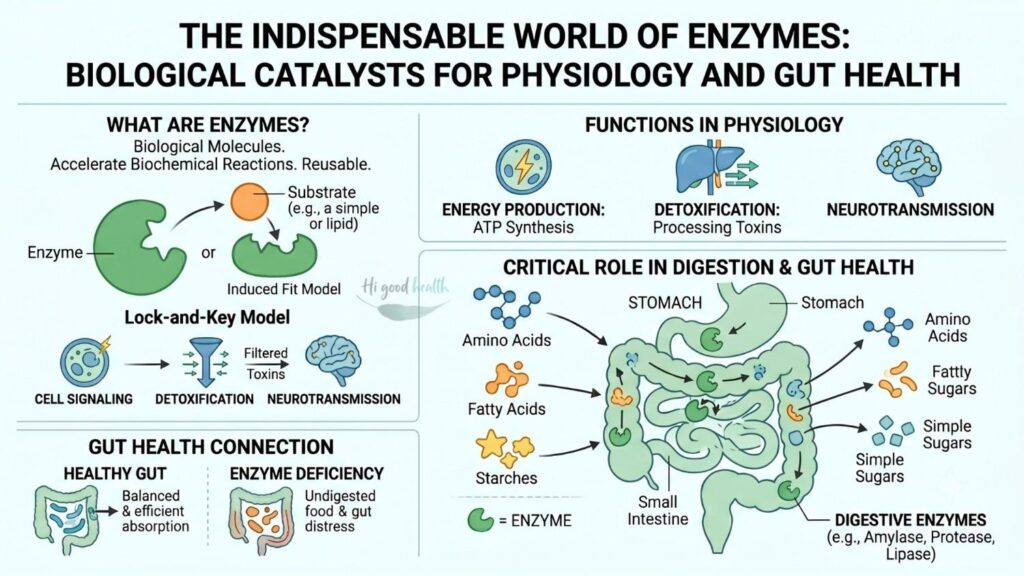
You eat well, sleep okay, exercise sometimes — yet you still feel bloated, sluggish, and drained after meals. The culprit might not be what you’re eating. It might be whether your body can actually process what you eat.
That’s where enzymes come in.
These microscopic proteins are biological catalysts — the body’s invisible workforce silently powering every chemical reaction happening inside you, right now. From breaking down your breakfast to repairing damaged tissue and fighting infection, enzymes make it all possible. Without them, life literally couldn’t function.
The digestion connection is especially eye-opening.
Three key players handle most of your food: amylase (carbs), protease (proteins), and lipase (fats). Together, they act like precision scissors, cutting food into pieces small enough for your bloodstream to absorb. When these enzymes are low, food doesn’t get broken down — it ferments. And that’s when bloating, gas, and that heavy “brick in the stomach” feeling show up.
So what slows enzyme production down?
More than most people realize. Natural aging reduces pancreatic enzyme output by roughly 10% per decade after 40. Chronic stress — a modern epidemic — diverts your body away from digestion entirely. A diet high in processed foods, heavy alcohol use, and conditions like celiac disease or Crohn’s can all quietly drain your enzyme reserves over time.
The good news? Simple shifts make a real difference. Chewing food slowly (seriously — it triggers enzyme release), eating raw fruits like papaya and pineapple, adding fermented foods like yogurt or kimchi, and managing daily stress can meaningfully support your enzyme levels.
Many people spend years treating digestive symptoms without ever looking at the root cause.
All reference links valid and accessible on 3 June 2026
[1] National Center for Biotechnology Information. (n.d.). Enzymes. In Biochemistry (5th ed.). https://www.ncbi.nlm.nih.gov/books/NBK9921/
[2] National Institute of Diabetes and Digestive and Kidney Diseases. (n.d.). Your digestive system & how it works. U.S. Department of Health and Human Services. https://www.niddk.nih.gov/health-information/digestive-diseases/digestive-system-how-it-works
Curious about which specific enzyme-rich foods work best, when supplements might help, and how to tell if your pancreas is struggling? The Unsung Heroes: How Enzymes Power Your Body and Drive Digestion
