
Part of the HiGoodHealth peptides series.
- Our pillar guide, Peptides: What They Are, How They Work, and Where They Stand in 2026, covers the science and the landscape.
- FDA Advisory Committee Votes on Peptides: What Changed—and What Didn’t reports what happened at the July 2026 advisory meeting.
- Are Peptides Legal in the US? covers the law in full — what may lawfully be sold, what happens to imports, and how state rules differ.
- This article carries the risks that apply across the whole category, rather than to one compound.
At a glance
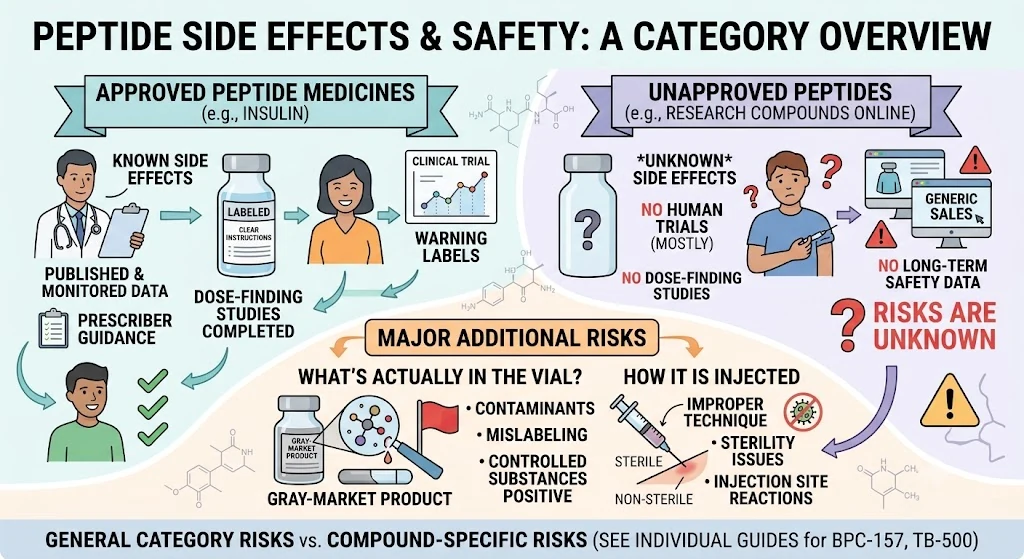
There is no single answer to “are peptides safe,” because “peptide” is a chemical description, not a safety category. Insulin is a peptide. So is a compound sold in a vial online with no human trials behind it.
For approved peptide medicines, the side effects are known, published and monitored. They are real, sometimes serious, and they come with a prescriber, a dose and a warning label.
Approved peptide medicines also do not share one universal side-effect profile. The risks depend on the molecule and what it does in the body. For example, insulin can cause hypoglycemia; desmopressin can cause dangerous low blood sodium when fluid balance is not appropriately managed; bremelanotide can cause nausea and temporary increases in blood pressure; and parathyroid-hormone analogues such as teriparatide have their own specific adverse-effect profiles.
The important point is that these risks are identified, studied and described in the prescribing information for the individual medicine rather than being inferred simply from the fact that it is a peptide.
For unapproved peptides, safety data are lacking. Without controlled human studies, risks remain unknown.
Two risks sit alongside the compound itself and are often larger: what is actually in the vial, and how it is being injected. Gray-market peptide products have tested positive for controlled substances.
This article covers the risks that apply across the whole category. Compound-specific risks are covered in each compound’s own guide — BPC-157 and TB-500.
Why there is no single answer
Safety depends on the molecule, the dose, the route, the formulation and the evidence behind it. Peptides differ on every one of those.
The useful division is not chemical, it is regulatory.
Approved peptide medicines — insulin, the GLP-1 drugs, oxytocin, desmopressin, teriparatide, bremelanotide and others — went through full clinical trials. Their side effects are documented because thousands of people were studied and followed.
Unapproved peptides — the compounds sold online for recovery, anti-aging and performance — have not. The absence of reported side effects in this group is not evidence of safety. It is an absence of studies.
Important safety note: the absence of published side effects or trials does not establish safety. It reflects a lack of study.
How strong is the safety evidence?
Not all peptide research carries the same weight. A useful hierarchy is:
Human clinical trials → human observational studies → human pharmacokinetic and safety studies → animal studies → laboratory/cell studies → testimonials and marketing claims.
Evidence from animals or cells can help researchers decide what to study next, but it cannot establish that a peptide is safe or effective in humans. Similarly, a large number of online testimonials is not a substitute for controlled human safety data.
Natural does not automatically mean safe
Some experimental peptides are promoted as “naturally occurring,” “body-identical,” “bioactive” or “naturally derived.” Those descriptions do not establish safety. A synthetic version of a naturally occurring peptide can differ in dose, formulation, route of administration and exposure. A substance being present naturally in the body does not mean that injecting or otherwise administering it at a different concentration is harmless.
Side effects of approved peptide medicines
These are worth stating plainly, because “approved” does not mean “harmless.”
Digestive effects are the most common class with the GLP-1 medicines — nausea, vomiting, constipation and diarrhea, most pronounced while the dose is being increased.
Injection-site reactions — redness, itching, swelling — are common across injected peptide medicines and usually mild.
Gallbladder problems have been associated with rapid weight loss, including weight loss on GLP-1 medicines.
Pancreatitis is an uncommon but serious concern carried in the prescribing information for the GLP-1 class. Severe, persistent abdominal pain is a reason to seek medical care rather than wait.
Low blood sugar is a risk when a peptide medicine is combined with insulin or certain other diabetes drugs.
Loss of lean mass accompanies rapid weight loss of any kind. It is not unique to these drugs and it is partly modifiable with protein and resistance training.
These risks are manageable precisely because they are documented and prescribers can adjust treatment accordingly. A prescriber can adjust a dose, pause treatment, or choose a different drug. None of those options exists for a compound bought online.
The risks of unapproved peptides
The unknowns cluster into four areas.
Unknown pharmacology. For most unapproved peptides there is no published human data on how much is absorbed, how long it stays in the body, or how it is cleared. Without that, “a dose” is a guess.
Unknown long-term effects. Short-term studies, where they exist, are short. Nobody has followed users for years.
Immunogenicity. Regulators repeatedly raise the possibility that a peptide product triggers an unwanted immune response. This was the FDA’s stated concern in keeping one peptide in its restricted category during the 2026 review.
Effects on tissue growth. Some experimental peptides are marketed for tissue repair or angiogenesis. Whether manipulating these pathways has clinically important long-term consequences in humans remains uncertain, because adequate human safety data are lacking for many of these compounds.
The American Medical Association has urged caution on injectable peptides marketed for anti-aging or performance, on the grounds that most of the supporting evidence comes from animal studies.
Combining multiple experimental peptides increases uncertainty, as interactions and cumulative effects have not been studied. Using several experimental peptides together can make an already uncertain situation harder to assess. There may be no clinical evidence describing their combined effects, interactions or cumulative toxicity. The same applies when an unapproved peptide is combined with prescription medicines: the presence of an approved drug does not make the experimental compound safer.
What is actually in the vial
This risk is separate from the compound, and for gray-market products it may be the larger one.
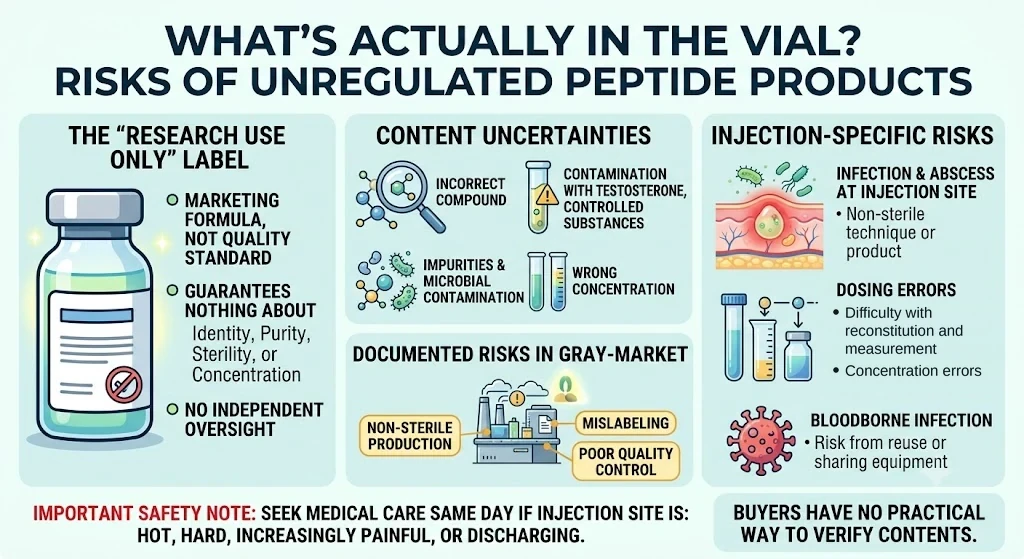
Most unapproved peptides are sold under a “research use only” label. That is a marketing formula, not a quality standard. It guarantees nothing about identity, purity, sterility or concentration, and nobody is checking.
The uncertainty can extend beyond the peptide itself. An unverified injectable product may contain unexpected impurities, degradation products, particulate matter or microbial contamination, including bacterial endotoxins. Storage and handling can also affect peptide stability. A vial that looks clear and correctly labeled cannot, by appearance alone, establish its identity, purity, potency or sterility.
Counterfeit products create another problem: the substance in the vial may not even be the compound named on the label.
Independent testing has found contaminants, including controlled substances such as testosterone, in some gray-market peptide products. In July 2026 the owner of one peptide seller received a 70-month federal prison sentence over unapproved drugs sold to roughly 54,000 customers, with products that tested positive for testosterone.
Contamination, mislabeling, wrong concentration and non-sterile production are all documented problems in this market. A buyer has no practical way to verify any of them.
The route matters too
Peptides can be marketed for injection, oral, nasal or topical use, among other routes. Changing the route does not automatically make an unapproved peptide safer. The route affects how much of a substance reaches the body, how quickly it is absorbed and what tissues are exposed to it. For experimental products, these questions may not have been adequately studied in humans.
Injection-specific risks
Most of these products are injected, by people at home, using materials of unverified sterility. That carries risk regardless of what is in the vial.
Infection and abscess at the injection site are the common consequences of non-sterile technique or non-sterile product.
Dosing error is easy when concentration is unverified and reconstitution is done by the user.
Bloodborne infection risk rises sharply if equipment is reused or shared.
Important safety note: injection sites showing signs of infection (heat, pain, swelling, discharge) require same-day medical evaluation.
Compounded peptides are not approved peptides
Compounding is a pharmacy preparing a customized medication for an individual patient with a prescription. It is not FDA approval, and compounded preparations do not go through the trial process approved drugs do.
It is also important to remember that FDA approval is specific to a particular drug product, formulation, route, dose and indication. A peptide that is approved for one medical use is not automatically approved for every other use for which it may be marketed.
That distinction has become blurred in marketing, particularly since the 2026 advisory committee review. A compounding recommendation is not an approval, and at the time of writing nothing recommended in July 2026 had been added to any list.
Quality standards differ across compounding pharmacies. Licensed facilities follow regulations, but compounded products are not equivalent to FDA-approved medicines.
Are Peptides Legal in the US covers the legal picture in full.
Who should be especially careful
- Anyone pregnant or breastfeeding. Unapproved compounds should not be assumed safe, and for most there is no data at all.
- Anyone taking multiple medications, because interaction data largely does not exist.
- Anyone with liver or kidney disease, where clearance may be affected in ways nobody has measured.
- Anyone with a cardiovascular or metabolic condition, particularly where a peptide is being taken alongside prescribed treatment.
- Anyone with a history of significant allergic reaction.
- Anyone competing in tested sport, or serving in the military, where the rules are separate from the FDA and stricter.
- Children and adolescents – Experimental peptides should not be assumed safe in growing bodies, particularly when developmental and long-term safety data are absent.
Red flags after taking any peptide
Seek urgent medical care for:
- Signs of a severe allergic reaction — swelling of the face, lips or throat, difficulty breathing, widespread rash.
- Severe or persistent abdominal pain, particularly if it radiates to the back.
- Persistent vomiting, or any inability to keep fluids down.
- An injection site that is hot, hard, spreading or discharging.
- Chest pain, fainting, or a sudden severe headache.
Tell the clinician what you have taken, including anything bought online. They are not there to judge it, and the information changes what they look for.
How to reduce risk
- If an approved medicine fits your situation, that is the route with evidence behind it.
- Do not self-dose an unapproved compound. There is no established dose to follow. Do not assume that increasing the dose, combining peptides or changing the route makes an experimental peptide more effective or safer.
- Tell your doctor and pharmacist everything you are taking, including supplements and anything unapproved.
- Treat “research use only” as a labeling disclaimer, not as evidence of quality, purity, sterility, correct concentration or suitability for human use.
- Never share injection equipment.
- If you are tested — sport, NCAA, military, or a job with an extended panel — assume unapproved peptides are off-limits.
Key takeaways
- “Peptide” is a chemical description, not a safety category. Insulin and an unapproved research compound are both peptides.
- Approved peptide medicines have real side effects that are known, published and manageable because a prescriber is involved.
- For unapproved peptides the honest answer is that nobody knows — not that they are safe.
- No published side effects plus no published trials is not reassurance. It is an absence of study.
- Product quality and injection practice are separate risks, and for gray-market products they may be the bigger ones.
- Compounding is not approval. A pharmacy preparing something is not the same as a drug being tested.
Frequently asked questions
- Are peptides safe? It depends entirely on which peptide. Approved peptide medicines have known, published side-effect profiles. Unapproved peptides have not been studied enough in humans for anyone to answer the question honestly.
- What are the most common peptide side effects? For approved peptide medicines, digestive symptoms and injection-site reactions are the most common. For unapproved compounds there is no reliable side-effect profile, because the studies that would produce one have not been done.
- Are injectable peptides safe? The injection itself carries risk — infection, abscess, dosing error — separate from whatever is in the vial. With unapproved products, sterility and concentration are unverified.
- Does “research use only” mean it is pure? No. It is a labeling disclaimer, not a quality standard, and it carries no guarantee of identity, purity, sterility or strength.
- Are compounded peptides FDA-approved? No. Compounding is a pharmacy preparing a medication for an individual patient. It does not involve the clinical trial process that approval requires.
- Can peptides interact with my prescription medicines? For most unapproved peptides, nobody has studied it. That is a reason to tell your doctor and pharmacist what you are taking, not a reason to assume it is fine.
- When should I stop and see a doctor? Severe allergic symptoms, severe or persistent abdominal pain, persistent vomiting, or an injection site that is hot, spreading or discharging all warrant same-day medical care.
Glossary
- Approved medicine: a drug that has completed clinical trials and been authorized by a regulator for a specific use.
- Compounding: a pharmacy preparing a customized medication for an individual patient. Not FDA approval.
- Immunogenicity: the risk that a substance provokes an unwanted immune response.
- Pharmacokinetics: what the body does to a drug — absorption, distribution, breakdown and elimination.
- RUO (“research use only”): a labeling disclaimer, not a legal exemption and not a quality standard.
- Lean mass: everything in the body that is not fat — muscle, bone, organs and water.
References
- FDA — Human Drug Compounding: https://www.fda.gov/drugs/guidance-compliance-regulatory-information/human-drug-compounding
- FDA — Certain Bulk Drug Substances for Use in Compounding That May Present Significant Safety Risks: https://www.fda.gov/drugs/human-drug-compounding/certain-bulk-drug-substances-use-compounding-may-present-significant-safety-risks
- FDA — Pharmacy Compounding Advisory Committee, 23–24 July 2026 meeting: https://www.fda.gov/advisory-committees/advisory-committee-calendar/july-23-24-2026-meeting-pharmacy-compounding-advisory-committee-07232026
- FDA — Warning letter, Wholesale Peptide (17 June 2026): https://www.fda.gov/inspections-compliance-enforcement-and-criminal-investigations/warning-letters/wholesale-peptide-729447-06172026
- DOJ — Paradigm Peptides owner sentenced to 70 months (30 July 2026): https://www.justice.gov/usao-ndin/pr/illinois-man-and-indiana-woman-sentenced-respectively-70-months-and-16-months-prison
- WADA — 2026 Prohibited List: https://www.wada-ama.org/en/resources/2026-prohibited-list
Medical disclaimer
This article is for general education and is not medical advice, and it is not a guide to using any unapproved substance. If you are experiencing symptoms after taking any peptide product, seek medical care and tell the clinician exactly what you took. Speak to a qualified healthcare professional before starting, changing or stopping any medication.
