At a Glance
Peptides are molecules made from short chains of amino acids linked together by peptide bonds. They are smaller than proteins and frequently act as biological signalling molecules, allowing cells to communicate and regulate essential physiological processes. Some of the world’s most important medicines — including insulin, semaglutide (Ozempic, Wegovy), tirzepatide (Mounjaro, Zepbound) and teriparatide — are peptide drugs.
At the same time, peptides have become one of the fastest-growing wellness trends. Products such as BPC-157, TB-500, MOTS-c and GHK-Cu are widely marketed for recovery, anti-ageing and performance, despite limited human evidence and no FDA approval for medical use.
The key message is simple: a peptide is a type of molecule — not a guarantee that something is safe, effective or approved.
What Are Peptides?
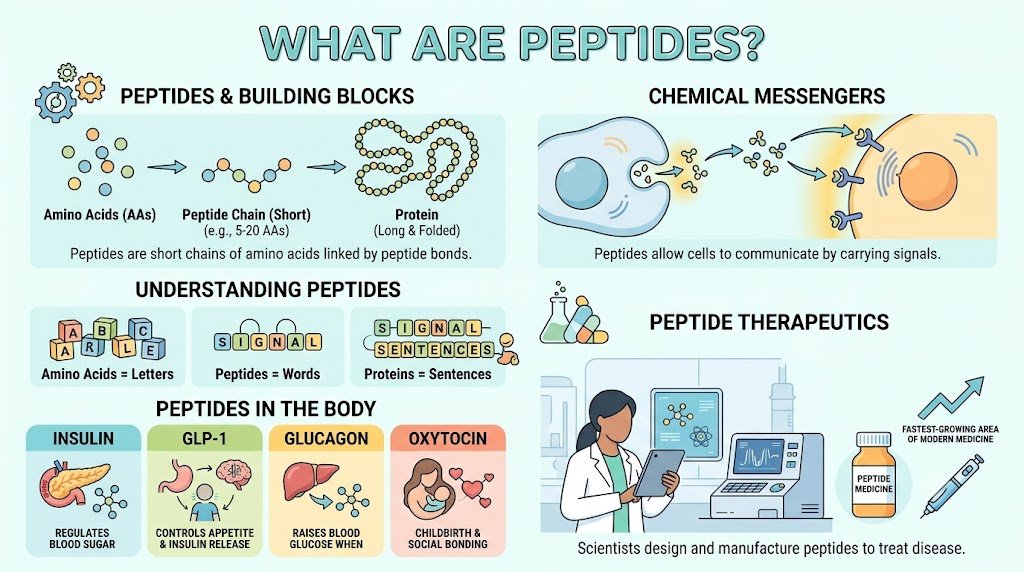
Peptides are short chains of amino acids linked together by peptide bonds. Amino acids are the building blocks of proteins, but peptides are smaller molecules that often act as chemical messengers, allowing cells to communicate.
Think of it this way:
- Amino acids = letters
- Peptides = words
- Proteins = sentences
Your body naturally produces hundreds of peptides. Insulin regulates blood sugar, GLP-1 controls appetite and insulin release, glucagon raises blood glucose when needed, and oxytocin plays important roles in childbirth and social bonding.
Scientists can also design and manufacture peptides to treat disease, making peptide therapeutics one of the fastest-growing areas of modern medicine.
Why Have Peptides Become So Popular?
Interest has surged for three reasons. GLP-1 medicines such as semaglutide and tirzepatide have transformed the treatment of obesity and type 2 diabetes, demonstrating how powerful peptide drugs can be.
Advances in biotechnology have accelerated peptide-based treatments for cancer, endocrine disorders, osteoporosis and rare diseases.
And social media and the wellness industry have promoted experimental peptides for muscle recovery, longevity, skin health and cognitive performance — often well ahead of the evidence.
Types of Peptides
Not all peptides serve the same purpose. They divide broadly into five groups, and each carries a different level of scientific evidence and regulatory oversight.
- Natural peptides — produced by the body: insulin, oxytocin, glucagon.
- Therapeutic peptides — FDA-approved medicines such as semaglutide, tirzepatide, teriparatide and desmopressin.
- Cosmetic peptides — skincare ingredients including GHK-Cu and Matrixyl.
- Nutritional peptides — collagen peptides used as dietary supplements.
- Research peptides — experimental compounds such as BPC-157, TB-500, MOTS-c, Semax, Selank and Epitalon.
| Type | Example | FDA approved | Evidence |
|---|---|---|---|
| Natural | Insulin | Body-produced | Established |
| Therapeutic | Semaglutide | Yes | Strong |
| Cosmetic | GHK-Cu | No | Moderate |
| Research | BPC-157 | No | Limited |
What Do Peptides Do, and How Do They Work?
Most peptides work by binding to specific receptors on cells, much like a key fitting a lock. That activates signalling pathways regulating hormone release, appetite, inflammation, immune function, metabolism and tissue repair.
Because peptides are highly specific, they can target biological pathways precisely, which makes them attractive drug candidates with fewer off-target effects than many conventional medicines.
They may be given as injections, tablets (such as oral semaglutide), nasal sprays or topical creams. Many still require injection because digestive enzymes break them down rapidly, though newer technologies are making oral peptide medicines increasingly possible.
Approved Medicines vs Wellness Peptides
The biggest source of confusion is that not all peptides are medicines.
Approved peptide drugs have been through years of laboratory research, clinical trials and regulatory review. Their benefits, risks, quality and manufacturing standards are well established.
Many peptides promoted online for anti-ageing, muscle growth or faster recovery remain experimental. Most have limited human studies, and many are sold as research use only. That label does not mean a compound has been shown to be safe or effective for personal use. Two compounds may both be peptides while one is an established medicine and the other an unproven research chemical.
What Are Peptides Used For?
Approved peptide medicines are already used to treat several conditions, and experimental peptides are marketed for many more.
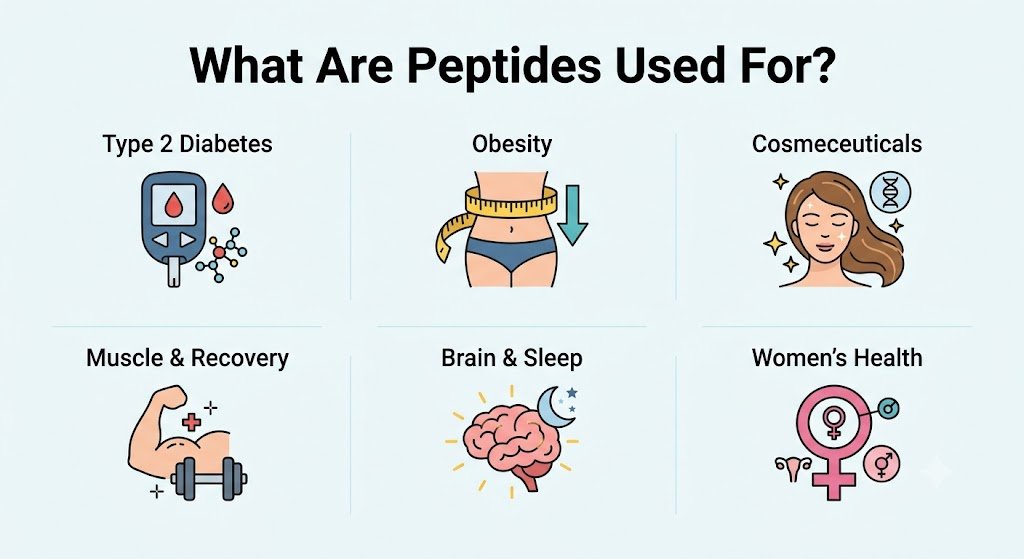
Type 2 diabetes
GLP-1 treatments work by boosting insulin release, lowering blood sugar and slowing digestion, helping manage both glucose and body weight.
Obesity
The peptides most people have heard of are the GLP-1 agonists — semaglutide (Ozempic, Wegovy) and tirzepatide — now joined by amylin analogues and combination therapies.
Skin, hair and nails
Collagen peptides, taken as supplements, are marketed for firmer skin, stronger nails and fuller hair. Copper peptides, especially GHK-Cu, are popular in serums for skin regeneration.
Muscle, recovery and performance
In sport and bodybuilding, peptides are marketed for muscle growth and faster recovery — often growth-hormone secretagogues such as sermorelin and CJC-1295, plus recovery compounds like TB-500 and BPC-157. None of these is an approved medicine for that purpose.
Brain, focus and sleep
A group of peptides has a following among people chasing sharper cognition and better sleep — Semax and Selank for focus and mood, and sleep-associated compounds such as delta sleep-inducing peptide (DSIP) and Epitalon.
Women’s health
Approved peptide therapies have limited but important applications here. Bremelanotide (Vyleesi) is approved for hypoactive sexual desire disorder in premenopausal women, and further peptide therapies targeting hormone deficiencies, reproductive disorders, osteoporosis and rare endocrine conditions are under investigation.
Researchers are also studying peptides for cancer, inflammatory diseases, neurological disorders, antimicrobial resistance, regenerative medicine and targeted drug delivery.
Are Peptides Safe? Side Effects and Risks
More than 100 peptide medicines have been approved worldwide, with hundreds more in clinical development. The peptides side effect question therefore has no single answer — it depends entirely on which peptide, and whether it is an approved medicine or a research compound. Route of administration, dose, treatment duration, manufacturing quality and clinical indication all influence a peptide’s safety profile.
Approved medicines have well-established safety profiles supported by large clinical trials and ongoing monitoring.
Experimental peptides are different. Human data are often limited, long-term safety is uncertain, and products sold online vary in purity, quality and dose. Independent testing has identified contamination and inaccurate labelling in some unregulated products.
Be especially cautious about anything marketed as “research use only”, “anti-ageing injections” or “performance peptides” without medical supervision.
What Changed in 2026?
Peptides became a major regulatory topic in 2026 when the FDA’s Pharmacy Compounding Advisory Committee reviewed several commonly marketed compounds, including BPC-157, TB-500, MOTS-c, GHK-Cu, Semax, Selank, DSIP and Epitalon.
The committee made recommendations about pharmacy compounding, but those votes were advisory only. They did not make these compounds FDA-approved medicines, and they did not establish safety or effectiveness for routine clinical use. Final regulatory decisions rest with the FDA.
We covered that meeting in detail in FDA Advisory Committee Votes on Peptides: What Changed—and What Didn’t.
The Future of Peptide Medicine
Peptide science is advancing quickly. Researchers are developing oral peptide medicines, long-acting formulations, AI-designed peptides, antimicrobial peptides, peptide-drug conjugates for targeted cancer treatment, and personalised therapies based on precision medicine.
As research expands, peptide medicines are expected to play a greater role in treating metabolic, infectious, inflammatory and neurological disease. Every new peptide must still pass rigorous clinical testing before it becomes part of routine care.
Key Takeaways
- Peptides are naturally occurring chains of amino acids that regulate many essential body functions.
- Some peptides are proven prescription medicines; many others remain experimental.
- The word “peptide” tells you nothing about whether a product is safe, effective or approved.
- FDA-approved peptide medicines have strong clinical evidence. Many wellness peptides do not.
- Peptide regulation is still evolving, which makes separating evidence from marketing more important than ever.
Frequently Asked Questions
What are peptides, in simple terms?
Peptides are short chains of amino acids joined by peptide bonds. Amino acids are the letters, peptides are the words, and proteins are the sentences. Your body makes hundreds of them, and they act as chemical messengers telling cells what to do.
What do peptides do in the body?
Most bind to receptors on cells like a key in a lock, switching on signalling pathways that control hormone release, appetite, inflammation, immune function, metabolism and tissue repair. Because they are highly specific, they tend to have fewer off-target effects than many conventional drugs.
Are peptides safe?
It depends entirely on which peptide. FDA-approved peptide medicines have safety profiles established through large clinical trials and ongoing monitoring. Experimental peptides sold online are a different matter: human data are limited, long-term safety is unknown, and independent testing has found contamination and inaccurate labelling in some unregulated products.
Does research use only mean a peptide is safe?
No. That label is a legal and commercial description, not a safety finding. It does not mean the compound has been shown to be safe or effective for people, and in most cases it signals the opposite: that it has not been approved for human use at all.
Did the FDA approve peptides in 2026?
No. In 2026 the FDA’s Pharmacy Compounding Advisory Committee reviewed several marketed peptides and made recommendations about pharmacy compounding. Those votes were advisory only. They did not make any compound an FDA-approved medicine, and they did not establish safety or effectiveness for routine clinical use.
Coming in This Series
This pillar is the overview. Each of the topics below gets its own detailed guide as the series is published.
- BPC-157 — claims, evidence and legal status
- TB-500 and MOTS-c — recovery and “longevity” peptides
- Peptides vs prescription GLP-1 drugs — what’s the difference
- Semaglutide for weight loss — what works, what’s hype, what’s risky
- Collagen peptides for skin, hair and nails — what the evidence shows
- GHK-Cu and copper peptides — the skincare peptide, explained
- Peptides for muscle growth and recovery — claims vs evidence
- Peptides for brain and sleep — nootropic peptides and DSIP
- Peptides in women’s health — what’s approved, what’s marketed
- Peptide side effects and risks — what the research actually shows
- Are peptides legal in the US?
Glossary
- Peptide — a short chain of amino acids, roughly fifty or fewer.
- Amino acids — the molecular building blocks of peptides and proteins.
- GLP-1 agonist — a class of peptide drugs, such as semaglutide, used for type 2 diabetes and obesity.
- Compounding — pharmacy preparation of a customised medication; the subject of the FDA’s 2026 peptide review.
- Research or wellness peptide — a peptide sold for human use without FDA approval, often labelled “research use only”.
References
All reference links checked and accessible on 1 August 2026.
- FDA — Pharmacy Compounding Advisory Committee, 2026 meeting materials. fda.gov
- STAT — FDA panel backs BPC-157 and KPV, 23 July 2026. statnews.com
- STAT — Panel backs Epitalon, rejects Emideltide, 24 July 2026. statnews.com
- American Medical Association — guidance on injectable wellness and anti-ageing peptides. ama-assn.org
- FDA — Vyleesi (bremelanotide) prescribing information. accessdata.fda.gov
- University of Colorado Anschutz — peptides explained, medical overview. cuanschutz.edu
Disclaimer
The content on higoodhealth.com is for general information only and is not a substitute for personalised medical advice. Many peptides discussed here are unapproved and under regulatory review. Speak with a qualified healthcare professional before making any health decisions, especially if you have a chronic condition or take other medications.
