At a glance
On 23–24 July 2026, the FDA’s Pharmacy Compounding Advisory Committee (PCAC) voted to recommend that six peptides—BPC-157, KPV, TB-500, MOTS-c, Semax, and Epitalon to be considered for inclusion on the 503A bulk substances list used by compounding pharmacies.
Emideltide was not recommended. Importantly, these recommendations are advisory only and do not constitute FDA approval. The FDA has not yet issued a final decision, and none of these peptides has undergone the conventional drug approval process required to establish safety and efficacy.
A recommendation to allow compounding is not the same as FDA approval. None of these peptides has passed the standard drug-approval process, and “available to compound” does not mean “proven safe and effective.”
The vote sits inside a bigger political push — associated with Health Secretary Robert F. Kennedy Jr. and the “Make America Healthy Again” framing — to widen access to peptides, set against regulators’ warnings about thin safety data.
Several panel members were also reported to have ties to the peptide industry. This page is a living tracker; we update it as the FDA acts.
What actually happened
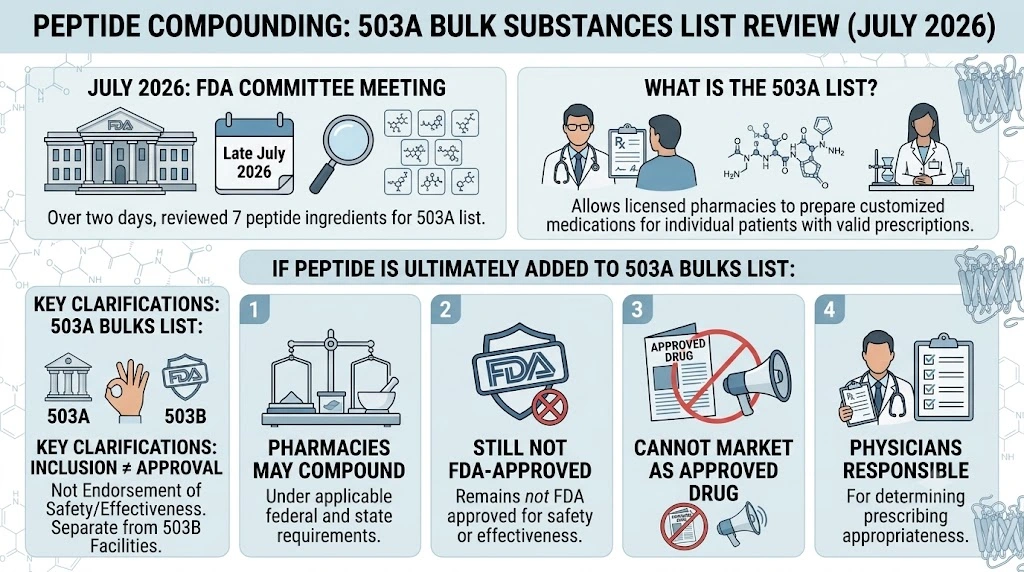
Over two days in late July 2026, the committee reviewed whether seven peptide ingredients should be added to the FDA’s 503A bulk substances list; a list that allows licensed compounding pharmacies to prepare customized medications for individual patients with a valid prescription.
Inclusion on this list does not indicate FDA approval or endorsement of a drug’s safety or effectiveness. It does not automatically affect outsourcing facilities regulated under Section 503B, which operate under different FDA requirements.
If the FDA ultimately adds a peptide to the 503A bulks list:
- licensed 503A pharmacies may compound it under applicable federal and state requirements,
- it still will not become FDA-approved,
- manufacturers still cannot market it as an approved drug,
- physicians remain responsible for determining whether prescribing it is appropriate.
The committee sided with wider access on six of the seven:
|
|
|
|
BPC-157 | Tissue repair | Limited human evidence | No |
KPV | Anti-inflammatory | No robust clinical evidence | No |
TB-500 | Recovery | Mostly animal studies | No |
MOTS-c | Metabolic health | Early clinical research | No |
Semax | Cognitive function | Regional clinical experience | No |
Epitalon | Sleep/Longevity | Very limited evidence | No |
Emideltide | Sleep disorders | Insufficient evidence | No |
Two things stand out. First, the margins were narrow — several passed by only a vote or two. Second, the recommendations went against the FDA’s own staff scientists, who had urged caution on most of the list, and news outlets reported that a number of panelists had industry ties.
The one thing most headlines get wrong
It’s easy to read “FDA panel backs peptides” and conclude these substances are now FDA-approved. They are not. Two distinctions matter.
An advisory vote is a recommendation, not a decision. The PCAC advises the FDA; it does not set policy. The agency makes the final call on whether to add these peptides to the compounding list, and it can decline to follow its committee.
“Allowed to be compounded” is not “approved as a drug.” Compounding is a separate pathway from standard drug approval. Adding a substance to the 503A bulks list means licensed pharmacies may prepare it for an individual patient with a prescription.
It does not mean the peptide has cleared the large clinical trials for safety and efficacy that a conventional FDA-approved medication must pass. A peptide can be legal to compound and still be unproven.
What these peptides are — and what’s claimed for them
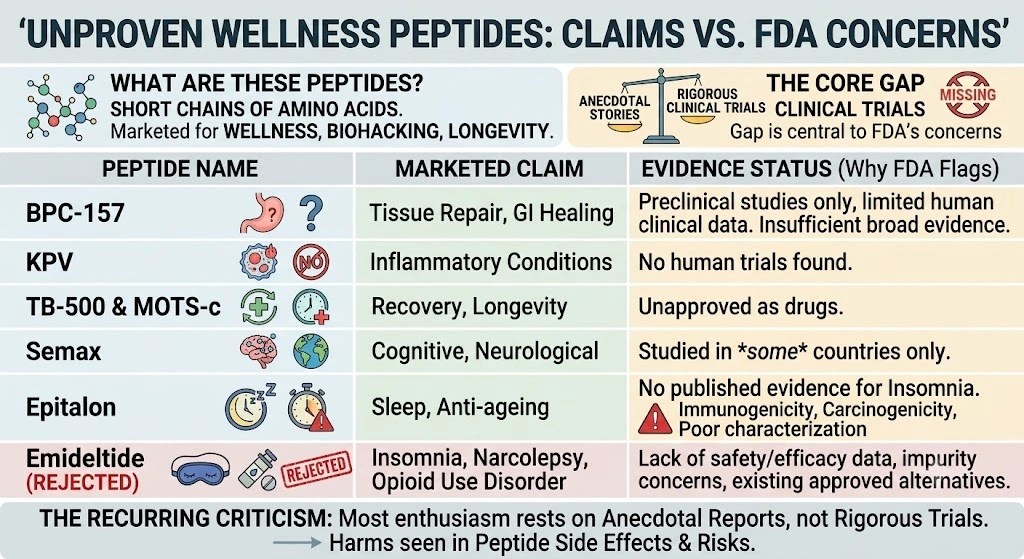
Peptides are short chains of amino acids. (If you want a deeper understanding of how these molecules function in the body, read our comprehensive guide on what peptides are and how they work). The ones on this list are marketed, largely in wellness and biohacking circles, for goals like recovery, gut health, sleep and longevity.
It’s worth stating plainly which claims rest on solid evidence and which don’t — because that gap is central to the FDA’s concerns.
- BPC-157 — BPC-157 has attracted considerable attention for tissue repair and gastrointestinal healing. However, current evidence is derived largely from preclinical studies, with only limited human clinical data available. FDA reviewers therefore concluded that evidence remains insufficient to support broad clinical use.
- KPV — promoted for inflammatory conditions; the FDA flagged that no human trials supported it.
- TB-500 and MOTS-c — associated with recovery and “longevity” claims respectively; both remain unapproved as drugs.
- Semax — studied in some countries for cognitive and neurological effects.
- Epitalon — marketed for sleep and anti-ageing; the FDA cited no published evidence of effectiveness for insomnia, plus concerns about immunogenicity, possible carcinogenicity and poor chemical characterisation.
- Emideltide (rejected) — marketed for insomnia, narcolepsy and opioid use disorder; the panel cited a lack of safety and efficacy data, impurity concerns and existing approved alternatives.
Across the board, the recurring criticism is the same: much of the popular enthusiasm rests on anecdotal reports rather than rigorous clinical trials.
Why the vote happened now: the politics
The advisory committee discussions occurred within a broader policy debate regarding patient access to compounded therapies. Advocates argued that physicians and pharmacists should have greater flexibility to individualize treatment, whereas FDA reviewers emphasized the importance of maintaining evidence-based regulatory standards before expanding access to peptides.
That energy was visible at the hearing, where longevity influencers testified in favour of access, arguing that millions of Americans already use peptides regardless of their regulatory status. Supporters on the panel echoed a version of this: that a physician and pharmacist, working with an individual patient, are well placed to weigh the risks case by case.
Regulators pushed back on the data. FDA reviewers pointed to limited clinical evidence, gaps in how these peptides are characterised and purified, and research on compounded GLP-1 medications showing higher rates of adverse events than their non-compounded counterparts — a caution about what can go wrong when demand outruns oversight.
Why this matters
Millions of Americans have become interested in peptides for recovery, metabolic health, longevity, and wellness. The committee’s recommendations could affect how legally prescribed compounded peptides are prepared by pharmacies, but they do not establish that these products are safe or effective.
What happens next
The advisory votes move the decision to the FDA. From here:
- The FDA reviews the recommendations and decides whether to add any of these peptides to the 503A compounding list. This is the binding step.
- Timing is uncertain. Advisory recommendations can take months to translate into agency action — if they do at all.
- Legal status today is unchanged by the vote alone. Until the FDA acts, the regulatory picture for these peptides is what it was before the meeting.
We update this page as the FDA issues its decision.
What the experts say
- FDA staff scientists recommended against most of the list, citing thin human data, purity and characterisation gaps, and — for some — safety concerns.
- The advisory panel majority favoured access, framing it as a physician-and-pharmacist judgement made per patient.
- Independent observers flagged the panel’s reported industry ties and warned that a compounding green light can be mistaken by the public for proof of safety and efficacy.
What this means if you’re reading about peptides
- A panel recommendation is not a green light. Nothing about your own health decisions should change on the basis of a non-binding advisory vote.
- “Available to compound” ≠ “proven safe and effective.” The compounding pathway deliberately sits outside the full approval process.
- Sourcing matters enormously. Much of what’s sold online as “research peptides” falls outside any pharmacy oversight — exactly the purity-and-quality gap regulators raised. Products marketed online as “research peptides” are generally not FDA-approved medicines and may not be manufactured under the quality standards required for approved drugs.
- Talk to a qualified clinician before acting on anything you read about peptides, including this article.
Key takeaways
The FDA has not approved any of these peptides. What happened in July 2026 was an advisory committee vote — a non-binding recommendation to the agency, not a decision by it. The FDA can accept the recommendations, reject them, or modify them, and it has not yet said which it will do.
Six peptides were recommended for possible inclusion on the 503A compounding list: BPC-157, KPV, TB-500, MOTS-c, Semax and Epitalon. Emideltide was not recommended. Inclusion would let licensed pharmacies compound a peptide for an individual patient with a prescription. It would not make it an approved drug.
A compounded peptide is not the same as an FDA-approved one, because compounded preparations skip the large clinical trials for safety and efficacy that approval requires. Until the FDA acts, the legal status of these peptides is unchanged, and nothing in this vote should change a decision about your own health.
Frequently asked questions
Did the FDA approve these peptides?
No. An FDA advisory committee recommended six of them for the pharmacy compounding list. That is a recommendation, not approval, and compounding eligibility is not the same as being approved as a drug.
Which peptides were backed, and which was rejected?
Backed: BPC-157, KPV, TB-500, MOTS-c, Semax and Epitalon. Rejected: emideltide.
Are peptides legal now after the vote?
The vote did not change any peptide’s legal status by itself. The FDA still has to decide whether to add these to the compounding list. Until then, compounds like BPC-157 and TB-500 remain unapproved as drugs. See our full guide, Are Peptides Legal in the US?
Is BPC-157 legal or FDA-approved now?
No. The vote didn’t change BPC-157’s status. It remains unapproved as a drug, and the FDA has not yet acted on the compounding recommendation.
When will the FDA make its final decision?
There is no fixed timeline. Advisory recommendations can take months to result in agency action — and the FDA can decline to follow them.
Is a compounded peptide the same as an FDA-approved one?
No. Compounded preparations are made by a pharmacy for a specific patient and do not go through the FDA’s full drug-approval process for safety and efficacy.
Glossary
- PCAC (Pharmacy Compounding Advisory Committee): An outside expert panel that advises the FDA on compounding questions.
- Advisory (non-binding) vote: A recommendation to the FDA; it does not, by itself, change law or policy.
- Compounding: A pharmacy preparing a customised medication for an individual patient with a prescription.
- 503A bulks list: The list of bulk substances that compounding pharmacies are permitted to use.
- FDA approval: The standard pathway requiring clinical trials for safety and efficacy — distinct from compounding eligibility.
References
All reference links checked and accessible on 1 August 2026.
- CNN — FDA advisers support easing restrictions on six peptides: what they are and what happens next (31 July 2026):
- STAT — FDA panel backs BPC-157, KPV (23 July 2026):
- STAT — Panel backs Epitalon, rejects emideltide (24 July 2026):
- NBC News — FDA panel, with ties to the peptide industry, recommends easing restrictions:
- RAPS — FDA advisory committee backs two controversial peptides:
- Fox News — FDA panel votes to allow 6 peptides to be compounded by pharmacies:
Disclaimer
This article is for general education and is not medical advice. The peptides discussed here are largely unapproved as drugs and are the subject of ongoing regulatory review. Speak with a qualified healthcare professional before making any health decisions.
