You reach for your fourth can of sparkling water at 2 PM, and a thought crosses your mind: is too much sparkling water bad for you? Sound familiar? You are not alone.
At a glance
For most healthy adults, sparkling water is not bad for you and hydrates about as well as still water. Is too much sparkling water bad for you? Only in a limited way: drinking a lot all day can slowly soften tooth enamel and cause bloating or gas. It does not weaken bones or harm healthy kidneys. Aim for up to 64 ounces daily, favor plain unflavored types, and alternate with plain water.
Across America, millions of people have traded their sodas for sparkling water, convinced they are making a healthier choice. But like any good habit, the real question is whether you can overdo it. This guide walks through the science on hydration, teeth, bones, digestion, and daily limits so you can decide what fits your body.
What Exactly Is Sparkling Water? The Basics Explained
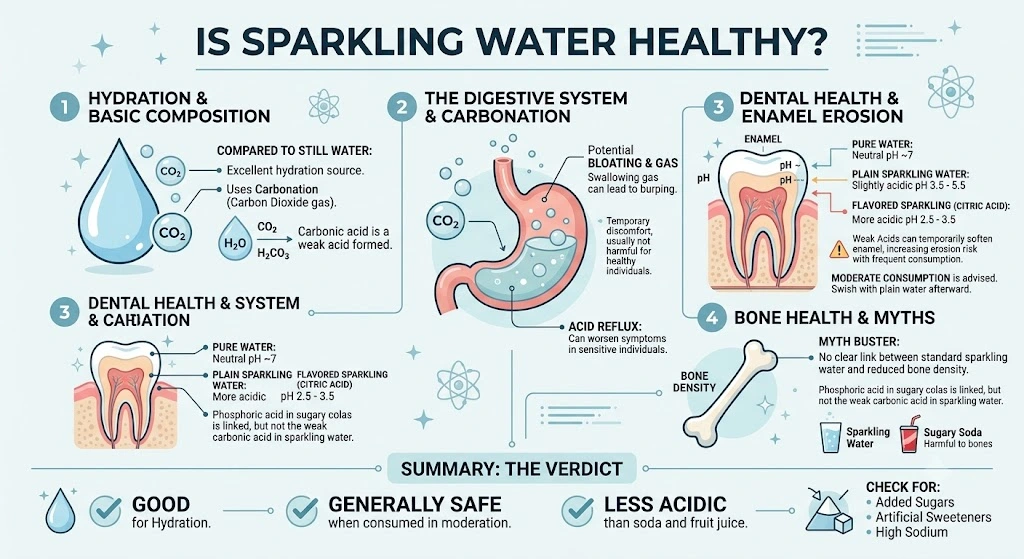
Before we get into the health effects, let us set the definition. Sparkling water, also called carbonated water, seltzer, or fizzy water, is simply water infused with carbon dioxide gas under pressure. The dissolved carbon dioxide forms carbonic acid, which creates the bubbles and the mildly tangy taste.
The Fascinating History of Sparkling Water
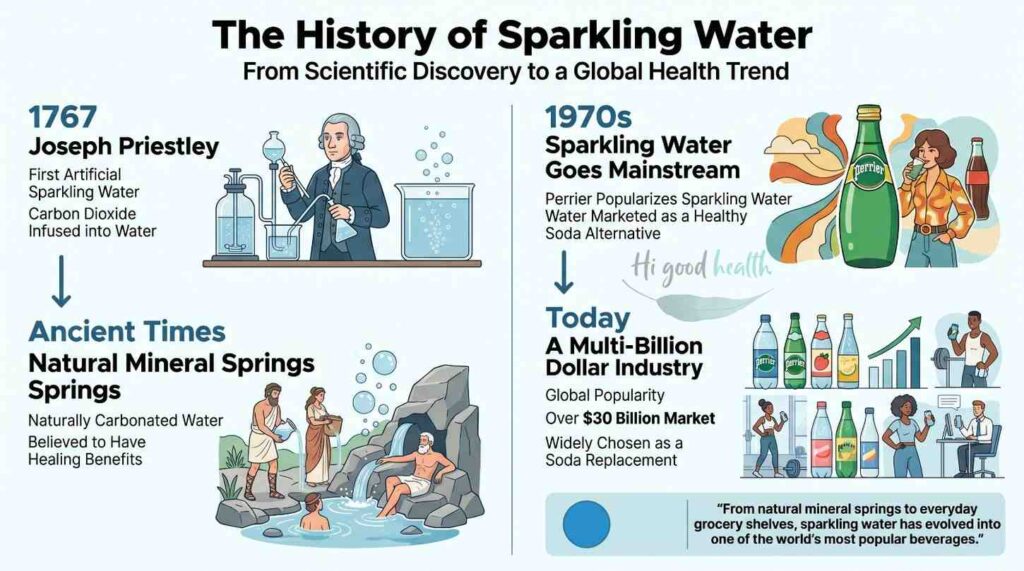
The story starts in 1767, when English scientist Joseph Priestley found a way to infuse water with carbon dioxide. Naturally sparkling water goes back much further. Ancient Romans prized naturally carbonated springs and believed they had healing properties.
The modern industry took off in the 1970s when Perrier ran an aggressive U.S. marketing campaign, positioning sparkling water as a sophisticated, healthier alternative to soft drinks. Today the global sparkling water market is worth over $30 billion.
How Sparkling Water Is Made
There are two main types of sparkling water.
Naturally sparkling water: This forms underground in natural springs, where volcanic gases or high-pressure geological deposits infuse the water with carbon dioxide before it is bottled at the source. It carries natural minerals and tends to cost more. Examples include Perrier, San Pellegrino, and Gerolsteiner.
Artificially carbonated water: Pure water is chilled so it absorbs gas better, then injected with pressurized carbon dioxide. That creates carbonic acid and gives the water its signature tang and fizz. Once bottled and sealed under pressure, the bubbles stay dissolved until you open it. It is more affordable. Examples include LaCroix, Bubly, and Polar.
Home methods: You can use a countertop machine to inject carbon dioxide, or use fermentation, where microbes consume sugar and release carbon dioxide as a byproduct.
Popular Brands and Their Ingredients
Here is what is actually in some favorite brands.
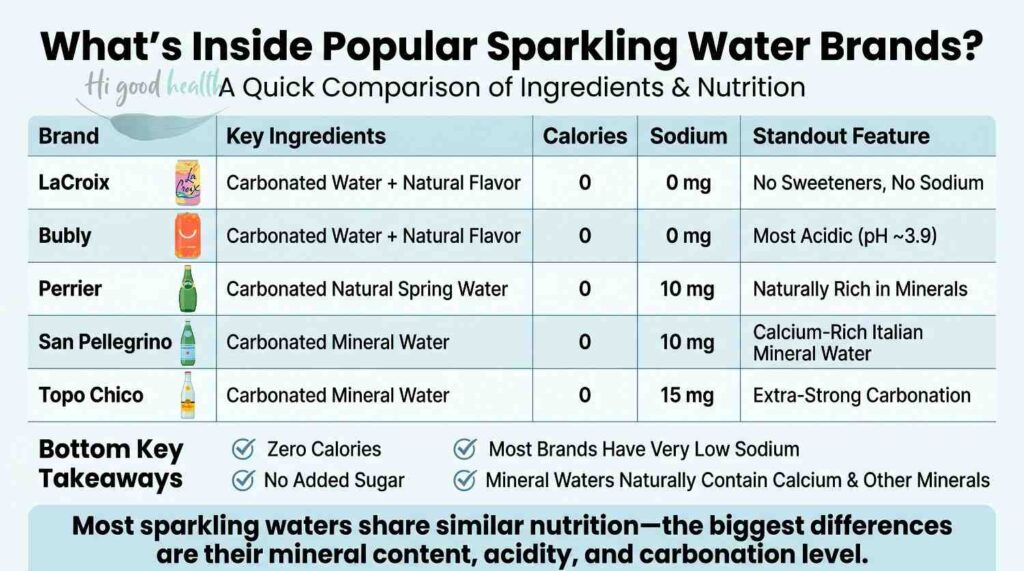
LaCroix: Carbonated water and natural flavor; 0 mg sodium; 0 calories; pH 4.71. Uses natural essences, no artificial sweeteners or sodium.
Bubly (PepsiCo): Carbonated water and natural flavor; 0 mg sodium; 0 calories; pH 3.86, the most acidic. Contains no calories, sodium, or sweeteners.
Perrier: Carbonated natural spring water; 10 mg sodium; 60 mg calcium; pH 5.46. Natural minerals from French springs.
San Pellegrino: Carbonated natural mineral water; 10 mg sodium and 60 mg calcium. Italian mineral water with a distinctive taste.
Topo Chico: Carbonated mineral water; 15 mg sodium. Extremely high carbonation; Mexican mineral water.
Brand Comparison: What Makes Them Different
| Brand | Origin | Carbonation Level | Mineral Content | Price Range | Best For |
|---|---|---|---|---|---|
| LaCroix | USA | Medium | None | $3-5/12pk | Flavor variety |
| Bubly | USA | High | None | $3-5/12pk | Soda replacement |
| Perrier | France | Medium | Natural minerals | $5-7/12pk | Sophisticated taste |
| San Pellegrino | Italy | Medium | Natural minerals | $5-7/12pk | Meal pairing |
| Topo Chico | Mexico | Very High | Natural minerals | $4-6/12pk | Intense carbonation |
Sparkling Water vs. Other Drinks: The Truth About Your Choices
Now that we know what sparkling water is, here is how it stacks up against other popular drinks.
Sparkling Water vs. Soda: The Clear Winner
| Aspect | Sparkling Water | Regular Soda | Diet Soda |
|---|---|---|---|
| Calories | 0 | 140-150 per can | 0-5 |
| Sugar | 0g | 35-40g | 0g |
| Sodium | 0-15mg | 40-50mg | 40-70mg |
| Artificial Sweeteners | None | None | Multiple |
| Caffeine | 0mg | 34-54mg | 34-54mg |
| pH Level | 3.5-5.5 | 2.5-3.5 | 3.0-4.0 |
The verdict: Sparkling water is clearly healthier than both regular and diet soda. You drop the sugar, artificial sweeteners, and excess sodium while keeping the satisfying fizz.
Sparkling Water vs. Juice: Surprising Results
| Aspect | Sparkling Water | 100% Fruit Juice | Flavored Juice |
|---|---|---|---|
| Calories | 0 | 110-140 per 8oz | 60-120 per 8oz |
| Sugar | 0g | 22-28g | 15-25g |
| Fiber | 0g | 0-1g | 0g |
| Vitamins | None | Natural vitamins | Added vitamins |
| Processing | Minimal | Minimal | Highly processed |
The verdict: Juice provides vitamins, but it is also high in natural sugar. Sparkling water with a few fresh fruit slices gives you flavor without the sugar spike.
Sparkling Water vs. Sports Drinks: For Active Lifestyles
| Aspect | Sparkling Water | Sports Drinks | Electrolyte Water |
|---|---|---|---|
| Calories | 0 | 50-80 per 12oz | 0-10 |
| Sugar | 0g | 14-21g | 0-2g |
| Electrolytes | Minimal | High | Moderate |
| Hydration Speed | Standard | Fast | Fast |
| Best Use | Daily hydration | During exercise | Post-workout |
The verdict: For regular daily hydration, sparkling water wins. For intense exercise, sports drinks may be worth it to replace electrolytes.
Curious why you still feel dehydrated even after drinking plenty of water? Read our detailed guide: Still Thirsty Even After Drinking Water? Unmasking the Real Reasons.
The Sparkling Water Boom: More Than a Trend
The numbers tell the story. Sparkling water consumption has climbed steadily over the past decade as shoppers swap sugary soft drinks for lower-calorie options. Easy digestion and effective hydration keep people reaching for it, and that shift built a multi-billion dollar industry. What started as a European luxury became an American staple, with LaCroix, Bubly, and Perrier lining grocery shelves.
Here is the part people miss. While everyone argues about whether sparkling water is healthy, the better question is what your body actually needs and how the fizz fits in. So, is too much sparkling water bad for you? The answer depends on how much you drink and which type you choose.
The Root Cause: Why We Crave the Fizz
So why are we so hooked on the bubbles?
The sensory appeal. Dr. Rachel Johnson, a nutritionist at the University of Vermont, explains that the carbonation stimulates the trigeminal nerve, which creates that tingly sensation we find so satisfying. That experience tricks the brain into feeling like it is getting something more substantial than plain water.
The habit transfer. Many sparkling water fans are former soda drinkers. The fizz gives the familiar feeling without the sugar crash, which makes it an easier switch than jumping straight to still water.
The flavor factor. Plain water can feel boring. Sparkling water offers variety without the guilt, giving you dozens of flavors to pick from. It is hydration with personality.
The Science Behind the Bubbles: What Research Really Shows
The Good News: Hydration Hero
Sparkling or carbonated water can be good for you in moderation when it is naturally flavored [7]. It supports hydration and may relieve constipation, which matters because staying hydrated is fundamental to every bodily function.
A 2017 study in the American Journal of Clinical Nutrition found that sparkling water hydrates just as effectively as still water [1]. Researchers tracked 72 healthy adults for two weeks and found no meaningful difference in hydration between the sparkling and still water groups.
The digestive benefits. Research in the European Journal of Gastroenterology showed that carbonated water can improve digestion by stimulating digestive enzymes [2]. That may be why many people feel less bloated when they drink sparkling water with meals.
The bone health question. One of the biggest myths is that sparkling water weakens bones. That confusion comes from studies on cola, which contains phosphoric acid. Plain sparkling water does not cause calcium loss, though it may contribute to tooth decay or flare-ups of IBS symptoms in some people. It is still a healthier choice than sugary drinks.
Dr. Susan Lanham-New, a professor of nutrition at the University of Surrey, reviewed the carbonated water research and concluded that plain carbonated water has no effect on bone health [4]. The bone loss concerns are specific to phosphoric acid in sodas, not simple carbonated water.
The Potential Concerns: When Bubbles Become Trouble
So is too much sparkling water bad for you in real life? For most people the downsides are minor, but they are worth knowing.
Dental health reality check. Sparkling water will not wreck your teeth the way soda can, but it is not entirely innocent. Carbonation creates carbonic acid, which can soften tooth enamel if you sip it constantly. Unflavored sparkling water is generally considered safe for teeth, but watch out for varieties with citric acid, phosphorus, or sugar [18].
Dr. Ada Cooper, a spokesperson for the American Dental Association, offers a simple fix: if you are drinking sparkling water throughout the day, use a straw to limit contact with your teeth, and rinse with plain water afterward [5].
The IBS connection. If you have irritable bowel syndrome, sparkling water might not be your friend. The carbonation can raise gas production in your digestive tract and worsen bloating and discomfort.
The sodium trap. Not all sparkling waters are equal. Some contain added sodium, which can be a problem if you watch your salt intake or manage blood pressure. Check the label; ideally your sparkling water should have zero sodium.
How Much Is Too Much? The Daily Consumption Guide
Here is what the guidance looks like.
For healthy adults:
- Up to 8 glasses (64 ounces) of sparkling water per day is generally considered safe.
- This can replace your daily water intake if you prefer, but alternate with a few glasses of plain water daily to protect your teeth and stomach.
For those with digestive issues:
- Start with 1 to 2 glasses per day to check your tolerance.
- Avoid drinking sparkling water with meals if you tend to bloat.
For children and teens:
- Limit to 1 to 2 glasses per day.
- Choose unflavored varieties to protect developing teeth.
The 80/20 rule: Make about 80% of your hydration plain water and 20% sparkling. You get the benefits of both without overdoing the carbonation.
The Cost Reality: Is Your Bubble Habit Breaking the Bank?
Let us talk money. A 12-pack of premium sparkling water runs about $6, or roughly $0.50 per can. Drink three cans a day and that is $1.50 daily, or about $547.50 a year.
Compare that to making your own with a home carbonation system, which costs about $0.25 per liter after the initial purchase. That can save you over $300 a year.
Environmental impact. Each year Americans go through billions of cans and bottles of sparkling water. Many are recyclable, but the footprint is still large. Home carbonation systems can cut that footprint by up to 90%.
The Microplastics and Chemical Contamination Reality
Here is where it gets concerning. Recent research has turned up some unsettling facts about what is in bottled water beyond the bubbles, from microplastics to forever chemicals, heavy metals, and microbial pathogens.
Microplastics: the invisible threat. Researchers have detected thousands of tiny plastic bits in common single-use water bottles [11]. These microplastics are troubling because they carry toxic chemicals and can interfere with hormone function.
A 2025 study from the National Institutes of Health found that bottled sparkling water contained noticeably more microplastic particles than tap water. The particles ranged from 0.1 to 5,000 micrometers, with the highest counts in bottles stored in warm conditions. [LINK CHECK NEEDED]
BPA and chemical leaching. The picture gets worse with chemical leaching. Most plastics, including bottles meant to be reused, leach chemicals such as BPA, especially when heated or scratched [17].
Even more concerning: the lining of aluminum cans can contain BPA and similar chemicals that act as endocrine disruptors with the potential to cause hormonal and reproductive harm [12].
Forever chemicals (PFAS) in popular brands. Testing conducted between 2019 and 2021 found PFAS (per- and polyfluoroalkyl substances) in some popular brands:
Understanding the Safety Context
These levels sit well below current EPA safety standards. As of April 2024, the EPA set enforceable drinking water limits at 4.0 parts per trillion (ppt) for individual PFAS compounds like PFOA and PFOS. All three brands tested well below that threshold.
Recent FDA testing (2023 to 2024) of 197 bottled water samples found that only 10 had detectable PFAS levels, and none exceeded EPA maximum contaminant levels. That suggests most bottled sparkling waters carry minimal to no detectable PFAS.
Still, PFAS are called forever chemicals because they do not break down naturally and can build up in your body over time. Current levels in major brands are considered safe by regulators, but you can cut long-term exposure further by using home carbonation systems with filtered tap water.
Tap Water vs. Bottled: The Safety Comparison
Here is what may surprise you: properly filtered tap water is often safer than bottled sparkling water. Municipal systems must test for hundreds of contaminants and publish annual quality reports, while bottled water companies face less strict requirements.
Dr. Sherri Mason, a microplastics researcher at UC San Francisco, recommends using a glass water bottle to avoid plastic [13] and notes that heat makes plastic release harmful chemicals like BPA.
If you regularly drink from plastic bottles, our guide Are Plastic Bottles Safe? The Hidden Risks of Drinking Water from Plastic and What to Do explains what current research says about their long-term safety.
Making safer choices. To limit your exposure to harmful chemicals:
- Choose glass bottles when possible.
- Avoid plastic bottles stored in warm conditions, like a car trunk.
- Consider home carbonation systems. Tests show that making your own sparkling water at home with a countertop soda maker may be best for avoiding PFAS [14].
- Use filtered tap water as your base for home carbonation.
- Never heat plastic bottles or leave them in direct sunlight.
- Read labels and treat real fruit extract as a green flag and added sugar as a red flag.
Latest Research: What 2024 to 2025 Studies Are Telling Us
Recent research from the Journal of Nutrition and Health Sciences (2024) followed 2,000 adults for 18 months, tracking hydration habits and health outcomes [3]. Key findings included:
- People who drank sparkling water took in 23% more fluid daily than those who only drank still water.
- No meaningful difference in kidney function or bone density between the groups.
- Sparkling water drinkers reported higher satisfaction with their hydration habits.
If you or a loved one has high creatinine levels, our guide Your Kidney Guardians: What to Eat, What to Avoid, and Why It Matters (Especially with High Creatinine) covers practical dietary steps that may support kidney health.
A 2025 study from the European Food Safety Authority is looking into whether certain flavor compounds in sparkling water affect metabolism [9]. Early results suggest natural citrus flavors may slightly raise metabolic rate, though the effect is minimal.
The most notable recent finding comes from NIH research on plastic particles in bottled water, which reported that bottled sparkling water can contain up to 100 times more microplastic particles than tap water [11]. That has renewed interest in home carbonation as a safer option.
Healthier Ways to Flavor Sparkling Water Naturally
Instead of relying on artificial flavors, try these natural ways to liven up your sparkling water.
Herbal infusions:
- Fresh mint leaves
- Basil and cucumber
- Lavender, used sparingly
Fruit additions:
- Lemon or lime wedges
- Frozen berries
- Watermelon chunks
Vegetable twists:
- Cucumber slices
- Fresh ginger
- A celery salt rim for a savory option
These natural add-ins bring vitamins and antioxidants without artificial ingredients, which makes your sparkling water habit even healthier.
Expert Perspectives: What the Professionals Say
Dr. Marion Nestle, Professor of Nutrition at NYU: Sparkling water is a perfectly fine way to stay hydrated. The key is choosing varieties without added sugars or artificial sweeteners. If it helps you drink more water overall, it is a win.
Registered Dietitian Dawn Jackson Blatner, author of The Superfood Swap: I tell clients to think of sparkling water as a tool in their hydration toolkit. It is not inherently better or worse than still water, just different. The best water is the one you will actually drink.
Dr. Michael Greger, founder of NutritionFacts.org: Sparkling water does not add the meal-time weight management benefits of plain water, but it is still a big improvement over sugary drinks. The carbonation might even help with fullness.
The Bottom Line: Making Sparkling Water Work for You
Your sparkling water habit is not something to feel guilty about. Compared with most drink choices, it is a healthy one. So when you wonder is too much sparkling water bad for you, the honest answer is that the risks are small and manageable. Stay mindful about:
- Quality over quantity: choose brands with minimal ingredients.
- Moderation: even good things can be overdone.
- Variety: do not let sparkling water be your only source of hydration.
- Cost: consider cheaper options if you drink a lot.
Creating Your Optimal Sparkling Water Plan
Week 1 to 2, assessment: Track how much sparkling water you drink and how it makes you feel. Note any digestive issues or changes in energy.
Week 3 to 4, optimization: Try the 80/20 rule. Replace some sparkling water with plain water and watch for changes.
Week 5 to 6, enhancement: Swap pre-flavored varieties for natural flavor add-ins. You control the ingredients and cut costs.
Week 7 to 8, sustainability: If you drink more than 2 to 3 cans a day, consider a home carbonation system for savings and less waste.
Key Takeaways
- Sparkling water hydrates about as well as still water and counts toward your daily fluid goals.
- Is too much sparkling water bad for you? For healthy adults, only mildly: heavy all-day sipping can soften enamel and cause bloating.
- It does not weaken bones or harm healthy kidneys; those fears come from studies on cola, not plain carbonated water.
- Pick plain, unflavored, zero-sodium types for the healthiest carbonated water, and use a straw to protect your teeth.
- Up to 64 ounces a day is generally safe; alternate with plain water using the 80/20 rule.
FAQ: Your Sparkling Water Questions Answered
Does sparkling water count toward my daily water intake?
Yes, research shows sparkling water hydrates just as effectively as still water. It counts fully toward your daily fluid intake goals. For best results, choose plain varieties without added sugars or sweeteners.
Is sparkling water bad for my teeth?
It can be if consumed excessively, as carbonation creates mild acid that may soften enamel. To protect teeth, choose unflavored varieties, drink with a straw, and rinse with plain water afterward.
Does sparkling water help with weight loss?
It can potentially support weight management efforts by increasing satiety (fullness) and replacing high-calorie sugary drinks. However, it is not a weight loss solution on its own; it simply eliminates the sugar and calories found in sodas and juices.
How much sparkling water is safe to drink daily?
Experts generally consider up to 8 glasses (64 ounces) per day safe for healthy adults. However, if you experience bloating, limit intake to 1 to 2 glasses daily or avoid drinking it with meals.
Does sparkling water weaken bones?
No, this is a myth based on soda studies. Experts conclude plain carbonated water has no negative effect on bone density. Bone loss concerns are specific to phosphoric acid found in colas.
Does sparkling water cause kidney stones?
No, plain sparkling water does not increase kidney stone risk. In fact, staying well-hydrated with any type of water is actually crucial for preventing kidney stones from forming.
Is sparkling water safe during pregnancy?
Yes, plain sparkling water is safe to drink while pregnant. It offers a hydrating alternative to soda, but you should avoid varieties containing caffeine or artificial sweeteners.
Can sparkling water cause bloating or gas?
Yes, the carbonation can increase gas production in your digestive tract. This may worsen symptoms for those with Irritable Bowel Syndrome (IBS) or frequent bloating, so monitor your tolerance.
Is too much sparkling water bad for you?
For most healthy people, no. Up to about 64 ounces a day is fine. Very heavy intake mainly risks softening tooth enamel over time and triggering bloating, so alternate with plain water and watch how your stomach feels.
What are the side effects of drinking too much sparkling water?
The most common side effects of drinking too much sparkling water are bloating, burping, and gas from the carbonation, plus a small risk of enamel wear if you sip it all day. It does not harm your kidneys or bones.
Which is the healthiest sparkling water?
The healthiest sparkling water is a plain, unflavored variety with zero sodium, zero sugar, and no artificial sweeteners. Check the label and pick brands that list only carbonated water, or make your own at home with filtered tap water.
Glossary
Carbonation: The process of dissolving carbon dioxide gas in water under pressure, creating bubbles and a slightly acidic taste.
Carbonic acid: The weak acid formed when carbon dioxide dissolves in water, responsible for the slightly tart taste of sparkling water.
Phosphoric acid: An additive found in colas (but not plain sparkling water) that has been linked to bone density concerns.
Trigeminal nerve: The nerve that detects the tingly sensation of carbonation in your mouth.
Satiety: The feeling of fullness or satisfaction after eating or drinking.
IBS (irritable bowel syndrome): A digestive disorder that carbonated drinks can aggravate in some people.
At Hi Good Health, we believe in giving you clean, credible health information that cuts through the noise and myths. Our mission is to help you make informed decisions using simple, science-backed explanations, with a focus on natural, plant-based solutions that work for everyone.
Have questions about other health topics? Explore our guides on hydration, natural digestive aids, and plant-based nutrition. We would love to hear about your sparkling water experiences and any topics you would like us to cover next; share your thoughts in the comments below.
References and Sources
- American Journal of Clinical Nutrition – Hydration effectiveness study (2017)
- European Journal of Gastroenterology – Carbonated water and digestion research
- Journal of Nutrition and Health Sciences – Large-scale sparkling water consumption study (2024) [LINK CHECK NEEDED]
- University of Surrey – Bone health and carbonated water review
- American Dental Association – Dental health guidelines for carbonated beverages
- Cleveland Clinic – Sparkling water health effects analysis
- UnityPoint Health – Is sparkling water good for you
- Medical News Today – Sparkling water health review
- European Food Safety Authority – Ongoing metabolic effects research (2025)
- NutritionFacts.org – Evidence-based beverage recommendations
- NIH – Plastic particles in bottled water research
- Center for Environmental Health – Sparkling water container safety
- UC San Francisco – Microplastics researcher recommendations
- Food and Wine – PFAS in sparkling water
- CBC News – Sparkling water acidity comparison
- Grand View Research – Global sparkling water market analysis
- Columbia University – BPA concerns in plastic bottles
- Healthline – Sparkling water and dental health
Disclaimer: This article is for informational purposes only and should not replace professional medical advice. Always consult a healthcare provider before making significant changes to your diet or if you have specific health concerns. Individual responses to sparkling water vary. The information is based on current research and expert opinion, and health recommendations may change as new studies emerge.
