
Introduction: The Fungus That Took Over the Wellness World
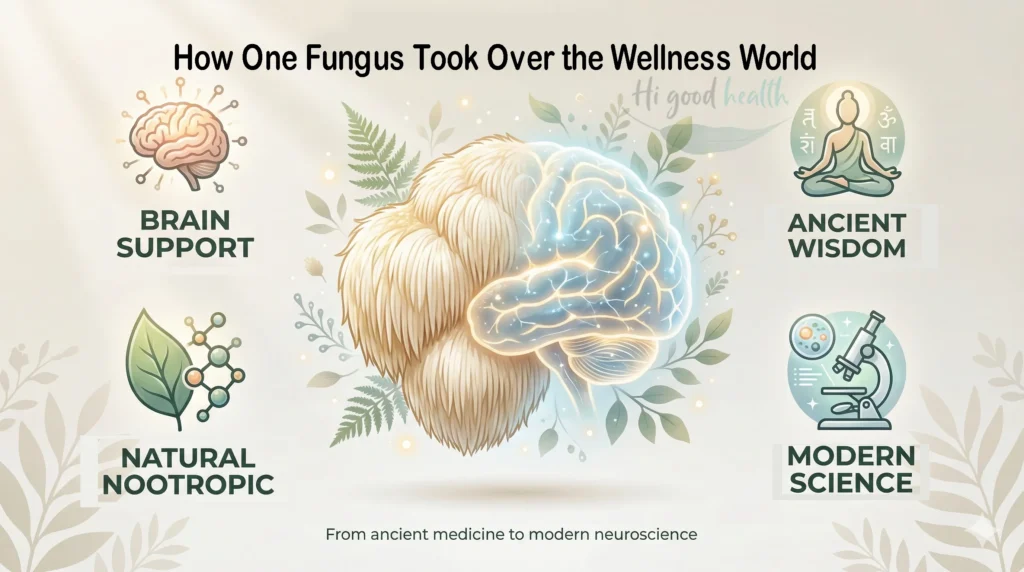
Once quietly growing on hardwood trees in East Asia, Lion’s Mane mushroom (Hericium erinaceus) has exploded in popularity. Trendy cafes in LA serve it in lattes. Health stores in Delhi and Boston stock its supplements. Biohackers swear by it. But long before it went viral, Buddhist monks used this unique fungus to enhance focus during meditation and support overall brain wellness.
Is this just another overhyped supplement? Or does Lion’s Mane truly offer benefits rooted in real neuroscience? Let’s explore the evidence, history, and modern use of this brain-loving mushroom.
Why Did Buddhist Monks Use Lion’s Mane?
In traditional Chinese and Japanese medicine, Lion’s Mane has been used for centuries to support the stomach, nerves, and mind. It’s sometimes referred to as the “Mountain Priest Mushroom,” hinting at its association with Zen monks and hermits who valued deep focus, clarity, and longevity.
“Lion’s Mane helped me achieve a kind of calm alertness I usually only reach during long retreats.”
— Tenzin S., a modern-day mindfulness teacher based in Dharamshala
(This reflects a personal experience rather than scientific evidence, but such traditional use helped inspire modern research interest).
These monks may not have had brain scans or peer-reviewed journals, but their subjective experience laid the groundwork for what science is catching up with today.
How Is Lion’s Mane Produced?
Lion’s Mane can be either wild-harvested or cultivated in controlled environments. Most commercial supplements today come from lab-grown mushrooms, cultivated on sterilized substrates such as sawdust, brown rice, or hardwood chips. Cultivated mushrooms are generally preferred for safety and quality control.
How to Check Quality:
- Look for certified organic or third-party tested products.
- Check for fruiting body extract (not just mycelium), as it contains higher levels of active compounds.
- Verify manufacturer certifications like GMP (Good Manufacturing Practice).
- Trusted brands will often publish lab test results online.
Avoid products without ingredient transparency or sourcing details. Mushrooms can absorb heavy metals and toxins from poor environments.

Are All Mushrooms Safe?
Not necessarily. Some wild mushrooms are toxic. Always buy from reputable suppliers who grow mushrooms under hygienic, controlled conditions and conduct proper screening.
How Does Lion’s Mane Work on the Brain?
Lion’s Mane contains two unique groups of compounds: hericenones and erinacines, which have been shown in animal studies to cross the blood–brain barrier. These stimulate the production of nerve growth factor (NGF) — a protein vital for the growth, repair, and survival of neurons.
Think of NGF as your brain’s personal repair crew.
As we age, NGF levels drop. This has been linked to memory issues, cognitive decline, and neurodegenerative diseases. Lion’s Mane appears to boost NGF, potentially supporting brain health and plasticity.
Japanese researcher Dr. Hirokazu Kawagishi, who first isolated erinacines from Lion’s Mane, demonstrated that these compounds stimulate nerve growth factor (NGF) production—an essential protein involved in neuron growth and maintenance. While these findings are promising, most evidence currently comes from laboratory and animal studies
Why Can’t We Just Manufacture Hericenones and Erinacines in the Lab?
While scientists have isolated these compounds, producing them synthetically is challenging and expensive due to their complex molecular structures. Additionally, bioavailability (how well the body absorbs them) from synthetic forms is not fully understood. Whole mushroom extracts may contain co-factors that support absorption and effectiveness.
That’s why many experts still recommend natural mushroom extracts, which contain a blend of active compounds in bioavailable forms.
Special Advice for People Above 60
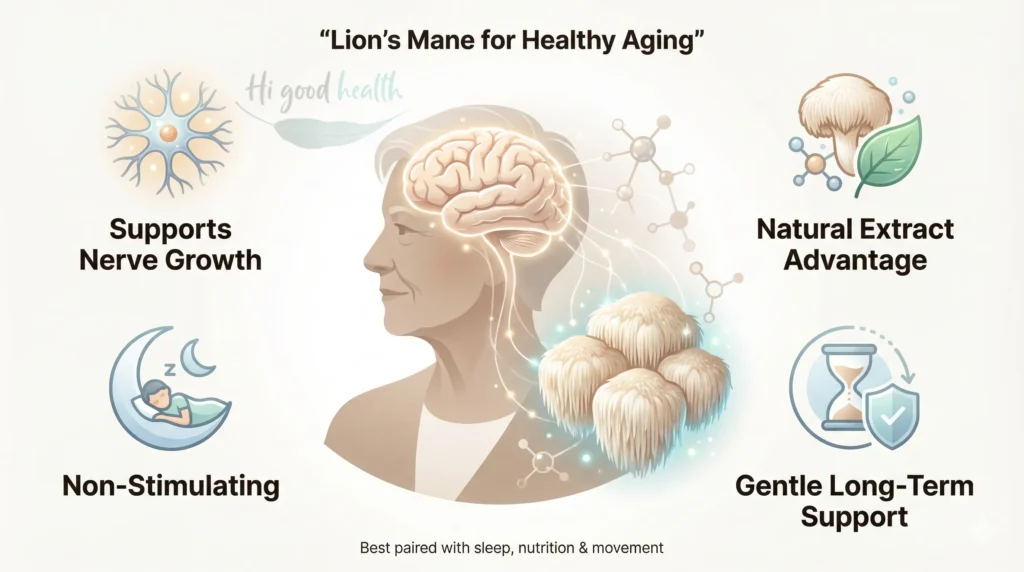
As we age, it’s natural to experience mild forgetfulness, slower recall, or mental fatigue. For those over 60, Lion’s Mane may offer gentle support without the side effects of pharmaceutical nootropics. Here are some key considerations:
Why Older Adults May Benefit:
- Lion’s Mane supports NGF, which declines with age
- It may help with age-related memory loss or brain fog
- It’s generally non-stimulating, so it won’t affect sleep or cause jitteriness
What to Keep in Mind:
- Always start with a low dose, especially if you’re on medications
- Combine Lion’s Mane with mental exercises, good sleep, and a brain-healthy diet for better results
- Monitor progress over 6–8 weeks, and consult a doctor if unsure
Complementary Approaches:
Besides Lion’s Mane, older adults may also benefit from:
- Omega-3 (DHA) from algae or fish oil
- B-complex vitamins for memory support
- Regular aerobic exercise (shown to boost brain volume)
- Mindfulness or meditation, which increases grey matter in the brain
Many geriatric specialists today are open to combining mild natural nootropics like Lion’s Mane with lifestyle and nutritional interventions for better long-term brain resilience.
To learn more about early warning signs of cognitive decline, refer to our insightful blog
Latest Scientific Discoveries on NGF
Recent research has opened new avenues for therapies targeting nerve growth factor (NGF), particularly in neurodegenerative conditions:
- A 2022 study published in Brain Research Bulletin reported that NGF analogues showed neuroprotective effects in experimental models of early Alzheimer’s disease, particularly by supporting the survival of cholinergic neurons. Researchers emphasized that these findings were primarily based on laboratory and animal studies, not clinical trials.
- A 2023 review in Molecular Psychiatry discussed NGF-mimetic molecules as a promising research direction, noting that they may overcome some limitations of direct NGF therapy, which is painful, difficult to administer, and unable to cross the blood–brain barrier efficiently.
- Scientists are also investigating advanced delivery systems, including nanocarriers and intranasal approaches, to transport NGF or NGF-like compounds into the brain more effectively. These technologies are still experimental but could represent a future breakthrough in treating cognitive and neurodegenerative disorders.
In this context, Lion’s Mane mushroom, which has been shown in preclinical studies to stimulate the body’s own production of NGF, is increasingly viewed as a potential supportive or adjunct strategy, rather than a standalone treatment. Researchers caution that while this approach is intriguing, it should complement—not replace—established medical therapies.
What Does Science Say Today? (In Simple Language)
Several small but promising human studies have explored Lion’s Mane and brain health:
- A Japanese study published in Phytotherapy Research (2009) gave 30 older adults with mild cognitive impairment 3 grams per day of Lion’s Mane powder. After 16 weeks, participants showed significant improvements in cognitive test scores compared to placebo. Notably, the benefits gradually declined after supplementation stopped, suggesting ongoing intake may be necessary.
https://pubmed.ncbi.nlm.nih.gov/18844328
- Recent pilot and observational studies (2022–2023) have explored Lion’s Mane as part of broader nutritional support for people experiencing brain fog, fatigue, or sleep disturbances, including those recovering from viral illnesses such as COVID-19. These early findings are preliminary, often involve small groups, and are still being evaluated in controlled trials.
- Researchers are also investigating Lion’s Mane for early neurodegenerative conditions, not because it regenerates nerves, but because compounds in the mushroom have been shown in laboratory and animal studies to stimulate nerve growth factor (NGF)—a protein essential for neuron health and maintenance.
While these findings are encouraging, the evidence is not yet conclusive. Most studies involve small sample sizes and short durations, and larger, long-term clinical trials are still needed before Lion’s Mane can be considered a proven therapeutic treatment.
Is Lion’s Mane a Psychedelic?
Despite some online confusion, Lion’s Mane is NOT a psychedelic. It does not contain psilocybin or any known hallucinogenic compounds.
Comparison Table:
| Substance | Psychedelic? | Known Effects | Legal Status (US/India) |
| Lion’s Mane | No | Brain support, focus, nerve growth | Legal, widely sold |
| Psilocybin Mushrooms | Yes | Hallucinations, altered perception | Controlled (illegal in most regions) |
| LSD | Yes | Intense hallucinations | Controlled substance |
| Reishi | No | Immunity, sleep aid | Legal, herbal supplement |
Real Experiences: What Users Are Saying
- “I didn’t expect much, but after 3 weeks, I noticed less brain fog and more clarity during work.” — Aarav J., software developer, Mumbai (Quora source)
- “I took Lion’s Mane for post-COVID fatigue. While it wasn’t a miracle, it helped me feel sharper.” — Sarah D., health coach, New York (Verywell Mind)
Note: The following are personal experiences and should not be considered clinical evidence.
How to Use Lion’s Mane: Forms, Dosage, and Tips
Lion’s Mane is available in many forms, depending on your preference and health goals:
Most Popular Forms:
- Powder (can be added to smoothies, coffee, soups)
- Capsules (for precise, convenient dosing)
- Tinctures (liquid extracts, fast absorption)
- Whole dried mushroom (can be cooked into meals or brewed into tea)
Suggested Dosage:
- 500 mg to 3,000 mg per day is a common range used in studies.
- Start small (e.g., 500–1000 mg/day), especially if you’re new to mushroom supplements.
- Effects may take 2–4 weeks to be noticeable, especially for cognitive support.
Medical Note:
Lion’s Mane is a dietary supplement, not a medication. It should not be used to diagnose, treat, cure, or prevent any disease. Individuals with neurological conditions, autoimmune disorders, or those taking medications should consult a healthcare professional before use.
When to Take:
- Morning or early afternoon is best, especially if it increases alertness.
- With meals can help with absorption and avoid stomach irritation.
What to Look For:
- “Dual-extracted” products (use both water and alcohol to extract compounds)
- Contains fruiting body (not just mycelium) for maximum active ingredients
Frequently Asked Questions (FAQs)
Studies suggest it supports memory, focus, and nerve health by boosting Nerve Growth Factor (NGF). It is widely used to help reduce brain fog and improve mental clarity for students and professionals.
No, Lion’s Mane is not a psychedelic and contains no psilocybin. It is a legal, non-intoxicating supplement used for brain support and focus, not for hallucinations or altered perception.
While some users feel sharper quickly, cognitive benefits often take 2 to 4 weeks to become noticeable. Experts recommend monitoring your progress over 6 to 8 weeks to see full results.
Most studies and protocols use a dosage range of 500 mg to 3,000 mg per day. If you are new to mushroom supplements, it is best to start small, around 500–1000 mg daily.
It is generally considered safe, but some users may experience mild stomach irritation. It is recommended to start with a low dose and consult a doctor if you are currently on other medications.
The morning or early afternoon is generally best, especially if the mushroom increases your alertness. Taking it with meals can help with absorption and prevent potential stomach upset.
It contains compounds that stimulate Nerve Growth Factor (NGF), a protein vital for the growth and repair of neurons. This offers potential support for neuron growth and brain plasticity by stimulating nerve growth factor (NGF), although true nerve regeneration in humans has not yet been proven.
Yes, it can support older adults with mild forgetfulness or mental fatigue without the harsh side effects of some pharmaceuticals. It is generally non-stimulating and should not interfere with sleep.
Glossary
Nerve Growth Factor (NGF): A protein that supports the survival and growth of neurons.
Hericenones/Erinacines: Bioactive compounds in Lion’s Mane that stimulate NGF production.
Mycelium: The root-like part of a fungus. Some products use only this instead of the fruiting body.
Fruiting Body: The visible mushroom part. Contains most active compounds.
Adaptogen: A natural substance that helps the body adapt to stress.
Nootropic: A substance that may improve cognitive function, memory, or focus.
Would You Like to Try It?
Before starting any supplement, consult with a medical professional — especially if you are on medications. But if you’re looking for something natural that supports memory, clarity, and long-term brain resilience, Lion’s Mane might be worth exploring.

