
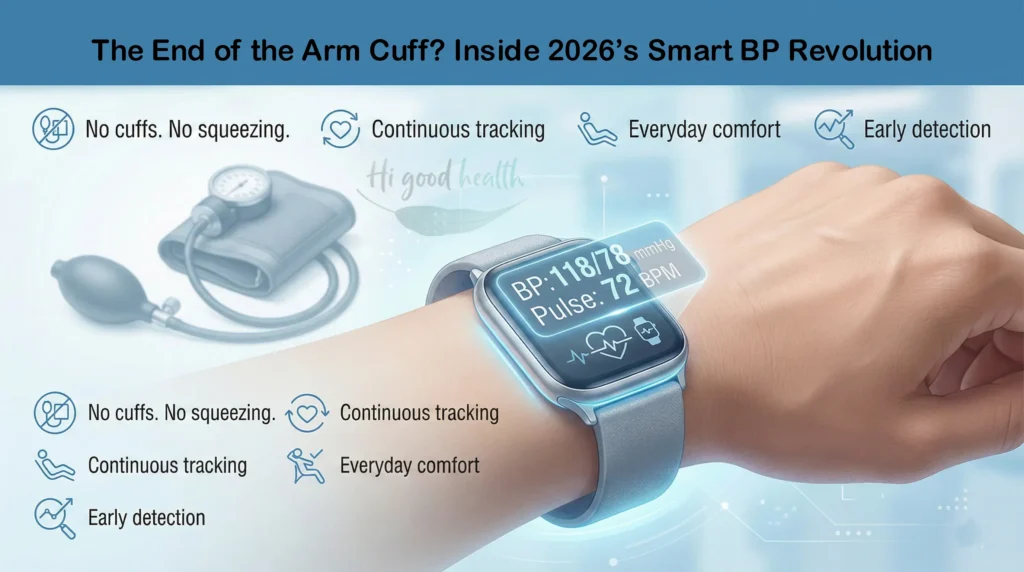
Imagine checking your blood pressure as easily as glancing at your watch—no squeezing, no discomfort, and no interruptions to your day. This futuristic vision is finally becoming a reality. Welcome to the world of cuffless blood pressure (BP) monitoring.
Ask any physician, and they’ll tell you that high blood pressure is one of the most dangerous silent threats to health, affecting nearly half of U.S. adults. Early detection and consistent monitoring save lives. However, blood pressure readings taken in clinical settings can sometimes be higher than usual due to anxiety—a phenomenon known as white coat hypertension, which studies suggest may affect 15–30% of patients.
This is why many medical organizations now recommend home or ambulatory blood pressure monitoring to confirm a diagnosis and avoid unnecessary treatment
At Higoohealth.com, our mission is to make credible health science understandable for everyone. Our goal is to empower you and your loved ones to track and take control of your health with the latest, proven science. We want to clear the confusion and help you find health tools that actually work.
How Cuffless Blood Pressure Monitors Work
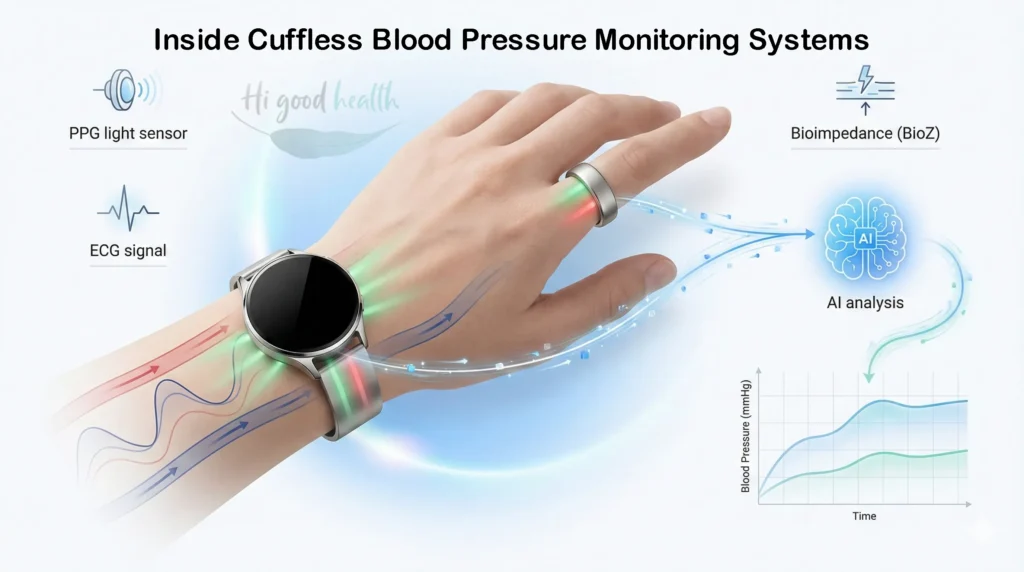
Instead of inflating a cuff, these devices use clever sensors and AI. Most use a technology called photoplethysmography (PPG), which shines a light through your skin to measure changes in blood flow. Others may also use ECG (Electrocardiogram) or Bioimpedance (BioZ) signals to measure your pulse and blood pressure.
These wearables, whether a sleek wristband or a discreet ring, can collect data continuously—even while you sleep. This provides a much more reliable, long-term view of your health than a once-a-week spot check.
Latest Studies & Science Explained
Are cuffless blood pressure monitors accurate? It’s a critical question. Recent peer-reviewed studies and reviews published through 2024–2026 suggest that some cuffless devices—such as the extensively studied Aktiia monitor—can show reasonable agreement with 24-hour ambulatory blood pressure monitoring (ABPM) for tracking daytime blood pressure trends, particularly at the population level.
However, researchers consistently note that accuracy is less reliable during nighttime measurements, physical activity, and situations involving movement or rapid physiological changes. A 2026 expert review in JAMA Cardiology cautioned that many cuffless blood pressure devices have not yet undergone standardized clinical validation, raising concerns about their use for diagnosis or treatment decisions.
As cardiologist Dr. Eugene Yang, a professor of medicine and digital health expert, has warned:
“Accuracy—with the risk of undertreatment or overtreatment—remains a key concern… we should not rely on data from unvalidated devices.”
For now, experts agree that cuffless monitors may be useful for trend tracking and supplemental monitoring, but should not replace validated cuff-based or ambulatory measurements.
The good news is that AI is helping to close this gap. Developers are increasingly using deep learning to compensate for factors like skin tone, wrist position, and movement, helping reduce measurement errors in controlled settings, with some devices approaching internationally accepted accuracy thresholds under validation protocols.
To know more about wearable health tech – separating hype from reality, read our detailed blog
A Head-to-Head Comparison: 2026
Here’s what real users and experts are saying about the top cuffless BP monitors on the market or coming soon.
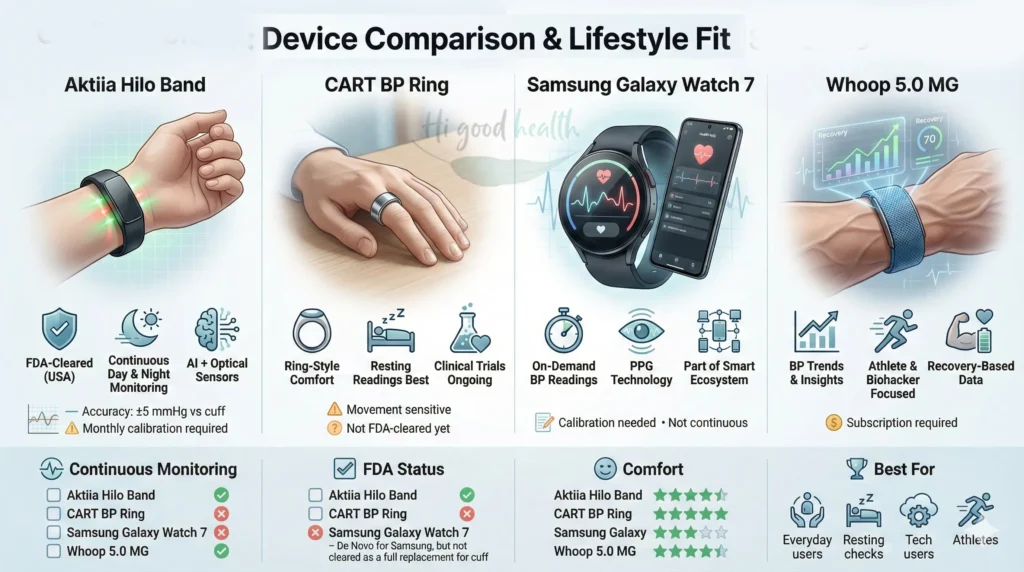
Aktiia Hilo Band: The most talked-about release of the year is the Aktiia Hilo Band, one of the few cuffless blood pressure monitoring systems to receive FDA clearance for use in the U.S., under specific indications. This sleek wristband uses optical sensors and AI to measure BP comfortably, day and night.
- Real-World Feedback: Users love the comfort, with many saying it “feels like a regular fitness tracker”. The app is also praised for its easy setup and useful charts that can be shared with a doctor.
- Accuracy: Early studies and user reports suggest reasonable agreement with validated cuff-based measurements for daytime readings, though individual accuracy varies. Aktiia’s CTO, Jose Sola, calls this not just a regulatory achievement, but “the beginning of a transformation in hypertension management”.
To know more about how blood pressure affects kidney health, read our detailed blog
- Drawbacks: Nighttime readings can sometimes drift, and monthly calibration is required. It’s best for everyday checks and long-term trend tracking.
To know more about Role of AI in healthcare and its promises and pitfalls, read our in-depth blog
CART BP: This ring-style wearable is expected to arrive in the US soon. Early reviews from clinical trials note its ease-of-use, with one user saying, “I hate arm cuffs, so slipping on a ring is a game-changer”. It’s also praised for its health app integration, which allows for direct sharing with doctors or family. However, it only works well for resting readings due to finger movement sensitivity and is not yet FDA-cleared.
Samsung Galaxy Watch 7: This smartwatch uses PPG technology for on-demand cuffless BP readings after calibration. It delivers readings in seconds and is popular with tech-savvy users who want BP tracking as part of a full smart ecosystem. The main drawback is that it’s not a continuous monitor, and the BP feature has regional and phone pairing limits.
Whoop 5.0 MG: This screenless band adds BP tracking to its recovery-focused system. It provides “BP insights” and trends rather than absolute numbers. It’s best for athletes or “biohackers” who want a holistic view of their health, but its high subscription cost may be a barrier for some.
What Experts and Social Media Say
Instagram and YouTube are filled with unboxing videos, reviews, and side-by-side comparisons of cuffless blood pressure monitors. A common theme emerges across both users and clinicians: these devices often require regular calibration and should be cross-checked with a traditional cuff or a doctor’s measurement.
Professional organizations such as the American Heart Association and digital-health experts including cardiologist Dr. Eugene Yang have emphasized that while cuffless monitors offer greater comfort and convenience, their clinical role remains limited until more standardized validation data is available. For now, experts generally view them as supplemental tools for tracking trends, rather than replacements for clinically validated blood pressure measurements.
Our Doctor’s Take & Expert Advice
It is seen that more families bring in apps showing daily BP trends. In most cases, these devices align well with daytime readings, but they should confirm major changes with a verified cuff system, especially for dose adjustments. Doctors say – use cuffless devices for long-term trends and home tracking, but keep your regular cuff for key clinical reviews.
The purpose of Higoodhealth.com is to share honest, clear health reviews and empower families everywhere—no jargon, just results you can trust. We review only the most credible real-world experiences and the latest scientific consensus.
Frequently Asked Questions (FAQ)
Recent studies indicate that devices like the Aktiia Hilo Band provide daytime readings that show reasonable agreement with gold-standard ambulatory monitoring in research settings. Deep learning methods are being used to compensate for factors like movement and wrist position. In controlled validation settings, some devices are approaching internationally accepted accuracy thresholds under validation protocols, though real-world accuracy varies by user and situation.
Yes. The Aktiia Hilo Band is one of the first cuffless blood pressure monitoring systems to receive FDA clearance for use in the U.S., under specific indications. Other contenders, like the ring-style CART BP, show promise in trials but are not yet FDA-cleared.
The Aktiia Hilo Band is the standout for 2026 as the only FDA-cleared option for continuous tracking. For smartwatch users, the Samsung Galaxy Watch 7 offers on-demand readings, though it lacks continuous monitoring capabilities.
No. Experts advise using cuffless monitors for tracking long-term trends rather than immediate diagnosis. You should always confirm major changes or high readings with a validated arm cuff before adjusting any medication or treatment.
Yes. Calibration—setting the device using a standard cuff—is crucial for maintaining accuracy. For instance, the Aktiia Hilo Band requires monthly calibration, while others like Samsung’s watch also need initial setup with a cuff.
Instead of inflating a cuff, these devices use sensors and AI to estimate blood pressure. Most use photoplethysmography (PPG) to analyze blood flow changes through the skin, often tracking data continuously day and night.
This condition occurs when anxiety in medical settings causes blood pressure to spike, leading to potential misdiagnosis. Cuffless monitors help you avoid this by allowing for comfortable, relaxed tracking in your own home.
Glossary
- Cuffless BP: Measurement of blood pressure without an arm cuff.
- FDA-cleared: Certified as safe and accurate for medical use by the US Food & Drug Administration.
- Calibration: Setting up a device with reference measurements from a standard cuff.
- PPG (Photoplethysmography): Sensing blood flow with light.
- White coat syndrome: Blood pressure rises due to anxiety in medical settings.
Selected References & Further Reading
- FDA clearance for Hilo Band
- https://jamanetwork.com/journals/jamacardiology/fullarticle/2832857
- Scientific validation study
- Cuffless Wearables Clinical Trial
- Vivalink on cuffless BP monitoring
- AMA on cuffless technology
- Boston University SCOS study
- https://pubmed.ncbi.nlm.nih.gov/41193706
- https://www.nature.com/articles/s41440-025-02410-w
- Heart.org overview
- Harvard Health piece on upcoming cuffless devices

